Attach or paste your keyword list.
``` Claude Opus 5.5 | Cluster | Primary keyword | Supporting keywords | Intent | Page type | | --- | --- | --- | --- | --- | | Choosing an AI for SEO | best ai for seo | best ai tools for seo 2026, which ai model is best for seo writing, ai seo tools for beginners, free ai tools for seo | Commercial | Pillar comparison guide | | Plan comparison | claude pro vs chatgpt plus | is chatgpt plus worth it for seo | Commercial | Head-to-head comparison | | Tool-specific how-tos | chatgpt for seo | claude for seo, gemini for seo | Informational | One guide per tool (3 pages) | | AI keyword research | ai for keyword research | ai keyword clustering, chatgpt keyword research prompt | Informational | Tutorial with prompts | | AI content | can ai write seo content | ai content brief generator | Informational | Guide + brief template | | AI content and Google | does google penalize ai content | ai content detection seo | Informational | Explainer citing Google's guidance | | AI technical audits | ai for technical seo audit | chatgpt seo audit prompt, claude code seo audit, screaming frog with chatgpt | Informational | Workflow tutorial | | Prompt library | ai prompts for seo | seo prompt library | Informational | Template / resource page | | Single-task pages | ai schema markup generator; ai for internal linking; ai link building outreach; ai for local seo; ai seo reporting | chatgpt outreach email template (with outreach) | Mixed | Short task guides or a tool page | | Data connectors | search console mcp | — | Informational | Technical setup guide | Own page: "does google penalize ai content" (a distinct question with its own answer, which would dilute the comparison page) and "ai schema markup generator" (users expect a tool, not an article). Drop: none outright; "ai content detection seo" folds into the Google page because the honest answer is short. Pages to create first 1. Best AI for SEO (pillar): the cluster with the widest commercial intent. 2. Claude Pro vs ChatGPT Plus for SEO: the decision readers are actually stuck on. 3. SEO prompt library: linkable, refreshable, supports every other page. 4. AI technical SEO audit workflow: four keywords, little genuinely hands-on competition. 5. Does Google penalise AI content?: a quotable answer with high citation potential. GPT-6.1 Sol · medium † = give this keyword its own page; the cluster label states why. Supporting keywords share one page. No keywords dropped: all express a useful task or decision. | Cluster / own-page reason | Primary keyword | Supporting keywords | Dominant intent | Page type | | --- | --- | --- | --- | --- | | Overall shortlist | best ai tools for seo 2026 | best ai for seo | commercial | Roundup | | ChatGPT†—specific workflow | chatgpt for seo | — | informational | Guide | | Claude†—specific workflow | claude for seo | — | informational | Guide | | Gemini†—specific workflow | gemini for seo | — | informational | Guide | | Subscription value†—purchase decision | is chatgpt plus worth it for seo | — | commercial | Review | | Subscriptions†—head-to-head decision | claude pro vs chatgpt plus | — | commercial | Comparison | | Free tools†—budget constraint | free ai tools for seo | — | commercial | Roundup | | Beginner tools†—usability constraint | ai seo tools for beginners | — | commercial | Roundup | | Research†—discovery workflow | ai for keyword research | — | informational | Guide | | Research prompt†—copyable asset | chatgpt keyword research prompt | — | informational | Template | | Clustering†—intent grouping | ai keyword clustering | — | informational | Guide | | Briefs†—generator selection | ai content brief generator | — | commercial | Comparison | | Content capability†—feasibility question | can ai write seo content | — | informational | Explainer | | Google policy†—penalty concern | does google penalize ai content | — | informational | Explainer | | Detection†—reliability concern | ai content detection seo | — | informational | Explainer | | Auditing†—technical workflow | ai for technical seo audit | — | informational | Guide | | Audit prompt†—copyable asset | chatgpt seo audit prompt | — | informational | Template | | Code audit†—agent workflow | claude code seo audit | — | informational | Tutorial | | Crawler integration†—specific setup | screaming frog with chatgpt | — | informational | Tutorial | | Schema†—generator selection | ai schema markup generator | — | commercial | Comparison | | Internal links†—site architecture | ai for internal linking | — | informational | Guide | | Outreach†—campaign workflow | ai link building outreach | — | informational | Guide | | Email template†—copyable asset | chatgpt outreach email template | — | informational | Template | | Local SEO†—location-specific workflow | ai for local seo | — | informational | Guide | | Reporting†—measurement workflow | ai seo reporting | — | informational | Guide | | MCP†—connector setup | search console mcp | — | informational | Tutorial | | Prompt collection | ai prompts for seo | seo prompt library | informational | Library | | Writing models†—task-specific selection | which ai model is best for seo writing | — | commercial | Comparison | **Pages to create first** 1. Overall shortlist—core tool-selection intent. 2. Writing models—focused selection decision. 3. Free tools—clear budget segment. 4. Subscription comparison—purchase decision. 5. Prompt library—practical adoption resource. Real outputs from 11 October 2026, unedited. Observed **Verdict: Claude.** Both followed the rule "one page must satisfy both keywords", but GPT-6.1 Sol applied it so strictly that it produced 28 clusters for 30 keywords, which is a list, not a plan. Claude produced 10 clusters you could turn into a site structure. GPT's answer was not wrong, and its strictness would suit a programmatic site. For a normal blog, Claude's grouping is the one I would use. Opinion Neither model invented search volumes, because the prompt told them not to. Always say that. Without real volumes from a keyword tool or Search Console, clustering is a structure exercise, not a prioritisation. ## 6. Content briefs, titles and meta descriptions ### The content brief ``` You are a senior content strategist. Write a content brief for a blog post targeting the keyword "best AI for SEO" in 2026. Audience: beginner to intermediate SEO practitioners deciding which AI subscription to pay for. Purpose: rank in Google and be cited by AI answers (AI Overviews, ChatGPT, Perplexity), and convert readers into newsletter subscribers. Include: 1. Search intent in one sentence, and what the reader must leave knowing. 2. Recommended title (under 60 characters) and meta description (under 155 characters). 3. An H2/H3 outline (max 10 H2s) with one line on what each section must prove. 4. The 3 questions an answer engine is most likely to lift from this page, each with a 40-60 word answer written to be quoted. 5. First-hand evidence the writer must add that a competitor cannot copy. 6. What to leave out. Do not invent statistics. Keep the brief under 500 words.Claude Opus 5.5
``` Intent: readers want to know which AI subscription to pay for, given their level and tasks. They must leave with one plan to try first and the reasoning to change it later. Title (54): Best AI for SEO in 2026: Which Plan Is Worth Paying For? Meta (153): ChatGPT, Claude or Gemini for SEO? A working SEO compares them on content, audits and link building, with real prompts, outputs and a free-vs-paid verdict. Outline 1. The short answer: one plan per reader type; proves the post respects their time. 2. What "best" means for SEO: task fit, data access, limits; sets the criteria. 3. Free vs paid: what the free tiers actually cap; proves when $20 matters. 4. Content (briefs, drafts, refreshes): side-by-side outputs from one prompt. 5. Research and keyword clustering: the same keyword list, both models. 6. Technical audits: a real crawl export, prioritised by each model. 7. Link building: prospecting and an outreach draft, with what a human must change. 8. Connecting your data: Search Console and GA4 connectors; when chat isn't enough. 9. What other SEOs recommend: named practitioners and survey data. 10. Your stack by level: beginner, intermediate, advanced. Answer-engine Q&A - Is the free version of ChatGPT or Claude enough for SEO? For learning and occasional tasks, yes. Free tiers cap usage, file uploads and access to the strongest reasoning models, which is where audits and long content run out. Anyone doing SEO for clients should budget one paid plan of about $20 a month. - Which AI is best for SEO writing? It depends on the writer's standard and the edit pass. Claude is widely preferred for long-form drafts and tone; ChatGPT is faster for titles, metas and variations. Neither should publish without a human fact-check, which Google's own guidance now calls critical. - Can AI do a technical SEO audit? AI can analyse and prioritise a crawl, but it cannot crawl reliably on its own. Run a crawler such as Screaming Frog, then give the export to the model and ask for a prioritised fix list based only on the data. First-hand evidence to add: the writer's real prompts and outputs on their own site, their actual subscription mix and why, screenshots of limits being hit, time saved on one real task. Leave out: tool lists with no testing, affiliate-style "top 25" padding, invented benchmark scores, and AI-detector claims. GPT-6.1 Sol · medium **1. Intent and reader outcome** Commercial investigation: readers want to choose the best AI subscription for their SEO workload and budget. They must leave knowing which plan to buy, when free access is enough, and which tasks still require SEO data and human review. **2. Search snippet** **Title:** Best AI for SEO in 2026: Which Subscription Is Worth It? **Meta description:** Compare AI subscriptions for SEO research, writing and analysis. See practical tests, costs and limitations to choose the right plan for your workflow. **3. H2/H3 outline** - **H2: Which AI should you pay for?** — Prove the recommendation with a verdict table: task, winning plan, monthly cost, limitation, evidence. - **H2: How we tested these AI subscriptions** — Prove fairness using identical inputs, task-specific criteria, repeat runs and recorded human corrections. - **H2: ChatGPT vs Claude vs Gemini vs Perplexity** — Prove differences through outputs, rather than feature lists. **H3: Research and keyword clustering** — Show source accuracy and intent-grouping errors. **H3: Content briefs and editing** — Show completeness, factual accuracy and editing effort. **H3: Technical SEO and data analysis** — Show correct findings from supplied crawl and Search Console exports. - **H2: When a dedicated SEO platform is worth paying for** — Prove when tools such as Surfer add value beyond a chatbot; verify [plan inclusions](https://docs.surferseo.com/en/articles/7545943-pricing-faq). - **H2: What each subscription actually costs** — Compare dated prices, billing terms, usage caps, add-ons and free alternatives using official sources. - **H2: Can these tools improve rankings and AI visibility?** — Separate workflow benefits from measured outcomes; follow [Google’s guidance](https://developers.google.com/search/docs/appearance/ai-features), without promising citations. - **H2: Make your choice with a one-week trial** — Give a decision checklist; offer the benchmark worksheet and future retest results through the newsletter. Keep recommendations publicly accessible. **4. Likely answer-engine questions** Treat these as editorial predictions, not observed extraction data. **What is the best AI for SEO in 2026?** The best AI for SEO in 2026 depends on your main task: research, content production or technical analysis. Compare ChatGPT, Claude, Gemini and Perplexity on the same real assignment before subscribing. Choose the plan that produces accurate, usable work with the least correction within your budget. **Is a paid AI subscription worth it for SEO?** A paid AI subscription is worth considering when free access repeatedly limits your actual SEO work. Test whether the paid plan improves output quality, handles your files or supports the volume you need. Judge value by usable work after fact-checking and editing, rather than the number of features advertised. **Can AI replace SEO tools?** AI can assist with interpreting SEO exports, drafting briefs and suggesting fixes, but those capabilities do not establish that it replaces your SEO tools. Check whether the subscription supplies the keyword, ranking, backlink and crawl data your work requires. Validate recommendations against actual site evidence before implementing them. **5. First-hand evidence** Require original-site datasets, dated prompts and outputs, screenshots, failed attempts, correction logs, editing time and a documented purchase decision. Publish the scoring rubric and anonymized artifacts so readers can inspect the verdict. **6. Leave out** Untested winners, invented savings, exhaustive tool directories, generic AI history, unsupported ranking claims, keyword stuffing and guaranteed AI-citation tactics. Real outputs from 11 October 2026, unedited. Observed **Verdict: Claude, narrowly.** Claude's brief is more concrete: a clear outline, three answers written to be quoted, and specific first-hand evidence to collect. GPT-6.1 Sol's is more rigorous about method (publish the scoring rubric, keep correction logs) and added Perplexity and dedicated SEO tools, which a reader might want. Both proposed almost the same title. I would merge them. Opinion ### Title tag and meta description rewrite ``` You are an SEO copywriter. Rewrite the title tag and meta description for this live page. URL: https://thejayant.in/blog/llms-txt-explained Current title (81 characters including the site name suffix): "LLMs.txt Explained: Useful AI Standard or the New Meta Keywords? | Jayant Solanki" Current meta description (255 characters): "Google says Search does not use llms.txt and that it neither helps nor harms visibility. So what is the file for, who reads it, and how does it differ from robots.txt and sitemap.xml? A practical answer, plus the AI crawler decisions that actually matter." Page summary: Google Search does not use llms.txt; no major AI provider has committed to reading it; it is not robots.txt; robots.txt is the file that governs AI crawler access; publishing one is harmless but buying one as a ranking product is not. Give 3 options. Each title must be 60 characters or fewer including " | Jayant Solanki" if you keep the suffix, and each meta description 150-155 characters. Show the character count for each. Then pick one and explain why in two sentences. Do not use clickbait or claims the page does not support.Claude Opus 5.5
``` | # | Title | Chars | Meta description | Chars | | --- | --- | --- | --- | --- | | 1 | Do You Need llms.txt? What Google Says \| Jayant Solanki | 55 | Google says Search ignores llms.txt. Here's what the file does, how it differs from robots.txt, and the AI crawler settings that actually affect visibility. | 155 | | 2 | llms.txt in 2026: Useful or the New Meta Keywords? | 50 | llms.txt is a harmless proposal, not a ranking factor. See Google's position, who reads it, and why robots.txt decides your visibility in AI search answers. | 155 | | 3 | llms.txt Explained: Does Your Site Need It in 2026? | 51 | Google Search doesn't use llms.txt and no major AI lab reads it. What the file is for, how it differs from robots.txt, and the crawler rules that matter. | 152 | Pick: option 1. It answers the searcher's real question ("do I need it?") and puts Google's position in the title, which is the fact that settles it. Keeping the name suffix still fits under 60 characters, so the brand survives truncation. GPT-6.1 Sol · medium 1. **Title (54 characters):** LLMs.txt Explained: Does It Help SEO? | Jayant Solanki **Meta description (154 characters):** Google Search does not use llms.txt. Learn what the file does, how it differs from robots.txt, and which AI crawler access decisions matter for your site. 2. **Title (53 characters):** LLMs.txt vs robots.txt: What Matters | Jayant Solanki **Meta description (153 characters):** Understand llms.txt, robots.txt and sitemap.xml, Google's position on llms.txt, and why crawler access matters more than publishing another file for SEO. 3. **Title (55 characters):** Do You Need LLMs.txt for Your Website? | Jayant Solanki **Meta description (155 characters):** Should you publish llms.txt? Explore its limited uses, the lack of major AI provider commitments, and why it should not be sold as a ranking product today. **Pick: Option 1.** It puts the core topic first and addresses the SEO question directly. The description gives the [page’s central answer](https://thejayant.in/blog/llms-txt-explained) while highlighting its practical guidance on AI crawler access. Real outputs from 11 October 2026, unedited. Observed **Verdict: GPT-6.1 Sol.** I counted every character. All six of GPT's counts were exactly right. Claude's titles were right, but two of its meta descriptions were 156 characters while it labelled them 155, breaking the 150–155 rule it was given. That is a small miss, and it is precisely the kind of miss that gets published unnoticed. Observed Language models read text in tokens, not letters, so counting characters is something they do by estimate. Paste every title and meta into a character counter, or ask the model to run code to count them, before anything goes live. ## 7. Content refresh audits **The job:** read a live article and say what to fix. I used my own [llms.txt article](https://thejayant.in/blog/llms-txt-explained), so I can tell you exactly what was true. ``` You are an editor doing a content refresh audit. Read inputs/llms-txt-explained.md (a Markdown copy of a live blog post published in 2026). Return: 1. The 5 highest-impact improvements, ranked, each with the exact section it applies to and a concrete instruction (not generic advice like "add more detail"). 2. Any factual claim that needs a source or re-verification, quoted exactly. 3. Any formatting or rendering errors you can see in the text. 4. One paragraph rewritten to be more quotable by AI answer engines (show before and after). Do not rewrite the whole article. Keep the answer under 450 words.Attach or paste the page (a Markdown or text copy works best).
``` Claude Opus 5.5 1. Highest-impact improvements 2. Section 5 (robots.txt example): a raw HTML paragraph (Whether you want that posture…
) sits inside the code block. Move it out as normal text; right now it reads as part of the robots.txt file someone might copy. 3. Section 3 (Google's position): quote the exact mythbusting sentence and link the guide with its "last updated" date instead of paraphrasing. The section's own advice is to check the date, so show it. 4. Section 4 (crawler table): add a "last verified" date and a link to each operator's crawler documentation. User-agent tokens change, and this table is the most copied part of the page. 5. Section 6 ("If you do publish one"): two headings are stacked with nothing between them ("### If you do publish one" / "### Keep it honest and small"). Merge them, then add a short example llms.txt for a service business, not just the docs-site template from Section 1. 6. Top summary: add one line on who should publish one (documentation and developer-tool sites), so the qualified "yes" in Section 6 is visible without scrolling. 7. Claims to source or re-verify 8. "Google's generative AI optimization guide was published on 15 May 2026 … I've seen a 10 July 2026 revision date on it." 9. "none of them documents llms.txt as a retrieval input." 10. "Google-Extended | Google | Gemini training and grounding | Reduced Gemini grounding; Search unaffected" 11. "New user-agent tokens appear several times a year" 12. Formatting errors 13. The HTMLinside the robots.txt code fence (Section 5). 14. The empty heading pair in Section 6. 15. The "## Sources" heading at the end has no visible list in this copy. 16. Quotable rewrite Before: "So: not vapourware, not a standard. A file with genuine adoption in developer tooling and no adoption in the systems most people are publishing it for." After: "llms.txt is a community proposal, not a standard. Some developer tools read it when a person points them at it, but Google Search does not use it, and OpenAI, Anthropic and Perplexity do not document it as an input for their answers." GPT-6.1 Sol · medium Based on the pasted Markdown: **1. Five highest-impact improvements, ranked** 1. **§4 “The crawler decisions that do matter”:** Correct the `ChatGPT-User` and `Perplexity-User` rows: robots.txt does not reliably prevent user-triggered fetches. OpenAI says rules may not apply; Perplexity says its fetcher generally ignores them. Cite [OpenAI](https://developers.openai.com/api/docs/bots) and [Perplexity](https://docs.perplexity.ai/docs/resources/perplexity-crawlers). 2. **§2 “robots.txt vs sitemap.xml vs llms.txt” and §7 Googlebot FAQ:** Replace “Access control” with “Crawl instructions.” Remove guaranteed disappearance claims: blocked URLs can remain indexed. Cite [Google’s robots.txt guidance](https://developers.google.com/search/docs/crawling-indexing/robots/intro). 3. **§3 “Google’s published position” and “Sources”:** Populate the empty source list; link each provider’s documentation inline. Replace remembered publication/revision dates with verified dates and a checked-on date. 4. **§3 “What about the other providers?”:** Replace “no adoption” with “no documented use as a search-ranking input.” Name and link two developer-tool integrations; distinguish publishing, consuming and ranking. 5. **§5 “Training vs search crawling”:** Remove the claim that opting out erases latent model knowledge. Explain that crawler exclusions concern future collection and do not establish removal from existing models. **2. Claims needing sources or re-verification — exact excerpts** - §1: “meta keywords were actively abused for spam and became a negative signal.” Google says they have [no ranking effect](https://developers.google.com/search/docs/crawling-indexing/special-tags). - §2: “Read by OpenAI?” → “Yes” for `sitemap.xml`; “A mistake in `llms.txt` costs nothing, because nothing depends on it.” - §3: “Google's generative AI optimization guide was published on 15 May 2026 and has been revised since”; “I've seen a 10 July 2026 revision date on it.” - §3: “OpenAI, Anthropic and Perplexity all document their crawlers and all respect `robots.txt`”; “no adoption in the systems most people are publishing it for.” - §4: “Absent from ChatGPT search”; “Absent from Claude search”; “Absent from Perplexity answers”; “Users can't pull your page in-session”; “Blocking `Googlebot` removes you from Search entirely”. - §5: “it also removes you from the latent knowledge a model carries between retrievals.” - §6: “It costs an hour.”; “All three are false”. - §7: “New user-agent tokens appear several times a year”. **3. Formatting/rendering errors** - §§1 and 5 contain indented `
…
` prose inside code fences; move it outside and remove HTML tags. - §6’s consecutive `###` headings create an empty subsection; demote “Keep it honest and small” to `####`. - “Sources” is empty. **4. Quotable rewrite — §7** **Before:** “No, and treating it as one is dangerous. `robots.txt` is a standardised access-control file that crawlers act on. `llms.txt` grants nothing and blocks nothing. They solve unrelated problems.” **After:** “`llms.txt` does not replace `robots.txt`. `llms.txt` proposes a curated Markdown guide to website content. `robots.txt` specifies crawl instructions for compliant crawlers; it does not enforce access restrictions.” Real outputs from 11 October 2026, unedited. Observed **Verdict: GPT-6.1 Sol, clearly.** The Markdown copy of that post really does have a stray HTML paragraph inside two code blocks. GPT found both; Claude found one. GPT also raised accuracy points I had not considered: user-triggered fetchers like ChatGPT-User do not reliably obey robots.txt, and a page blocked in robots.txt can still be indexed. Both points are documented by OpenAI, Perplexity and Google, and I checked that every link GPT cited works. Claude's suggestions were sensible but more cosmetic. Observed This is the single most useful thing in the whole test for me: I now have a list of real fixes for my own article. Run this prompt on your oldest page that still gets traffic. ## 8. Technical SEO audits **The job:** turn a crawl into a prioritised fix list. Neither model crawled anything. I crawled all 54 URLs in this site's sitemap and gave them the result, which is how you should use AI for audits: let a crawler such as Screaming Frog collect the data, and let the model do the thinking. ``` You are a technical SEO consultant. inputs/crawl.csv is a crawl of every URL in a website's XML sitemap (54 URLs) with these columns: url, status, final_url, ms (response time), title, title_len, meta_desc_len, h1_count, canonical, canonical_matches, robots_meta, word_count, img_missing_alt, img_empty_alt, internal_links, jsonld_types. Analyse the crawl and return: 1. A one-paragraph health summary with the numbers that support it. 2. A prioritised issue table: issue, how many URLs, example URL, impact (high/medium/low), and the fix. 3. Anything that looks fine and should NOT be changed. 4. What this crawl cannot tell you, and the next 3 checks you would run with other tools or data. Base every number on the file. Do not guess about things the columns do not show. Keep the answer under 450 words.Attach your crawl export (Screaming Frog: Internal > HTML, exported as CSV). Rename the columns in the prompt to match yours.
``` Claude Opus 5.5 Health summary: all 54 sitemap URLs return 200 with no redirects, every page has exactly one H1, every canonical is self-referencing, every page is indexable, and no image lacks an alt attribute. The problems are in snippets, not crawlability: 48 of 54 titles exceed 60 characters (median 79.5, longest 121) and 46 of 54 meta descriptions exceed 160 characters (median 289, longest 489). Median response time is 680 ms; 10 URLs take over 1 second and one takes 3.6 seconds. | Issue | URLs | Example | Impact | Fix | | --- | --- | --- | --- | --- | | Titles over 60 characters | 48 | /blog/weekly/2026-09-27 (121) | Medium | Lead with the keyword; drop the suffix where it pushes past ~60 | | Meta descriptions over 160 characters | 46 | /blog/weekly/2026-09-13 (489) | Medium | Rewrite to 140–155; Google will rewrite the rest anyway | | Slow response | 1 (+9 over 1 s) | /blog/gpt-6-astra (3,648 ms) | Medium | Re-test; check page weight and third-party scripts; rule out a cold cache | | Thin pages | 3 under 1,100 words | /marketer-companion-privacy (307) | Low | Fine for legal pages; no action | | Few internal links | 5 under 15 | /automations (9) | Low | Link it from relevant posts and the homepage | Leave alone: canonicals, robots meta (index, follow, max-image-preview:large), H1s, alt attributes, structured data coverage (every blog post has Article or NewsArticle markup; the weekly hub is a CollectionPage, which is correct). What this crawl can't tell you: whether pages are actually indexed, how Google renders them, real-user speed, or which long titles Google is already rewriting. Next checks: 1. Search Console page indexing and the performance report for these URLs, to see impressions and CTR before rewriting titles. 2. PageSpeed Insights / CrUX field data for /blog/gpt-6-astra. 3. A rendered crawl (JavaScript on) in Screaming Frog to confirm generated content and links match the raw HTML. GPT-6.1 Sol · medium The 54 sitemap URLs show consistent technical basics: all return HTTP 200, all final URLs match their submitted URLs, all have matching self-canonicals, and all report `index, follow` with exactly one H1. No missing or empty image-alt attributes are reported. The main review candidates are metadata length and response time: 48 titles exceed 60 characters, 46 descriptions exceed 160 characters, and 10 responses exceed 1,000 ms. Median response time is 680.5 ms; the slowest is 3,648 ms. These observations do not establish indexing, ranking, or user-experience problems. | Priority / issue | URLs | Example URL | Impact | Fix | | --- | --- | --- | --- | --- | | 1. Elevated recorded response time (>1,000 ms) | 10 | [GPT-6 Astra](https://thejayant.in/blog/gpt-6-astra) — 3,648 ms | Medium | Repeat measurements, identify what `ms` measures, then investigate server, cache and network contributions where delays persist. | | 2. Long titles (>60 characters) | 48 | [Weekly September 27](https://thejayant.in/blog/weekly/2026-09-27) — 121 characters | Medium | Review rendered search appearance; front-load the topic and shorten unnecessary wording or repeated branding where useful. Character count alone does not prove truncation. | | 3. Long descriptions (>160 characters) | 46 | [Weekly September 13](https://thejayant.in/blog/weekly/2026-09-13) — 489 characters | Low | Rewrite excessive descriptions into concise, page-specific summaries, prioritising pages with search impressions. Length alone is not a technical error. | The 60/160-character thresholds above are screening heuristics, not mandatory limits. Keep the working status codes, matching canonicals, single H1s and permissive robots metadata. Every URL has a title, a nonzero description length and reported JSON-LD types. Do not remove structured data merely because many types appear; type lists cannot establish validity or relevance. Zero reported alt issues require no bulk changes. The 307-word extension privacy page should not be expanded solely to meet an arbitrary word-count target. Reported internal-link counts do not reveal incoming links or prove that pages are well connected. This crawl cannot confirm actual indexing, Google-selected canonicals, robots.txt or HTTP-header restrictions, rendered content, structured-data validity, content accuracy, search performance, or Core Web Vitals. Next, run: 1. **Search Console:** inspect indexing and selected canonicals; review query-level impressions, clicks and CTR. 2. **Rendered full-site crawl and schema validation:** check robots.txt, headers, incoming links, orphan candidates, rendered content and markup properties against visible content. 3. **PageSpeed Insights/CrUX plus repeated timing tests:** assess field Core Web Vitals and distinguish persistent server delays from isolated crawl measurements. Real outputs from 11 October 2026, unedited. Observed **Verdict: a tie.** I checked every number both models quoted against the file, and every one was right: 48 titles over 60 characters, 46 meta descriptions over 160, a median response of 680.5 ms, one page at 3.6 seconds. Claude was more decisive and told me what to leave alone. GPT-6.1 Sol was more careful, pointing out that 60 and 160 characters are guidelines, not rules, and that one slow measurement is not proof of a slow page. Both are right. Observed And yes, they found real issues on this site: most of my titles are too long because of the name suffix. That is going on my own to-do list. ## 9. Schema markup ``` You are a structured data specialist. Using only the facts in inputs/business.txt, write JSON-LD for the page https://www.example.com/dentist-indore. Requirements: - Use the most specific schema.org type that fits. - Include address, geo only if you are given coordinates (you are not), opening hours, phone, services as an OfferCatalog or makesOffer, the lead dentist as a Person, and priceRange. - Decide whether to include aggregateRating for the Google review count shown in a widget, and explain the decision in one sentence based on Google's review snippet guidelines. - Output valid JSON-LD in one code block, then at most 4 bullet notes on what to verify before publishing.Paste the business facts. Use only facts that appear on the page.
``` Claude Opus 5.5 ``` { "@context": "https://schema.org", "@type": "Dentist", "@id": "https://www.example.com/dentist-indore#clinic", "name": "BrightSmile Dental Clinic", "url": "https://www.example.com/dentist-indore", "telephone": "+91 731 400 0000", "priceRange": "₹₹", "address": { "@type": "PostalAddress", "streetAddress": "21 MG Road", "addressLocality": "Indore", "addressRegion": "Madhya Pradesh", "postalCode": "452001", "addressCountry": "IN" }, "openingHoursSpecification": [{ "@type": "OpeningHoursSpecification", "dayOfWeek": ["Monday","Tuesday","Wednesday","Thursday","Friday","Saturday"], "opens": "09:30", "closes": "19:30" }], "employee": { "@type": "Person", "name": "Dr. Ananya Mehta", "jobTitle": "Lead Dentist", "hasCredential": [ {"@type": "EducationalOccupationalCredential", "credentialCategory": "degree", "name": "BDS"}, {"@type": "EducationalOccupationalCredential", "credentialCategory": "degree", "name": "MDS (Endodontics)"} ] }, "hasOfferCatalog": { "@type": "OfferCatalog", "name": "Dental services", "itemListElement": [ {"@type": "Offer", "itemOffered": {"@type": "Service", "name": "Teeth cleaning"}}, {"@type": "Offer", "itemOffered": {"@type": "Service", "name": "Root canal treatment"}}, {"@type": "Offer", "itemOffered": {"@type": "Service", "name": "Dental implants"}}, {"@type": "Offer", "itemOffered": {"@type": "Service", "name": "Braces and aligners"}}, {"@type": "Offer", "itemOffered": {"@type": "Service", "name": "Teeth whitening"}} ] } }aggregateRating: left out. Google's review snippet guidelines do not allow self-serving reviews for LocalBusiness, and ratings copied from Google reviews into a widget are not reviews the site collected itself.
``` Verify before publishing - The page visibly shows every fact in the markup (hours, phone, services, dentist). - Opening hours are current; Sunday is closed by omission, which is correct. - Add geo only once you have real coordinates from the map pin. - Validate in the Rich Results Test and the Schema Markup Validator. GPT-6.1 Sol · medium ``` { "@context": "https://schema.org", "@type": "Dentist", "@id": "https://www.example.com/dentist-indore#clinic", "name": "BrightSmile Dental Clinic", "url": "https://www.example.com/dentist-indore", "telephone": "+91 731 400 0000", "priceRange": "₹₹", "address": { "@type": "PostalAddress", "streetAddress": "21 MG Road", "addressLocality": "Indore", "addressRegion": "Madhya Pradesh", "postalCode": "452001", "addressCountry": "IN" }, "openingHoursSpecification": [ { "@type": "OpeningHoursSpecification", "dayOfWeek": [ "https://schema.org/Monday", "https://schema.org/Tuesday", "https://schema.org/Wednesday", "https://schema.org/Thursday", "https://schema.org/Friday", "https://schema.org/Saturday" ], "opens": "09:30", "closes": "19:30" }, { "@type": "OpeningHoursSpecification", "dayOfWeek": "https://schema.org/Sunday", "opens": "00:00", "closes": "00:00" } ], "member": { "@type": "Person", "@id": "https://www.example.com/dentist-indore#lead-dentist", "name": "Dr. Ananya Mehta", "jobTitle": "Lead dentist", "hasCredential": [ { "@type": "EducationalOccupationalCredential", "name": "BDS" }, { "@type": "EducationalOccupationalCredential", "name": "MDS (Endodontics)" } ] }, "hasOfferCatalog": { "@type": "OfferCatalog", "name": "Dental services", "itemListElement": [ { "@type": "Offer", "itemOffered": { "@type": "Service", "name": "Teeth cleaning" } }, { "@type": "Offer", "itemOffered": { "@type": "Service", "name": "Root canal treatment" } }, { "@type": "Offer", "itemOffered": { "@type": "Service", "name": "Dental implants" } }, { "@type": "Offer", "itemOffered": { "@type": "Service", "name": "Braces and aligners" } }, { "@type": "Offer", "itemOffered": { "@type": "Service", "name": "Teeth whitening" } } ] } }Real outputs from 11 October 2026, unedited. Observed
``` **Verdict: GPT-6.1 Sol, by a nose.** The two outputs are almost identical, and both correctly left out `aggregateRating` because Google treats a business's reviews shown on its own site as self-serving. GPT marked Sunday as explicitly closed and linked Google's guideline; Claude left Sunday out, which is also valid. Whichever you use, run it through the Rich Results Test. Observed For whether schema helps in AI answers at all, see [schema markup for AI search](https://thejayant.in/blog/schema-markup-ai-search). ## 10. Internal linking ``` You are an SEO editor. I am publishing a new post titled "Which AI Should SEOs Use in 2026? ChatGPT vs Claude vs Gemini for Content, Audits and Link Building". inputs/blog-posts.csv lists every existing post on the site (title, url). 1. Suggest the 6 best existing posts to link FROM the new post, each with the exact anchor text (descriptive, 2-6 words, no "click here"), and the sentence context where it belongs. 2. Suggest the 4 existing posts that should link TO the new post, with the anchor text and where in that post the link would naturally sit. Only use URLs from the file. Keep the answer under 350 words.Attach a list of your posts (title, URL), e.g. exported from your sitemap.
``` Claude Opus 5.5 Link FROM the new post 1. /blog/claude-opus-5-5-vs-gpt-6-sol, anchor "Claude Opus 5.5 vs GPT-6 Sol": "If you want the model-level detail behind these plans, see …" 2. /blog/claude-opus-5-5-vs-gpt-6-sol-cost-calculator, "API cost calculator": in the paid-plan section, for readers deciding between a subscription and the API. 3. /blog/how-to-get-cited-by-ai-search, "getting cited by AI search": in the content section, after explaining that the brief targets answer engines. 4. /blog/schema-markup-ai-search, "schema markup for AI search": after the schema prompt example. 5. /blog/computer-use-agent-safety, "running agents safely": in the advanced section on Claude Code, Codex and connectors. 6. /blog/notion-for-seo, "my Notion SEO workflow": where prompts are saved into a reusable library. Link TO the new post 1. /blog/claude-opus-5-5-vs-gpt-6-sol, anchor "which AI SEOs should use": in its verdict section. 2. /blog/how-to-get-cited-by-ai-search, "AI tools for SEO work": near the tools/workflow part. 3. /blog/notion-for-seo, "choosing an AI for SEO": where the post mentions AI inside Notion. 4. /blog/gpt-6-astra-seo-geo, "ChatGPT vs Claude for SEO tasks": in its practical takeaways. GPT-6.1 Sol · medium Placements are inferred from titles. The new post’s URL is missing, so inbound suggestions specify anchors without inventing a destination. **6 links FROM the new post** 1. **Model comparison introduction:** “For a broader comparison, see [GPT, Claude and Gemini compared](https://thejayant.in/blog/gpt-6-astra-vs-claude-fable-vs-gemini) before evaluating individual SEO tasks.” 2. **ChatGPT versus Claude section:** “For a closer look at this pairing, read [Claude versus GPT model comparison](https://thejayant.in/blog/claude-opus-5-5-vs-gpt-6-sol).” 3. **SEO implications section:** “Separate productivity gains from the [SEO implications of newer models](https://thejayant.in/blog/claude-opus-5-5-gpt-6-sol-seo) when choosing your workflow.” 4. **Pricing section:** “Estimate your expected usage with the [Claude versus GPT cost calculator](https://thejayant.in/blog/claude-opus-5-5-vs-gpt-6-sol-cost-calculator) before committing to API automation.” 5. **Technical audits section:** “When reviewing structured data, consider [schema markup for AI search](https://thejayant.in/blog/schema-markup-ai-search) alongside your conventional audit checks.” 6. **Link building section:** “When prioritising outreach targets, understanding [how AI chooses sources](https://thejayant.in/blog/how-ai-chooses-sources) provides useful context for evaluating citation opportunities.” **4 existing posts that should link TO the new post** 1. [GPT-6 Astra vs Claude Fable vs Gemini](https://thejayant.in/blog/gpt-6-astra-vs-claude-fable-vs-gemini) Anchor: **best AI tools for SEO** Placement: In the use-case recommendations, after discussing marketing or content work. 2. [Claude Opus 5.5 vs GPT-6 Sol](https://thejayant.in/blog/claude-opus-5-5-vs-gpt-6-sol) Anchor: **ChatGPT versus Claude for SEO** Placement: After the writing comparison, introducing task-specific guidance. 3. [Claude Opus 5.5 and GPT-6 Sol for SEO](https://thejayant.in/blog/claude-opus-5-5-gpt-6-sol-seo) Anchor: **choosing AI for SEO workflows** Placement: In practical recommendations, before readers select tools. 4. [Notion for SEO](https://thejayant.in/blog/notion-for-seo) Anchor: **AI for content and audits** Placement: Where the workflow discusses drafting content or managing audit tasks. Real outputs from 11 October 2026, unedited. Observed **Verdict: a tie.** Both used only real URLs from the list, which is the main risk with this task. Claude's anchors were shorter and more natural; GPT-6.1 Sol picked one better source page (the three-model comparison) and pointed out it did not know the new post's URL. I used suggestions from both in this article. Opinion ## 11. Link building outreach **The job:** find link prospects for a study and draft an outreach email. I believe AI should draft and a person should edit and send. The test shows why. ``` You are a digital PR specialist. I published a study called the "AI Search Visibility Benchmark 2026: India & UAE" at https://thejayant.in/blog/ai-search-visibility-benchmark . It tests 120 commercial prompts across ChatGPT, Gemini, Perplexity and Google AI Overviews and publishes the prompt set openly. 1. List 5 types of sites that would plausibly link to this study and why each would care (no made-up site names). 2. Write one outreach email (under 120 words) to a journalist who covers AI and marketing in India. It must: reference a specific reason this is useful to their readers, offer something concrete (data cut, quote or chart), contain no flattery, no fake familiarity, and no link request in the subject line. 3. Write a 7-word subject line. 4. List 3 things a human must check or personalise before sending.Claude Opus 5.5
``` Sites that would plausibly link 1. Indian and UAE marketing trade publications: local data on AI search is scarce. 2. SEO and GEO tool blogs: they need third-party data to cite in their own guides. 3. University digital-marketing courses and their resource pages: an open prompt set is reusable teaching material. 4. Agencies in India and the UAE writing client-education posts: the study supports their pitch. 5. Newsletters that round up AI-search research: new, open methodology fits their format. Subject (7 words): India-specific data on how AI answers buy Email Hi [Name], Most AI-search studies use US prompts. I've published one built for India and the UAE: 120 commercial prompts run across ChatGPT, Gemini, Perplexity and Google AI Overviews, with the full prompt set open. If it's useful for [their recent story/beat], I can send a cut for one category your readers care about, such as [category], plus a chart you're free to use with credit. The methodology is here: https://thejayant.in/blog/ai-search-visibility-benchmark Jayant Solanki A human must - Replace [their recent story/beat] with a real piece they wrote, and check the beat fits. - Confirm the study's published status: the page is currently titled as a methodology draft, so don't promise findings that aren't live. - Check the chart and data cut actually exist before offering them. GPT-6.1 Sol · medium The linked page currently labels this a **methodology draft**, with results pending and the full prompt CSV due alongside them. The outreach below reflects that status. [Study page](https://thejayant.in/blog/ai-search-visibility-benchmark) **1. Five plausible linking site types** | Site type | Why they would care | | --- | --- | | Indian technology and business publications | A local angle on how AI search could affect business discovery and customer acquisition. | | SEO and search marketing publications | A reproducible framework for comparing brand mentions and citations across four platforms. | | Advertising and marketing trade publications | Questions relevant to clients’ visibility, content strategy and marketing budgets. | | UAE business and digital economy publications | A UAE-specific research design and potential comparison with India. | | University research labs and research-methods blogs | Transparent prompts and controls they could critique, replicate or extend. | **2. Outreach email — under 120 words** Hi [First name], I’ve published the methodology for “AI Search Visibility Benchmark 2026: India & UAE,” covering 120 commercial prompts across ChatGPT, Gemini, Perplexity and Google AI Overviews. For Indian marketing readers, it addresses a practical question: when buyers ask AI for recommendations, does a business get mentioned, linked, or overlooked? The design separates brand mentions from citations and compares discovery, comparison and decision prompts. Results are still pending. I can provide a concise quote explaining why mentions and linked citations need separate measurement, plus the methodology for scrutiny. Methodology: https://thejayant.in/blog/ai-search-visibility-benchmark Would that fit a story you’re developing? Jayant Solanki **3. Seven-word subject line** How AI search surfaces businesses in India **4. Three checks before sending** 1. Verify the journalist’s current beat and personalise the angle around one relevant recent article. 2. Confirm the publication status, working URL and availability of the promised quote; update the email if results and CSV are now live. 3. Check that any supplied findings include collection dates, market coverage and sampling limitations. Real outputs from 11 October 2026, unedited. Observed **Verdict: GPT-6.1 Sol.** GPT checked the live page and noticed my benchmark is still a methodology draft with results pending, so its email offers a quote and the method, not data. Claude's email offered a "cut" of the data and a chart that do not exist yet, and only flagged the draft status in its checklist. If someone sent Claude's version without reading it, they would be promising a journalist something they cannot deliver. Observed This is the clearest case for human review in the whole test. Use AI to research prospects and draft, then edit every email yourself, and never let an agent send outreach on its own. ## 12. Search Console analysis and data connectors **The job:** find quick wins in Search Console data. This one uses a **demo export** for a fictional plumbing business in Indore, because the Search Console properties I have access to belong to clients and their data stays private. ``` You are an SEO analyst. inputs/gsc-demo.csv is a 3-month Google Search Console export (query, page, clicks, impressions, ctr, position) for a local plumbing business in Indore. It is a demo dataset. Find the quick wins: 1. Queries in positions 4-20 with high impressions and low CTR, ranked by opportunity. Explain your ranking rule in one sentence. 2. For the top 5, the specific change to make on the page (title, section, FAQ, internal link, new page). 3. Any query that is ranking on the wrong page (cannibalisation or intent mismatch). 4. One thing you would NOT change. Use only the data in the file and show the numbers you used. Keep the answer under 400 words.Attach a Search Console export with query and page dimensions, or connect Search Console through an MCP connector.
``` Claude Opus 5.5 Ranking rule: impressions × the CTR gap to a ~3% target, for positions 4–20, i.e. how many extra clicks a realistic CTR would add. | Query | Pos | Impr | CTR | Extra clicks at 3% | | --- | --- | --- | --- | --- | | how to fix leaking tap | 8.3 | 11,200 | 0.6% | ~269 | | geyser not heating | 9.7 | 8,940 | 0.2% | ~250 | | geyser repair near me | 12.6 | 7,410 | 0.4% | ~193 | | low water pressure fix | 7.2 | 6,710 | 0.6% | ~161 | | blocked drain cleaning | 11.4 | 6,230 | 0.9% | ~131 | Changes 1. /blog/fix-leaking-tap: rewrite the title to promise the fix and the time ("Fix a Leaking Tap in 10 Minutes"); add a "call a plumber if…" box linking to the service page. 2. /blog/geyser-not-heating: answer the top 3 causes in the first 60 words; link to /water-heater-repair with "geyser repair in Indore". 3. "geyser repair near me" ranks on /water-heater-repair, but the page says "water heater". Add "geyser" to the title, H1 and copy; Indian searchers use that word. 4. /blog/low-water-pressure: add a short causes checklist and a link to the booking page. 5. /drain-cleaning: "blocked drain cleaning" (6,230 impressions) and "drain cleaning cost" (3,870, position 14.2) want a price; add a visible price range and an FAQ. Wrong page / mismatch - "plumber charges per hour" (position 13.5) and "plumber price list" (10.9) land on /pricing: right page, but the low CTR suggests the title doesn't show prices; put a "from ₹" figure in it. - "bathroom renovation cost indore" (position 18.2) lands on /bathroom-fitting: cost intent; add a cost section or a dedicated page. Don't change: /emergency-plumber for "emergency plumber near me" (position 3.1, 412 clicks). Protect it; test titles only on the pages above. GPT-6.1 Sol · medium **Ranking rule:** Among queries at positions 4–20, I define high impressions as ≥3,000 and low CTR as <1%, then rank by impressions × (2.7% − observed CTR), using the highest qualifying-query CTR in this dataset as an illustrative target, not a forecast. All figures cover the supplied three months. Scores use the export’s rounded CTRs. | Rank | Query | Impressions | CTR | Position | Opportunity* | | --- | --- | --- | --- | --- | --- | | 1 | how to fix leaking tap | 11,200 | 0.6% | 8.3 | 235.2 | | 2 | geyser not heating | 8,940 | 0.2% | 9.7 | 223.5 | | 3 | geyser repair near me | 7,410 | 0.4% | 12.6 | 170.4 | | 4 | low water pressure fix | 6,710 | 0.6% | 7.2 | 140.9 | | 5 | blocked drain cleaning | 6,230 | 0.9% | 11.4 | 112.1 | | 6 | plumber charges per hour | 4,480 | 0.2% | 13.5 | 112.0 | | 7 | drain cleaning cost | 3,870 | 0.3% | 14.2 | 92.9 | | 8 | plumber price list | 3,120 | 0.2% | 10.9 | 78.0 | *Illustrative additional clicks at the target CTR. **Specific changes for the top five** 1. `/blog/fix-leaking-tap`: Add a dedicated **“Leaking tap washer replacement”** section with numbered steps. That related query also has 2,140 impressions, 0.2% CTR and position 16.9. 2. `/blog/geyser-not-heating`: Test the title **“Geyser Not Heating? Troubleshooting and When to Call a Plumber”**. 3. `/water-heater-repair`: Test **“Geyser Repair in Indore | Water Heater Repair”**, explicitly including the searcher’s terminology. 4. `/blog/low-water-pressure`: Add an opening **“Low water pressure: checks and fixes”** section organised by symptom. 5. `/drain-cleaning`: Add a **“Blocked drain cleaning”** section explaining symptoms, service scope and how to request help. These are proposed tests; the export does not reveal existing page content. **Possible wrong-page match:** “bathroom renovation cost indore” lands on `/bathroom-fitting` (3 clicks, 2,610 impressions, 0.1% CTR, position 18.2). The query suggests renovation pricing, while the URL suggests fitting services. Consider a dedicated renovation-cost page if that service is offered. Cannibalisation is unproven: no query appears against multiple URLs. **Would not change:** The `/emergency-plumber` targeting for “emergency plumber near me”: 412 clicks, 9,810 impressions, 4.2% CTR, position 3.1—the dataset’s strongest performer. Real outputs from 11 October 2026, unedited. Observed **Verdict: a tie.** Both found the same top five queries and both protected the page that already ranks third. Claude gave more specific fixes, such as adding "geyser" to a page that only says "water heater", which matches how Indians search. GPT-6.1 Sol was more careful with the maths, explained its target CTR and noted that cannibalisation cannot be proven from this data. I checked the arithmetic in both tables and it was correct. Observed The bigger lesson is about the input, not the model. A pasted export is a snapshot. Once Search Console and GA4 are connected through an MCP connector, you can ask "what dropped this week and why?" and the model fetches the data itself. That is how I work now, with the [Marketing Data MCP](https://thejayant.in/marketing-data-mcp), and it is also how Lily Ray's team works, below. ## 13. The scorecard 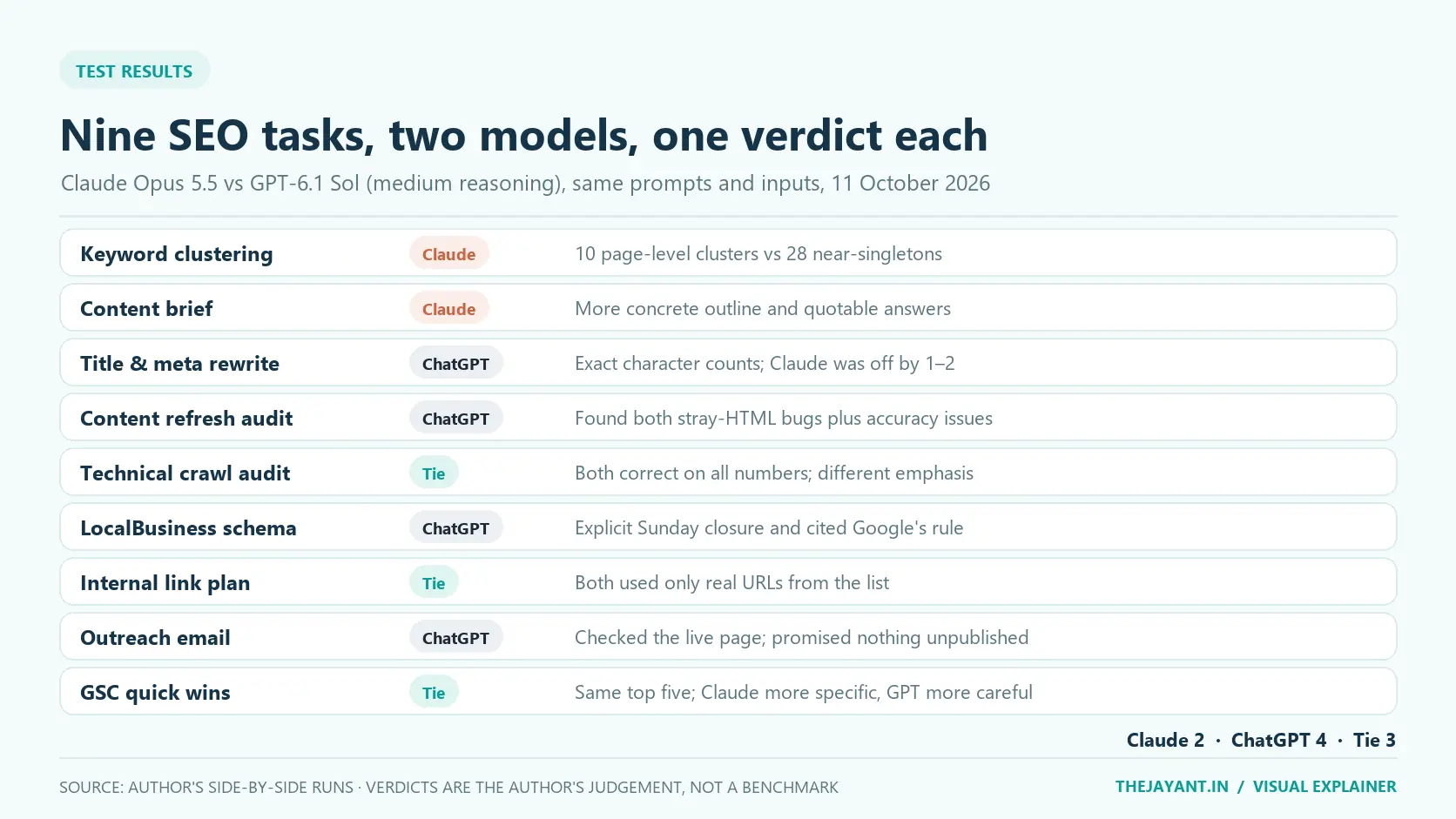 _Claude 2, ChatGPT 4, tie 3. My judgement on one run each, not a benchmark._ | Task | Better here | Why | Free plan OK? | | --- | --- | --- | --- | | Keyword clustering | Claude | Grouped 30 keywords into 10 buildable pages | Yes | | Content brief | Claude | Concrete outline and quotable answers | Yes, for short briefs | | Titles and metas | GPT-6.1 Sol | Exact character counts | Yes | | Content refresh audit | GPT-6.1 Sol | Found both real bugs plus accuracy issues | Limited by upload size | | Technical audit | Tie | Both correct on every number | No: crawl files are large | | Schema | GPT-6.1 Sol (narrowly) | Explicit closed day, cited Google's rule | Yes | | Internal links | Tie | Both used only real URLs | Yes | | Outreach email | GPT-6.1 Sol | Checked the live page, promised nothing unpublished | Yes | | Search Console quick wins | Tie | Same top five; different strengths | Yes for small exports; connectors need a paid plan | Read the pattern, not the total. Claude was better when the job was to plan or write something; GPT-6.1 Sol was better when the job was to check something against the facts. That matches how I already split my work, and it is why I keep both. Opinion ## 14. What other SEO leaders use and recommend My view is one practitioner's. Here is what others have said on the record, and what the survey data shows. - **The survey:** in Keyword.com's [State of AI in SEO 2026](https://keyword.com/reports/state-of-ai-and-automation-in-seo/), Claude appeared in 78% of respondents' AI stacks, ChatGPT in 57% and Gemini in 33%, and 91% used at least two tools. The most common uses were content briefs (77%), keyword research and clustering (68%) and drafting (66%); only 25% used AI for outreach. The sample is 97 people, so treat it as directional. Reported - **Lily Ray** said on the Content and Conversation podcast that her team uses MCP servers connecting Search Console, Ahrefs, DataForSEO, Similarweb and Semrush to build daily reporting, alongside Claude Cowork, and described AI research tools as "pretty much as good as an intern", per [PPC Land's summary](https://ppc.land/lily-ray-what-the-seo-industry-is-getting-dangerously-wrong-about-ai-search/). Reported - **Aleyda Solís** recommends a six-part prompt (task, location, format, audience, timing, purpose), which every prompt in this article follows, and puts the blame for bad output squarely on bad input that was not validated, as she told [Marketing Powerups](https://www.marketingpowerups.com/podcast/aleyda-solis-seo-ai-prompts/). Reported - **Paul Shapiro** demonstrated Claude Code, n8n and OpenClaw for agentic SEO workflows at SEO Week 2026, with an emphasis on security and control: "The future is agentic. We need to lean in," per [iPullRank's recap](https://ipullrank.com/seo-week-2026-in-review-day-4). Reported - **Google** updated its guidance on 1 October 2026 to say it is "critical" to fact-check and review all AI-generated content by hand, and on 6 October warned that fake authors and AI headshots are a signal of a low-quality page. I covered both in [AI & SEO Weekly #5](https://thejayant.in/blog/weekly/2026-10-10#quality-docs). Confirmed - **Marie Haynes** reported in October 2026 that requests for help with manual actions for thin, scaled and spam content went "from essentially no requests to several per week", per [Search Engine Roundtable](https://www.seroundtable.com/google-search-manual-action-spike-42258.html). Unreviewed AI content at scale is the obvious suspect. Reported The common thread: experienced SEOs use more than one model, connect their own data to it, and keep a human in charge of anything published. ## 15. Seven rules for using AI in SEO work 1. **Give it data, not a question.** A crawl, an export or a page beats "how do I improve my SEO?" 2. **Say what not to do.** "Do not invent volumes" stopped both models making numbers up. 3. **Count characters with a tool,** never with the model. 4. **Check every number and every link** before it reaches a client or a page. 5. **Match the reasoning level to the job:** low for titles, high for audits. 6. **Draft with AI, send as a human,** especially outreach. 7. **Turn off training** on personal plans before pasting client work. If the goal is to be the page that AI answers cite, rather than just to use AI, start with [getting cited by AI search](https://thejayant.in/blog/how-to-get-cited-by-ai-search) and [how AI chooses its sources](https://thejayant.in/blog/how-ai-chooses-sources). For the model-level detail, see [Claude Opus 5.5 vs GPT-6 Sol](https://thejayant.in/blog/claude-opus-5-5-vs-gpt-6-sol) and the [three-way model comparison](https://thejayant.in/blog/gpt-6-astra-vs-claude-fable-vs-gemini). ## 16. Free cheat sheet: every prompt, the comparison and the plans All nine prompts, the task map, the scorecard, the plan comparison and the seven rules on six printable pages. [Download the cheat sheet (PDF) ↓](https://thejayant.in/blog/downloads/best-ai-for-seo-cheat-sheet.pdf) No email required. Save the prompts into your own library; I keep mine in Notion, as described in [my Notion SEO workflow](https://thejayant.in/blog/notion-for-seo). ## 17. Frequently asked questions ### What is the best AI for SEO in 2026? There is no single best AI for SEO. In side-by-side tests on nine SEO tasks in October 2026, Claude Opus 5.5 was better at planning and writing tasks such as keyword clustering and content briefs, while GPT-6.1 Sol was better at precision tasks such as title and meta counts, content audits and outreach drafts. Many SEOs use both. ### Is the free version of ChatGPT or Claude enough for SEO? Free versions of ChatGPT, Claude and Gemini are enough to learn SEO tasks and handle occasional work. They cap usage and file uploads and exclude the strongest models and agent tools such as Claude Code and ChatGPT Work. Anyone doing SEO professionally should budget for one paid plan of about $20 a month. ### Should I buy Claude Pro or ChatGPT Plus for SEO? Both cost $20 a month. Choose Claude Pro if most of your SEO work is writing, briefs and technical work with Claude Code, and ChatGPT Plus if it is quick varied tasks, research and outreach. The best approach is to pay for each for one month on the same real work and keep the one you use more. ### Can AI do a technical SEO audit? AI can analyse and prioritise a technical SEO audit, but it should not do the crawling. Crawl the site with a tool such as Screaming Frog, then give the export to Claude or ChatGPT and ask for a prioritised fix list based only on the data. In my test, both models quoted every number from a 54-URL crawl correctly. ### Can I use AI for link building? AI is useful for link building research, prospect lists and first drafts of outreach emails, but a person should edit and send every email. In my test, one model drafted an email offering data that had not been published yet, which would have misled a journalist if sent unread. ### Does Google penalise AI-generated content? Google does not ban AI-generated content, but its guidance updated on 1 October 2026 says it is critical to fact-check and review all AI-generated content by hand before publishing. Google also warns that fake author names, AI-generated headshots and false credentials are a signal of a low-quality page. ### What reasoning level should I use for SEO tasks? Use low reasoning for titles, meta descriptions and rewording; medium for briefs, keyword clustering, outreach drafts and schema; and high for technical audits, content audits and data analysis. Higher reasoning is slower and uses more of your plan's limits, so match it to the task.