



- A running index of things people have built with GPT-6 Astra, updated every week. Not a review, not benchmarks — finished work.
- Every build is credited to the person who made it, with a link to their original post so you can watch the actual clip.
- These are creator demos, not verified results. Nearly all are unedited screen recordings, but they are the builder's own account of their own work. Treat them as evidence of what is possible, not proof of what is reliable.
- The pattern worth noticing: almost none of these are chat transcripts. They are Astra operating software — Blender, Unreal, Final Cut, Figma, Ableton, Krita — the way a person does.
OpenAI shipped GPT-6 Astra, its first Critical cyber-classified model, on 3 September 2026. Within about seventy-two hours, the interesting thing was not the benchmark table — it was that people stopped asking the model how to do things and started handing it the mouse.
OpenAI's developer account leaned into it directly, posting a 24-hour challenge: "What can you ship with GPT-6 Astra? Drop a demo or link below." Educator Min Choi's roundup thread passed 890,000 views. What follows is that output, organised.
How to read this page
Every entry carries a label, the same way the weekly roundup does, because the difference matters:
Creator demo — the builder posted it themselves, usually as a screen recording. Nobody independently reproduced it. Cherry-picking is not just possible here, it is the norm: you are seeing the take they chose to publish, not the four attempts before it.
Official — published by OpenAI as a first-party demo or measurement.
That caveat is not a reason to dismiss any of this. A cherry-picked demo still proves the ceiling exists. It just tells you nothing about the floor — and the floor is what you will actually live with in production. If you are costing a project on the back of these, read the API pricing and rate-limit maths first.
3D worlds, driven into Blender and Unreal 5 builds
The single most repeated demo of launch week. Not "write me a Blender script" — Astra opening Blender, moving through menus, and dragging objects.
Yunfan Ye turned a Zillow listing's photos into a walkable 3D house

Astra took ordinary estate-agent photographs of a house and reconstructed it as a 3D model you can move through, producing both exterior and interior shots as a cinematic walkthrough.
What it shows: spatial reasoning from flat photographs, which is the hard part. The 3D output is downstream of understanding the room layout from a handful of badly-lit listing pictures.
Goofy modelled a house in Blender, then exported it into an Unreal Engine 5 walkthrough

A complete house — pool, garden, individual rooms — built in Blender and then carried across into Unreal Engine 5 as a walkable tour.
What it shows: the handoff between two applications is the interesting bit. Cross-application workflows are where most automation historically breaks.
Tom Krcha turned a 2D sketch of a steam train into 3,295 editable Blender objects

From a flat drawing to a full 3D model containing 3,295 individually editable objects — not a single fused mesh, but a scene an artist can actually open and keep working in.
What it shows: the object count is the whole story. Generative 3D usually produces something impressive and unusable. Editable structure is what makes it production work rather than a screenshot.
Peter Gostev blended six Van Gogh paintings into one walkable town

Six separate paintings merged into a single coherent 3D environment built in Three.js, keeping the brushwork style across surfaces that never existed in any of the originals.
What it shows: style transfer applied to geometry rather than pixels — and consistency held across a whole environment, not one frame.
Karan ran the same Blender villa prompt through Astra and Claude Fable 5.1 side by side

A seaside villa, same brief, two models, results shown next to each other — one of the few launch-week posts that bothered with a control.
What it shows: a comparison is worth more than a demo. Both frontier models shipped in the same week, so a like-for-like run is the only way to read either result.
Playable games 5 builds
Goofy shipped a browser kart racer with eight racers, physics and pickups

Tidal Rush — a complete browser kart-racing game with eight racers, a physics model and item pickups.
What it shows: a working physics model and eight simultaneous racers means state management held together, which is usually where generated games fall over.
Riley Brown left Astra alone for 28 minutes and came back to a finished FPS map

A 28-minute autonomous run producing a Nuketown-style FPS map: 20 files and 80 automated checks, unattended.
What it shows: the 80 self-run checks matter more than the map. A model that verifies its own work across a long session is the difference between a demo and a tool.
Matthew Berman got a playable SimCity clone and a Fall Guys-style game from single prompts

Two playable 3D games — a city builder and an obstacle-course party game — each from one prompt.
What it shows: single-prompt playability is the demo that travels furthest on social, and the one to discount hardest. Playable is not the same as finished.
Playco turned one grey-box kart prototype into three themed games at once
The studio handed Astra a single untextured kart prototype and got back three themed builds — pirate, candy and cyberpunk — with most working on the first attempt and, by their count, 50% fewer manual fixes than with the previous model.
What it shows: the only number in this whole list from a studio measuring against its own previous baseline. A relative improvement from someone with a control is worth ten viral clips.
Mehul Mohan closed full-stack frontend tickets in 36 seconds, then built a driving game

Frontend tickets taken end to end — code written, tested and validated — in 36 seconds, alongside a separate GTA-style driving game comparison against Claude Fable.
What it shows: the ticket work is the more useful half. "Wrote the code" has been solved for a while; "tested and validated it without being asked" has not.
Agents and simulations 4 builds
Matt Shumer's Unreal survival agents started communicating without being told to

Astra built a world in Unreal Engine and populated it with agents in a survival scenario. Shumer reports the agents developed communication behaviour that was not part of the brief.
What it shows: treat the emergence claim carefully — unprompted-behaviour stories are exactly the kind that look different once someone reads the actual prompt. The world-building underneath it is the solid part.
Ethan Mollick asked for the world under a stormy ocean and got reefs and procedural animals

Starting from an open-source stormy-ocean demo, Astra built out what sat beneath it — reefs, deep-sea habitats and procedurally generated marine animals — and Mollick published the playable version and the source.
What it shows: extending an existing unfamiliar codebase, rather than generating from scratch, is much closer to real engineering work. Published source also makes this one of the few entries anyone can check.
Mollick also got a neo-gothic drowned city out of a WebGL shader in two prompts

A drowned gothic city written as a WebGL shader in twigl.app, refined with a single follow-up prompt.
What it shows: shader code is unusually unforgiving — it either compiles into something coherent or renders as noise. There is no partial credit, which makes it a cleaner signal than most demos.
Higgsfield built a museum scene with character movement and planned camera work

A museum environment with characters moving through it and camera choreography planned rather than static.
What it shows: camera planning is a directing decision, not a rendering one — the model is making choices about what the viewer should look at and when.
Creative tools, operated directly 4 builds
This is the category that separates Astra from every previous model. It is not producing files for these applications. It is using them.
Ben Davis had Astra run Final Cut Pro, Affinity Photo and Blender as a working pipeline

Professional workflows across three applications, including a ship render in Blender. In a second post Astra handled audio sync, colour grading and cutting reaction footage in Final Cut.
What it shows: audio sync and colour grading are judgement tasks with no single correct answer — closer to taste than to a benchmark.
Pietro Schirano built a 3D iPod interface for browsing his Codex threads

A working 3D iPod-style Mac interface, click wheel and all, for scrolling through Codex conversation threads. Schirano separately drove Ableton with it — synthesiser setup and arrangement, not just MIDI generation.
What it shows: a genuinely useless-but-delightful interface is a real test. Nothing in the training data tells you how an iPod should feel; that has to be reconstructed.
A designer handed over their computer and got a finished YouTube thumbnail out of Figma

Claire Vo automated an entire thumbnail pipeline — image processing in Flora, assembly in Figma — with Astra driving both, producing what she describes as a textbook "YouTube classic" thumbnail.
What it shows: a repeatable production pipeline rather than a one-off. This is the shape of the work that actually gets automated first.
OpenAI's own demo has Astra painting in Krita and building a slide deck from templates

OpenAI's launch material shows Astra painting the Golden Gate Bridge into a photograph in Van Gogh's style inside Krita — working from screenshots as it goes — plus building a slide deck from template slides while holding tone and layout consistent, editing a contract, drafting an eBay listing, ordering lunch and booking a tennis court.
What it shows: first-party demos set the ceiling the vendor wants you to see. Useful as a statement of intent about where the product is aimed, not as evidence of reliability.
Business and workflow automation 3 builds
Less shareable than a 3D city, and considerably more relevant to anyone with a budget.
Claire Vo automated a node-based CRM lead-routing workflow end to end
A complex node-based CRM workflow for routing leads, including generating custom emails per lead — built and wired up by Astra rather than configured by hand.
What it shows: node-based builders are visual, fiddly and full of implicit state. Getting one right is a much better test of computer use than writing code in a text editor.
She also built a product intelligence dashboard pulling from Intercom, GitHub and Linear
A pipeline ingesting four data sources, deduplicating overlapping insights and generating an auto-updating internal wiki — plus automated QA testing that hunted race conditions in a chat application.
What it shows: deduplication across sources requires deciding when two differently-worded complaints are the same complaint. That is judgement, and it is the part teams usually cannot automate.
And she reverse-engineered a Bluetooth pixel speaker into a working web app and CLI
Astra worked out how to talk to a Divoom Bluetooth pixel-display speaker and produced both a web app and CLI tooling for it, including live drawing and animated graphics.
What it shows: undocumented hardware protocols mean no training-data shortcut. It has to probe, observe and correct — the loop that matters for agentic work.
Teaching and explainer work 3 builds
Derya Unutmaz generated a five-minute immunology lesson from a single prompt

A complete teaching video on T cell development — script, animations, on-screen text and narration through HeyGen — from one prompt, built with the Remotion plugin. Unutmaz is a practising immunologist, so the subject-matter check is unusually credible here.
What it shows: the most valuable entry on this page for anyone in content. A domain expert judged the output correct in their own field, which almost no viral demo can claim.
He also built a ship-in-a-bottle scene with physics, video and music
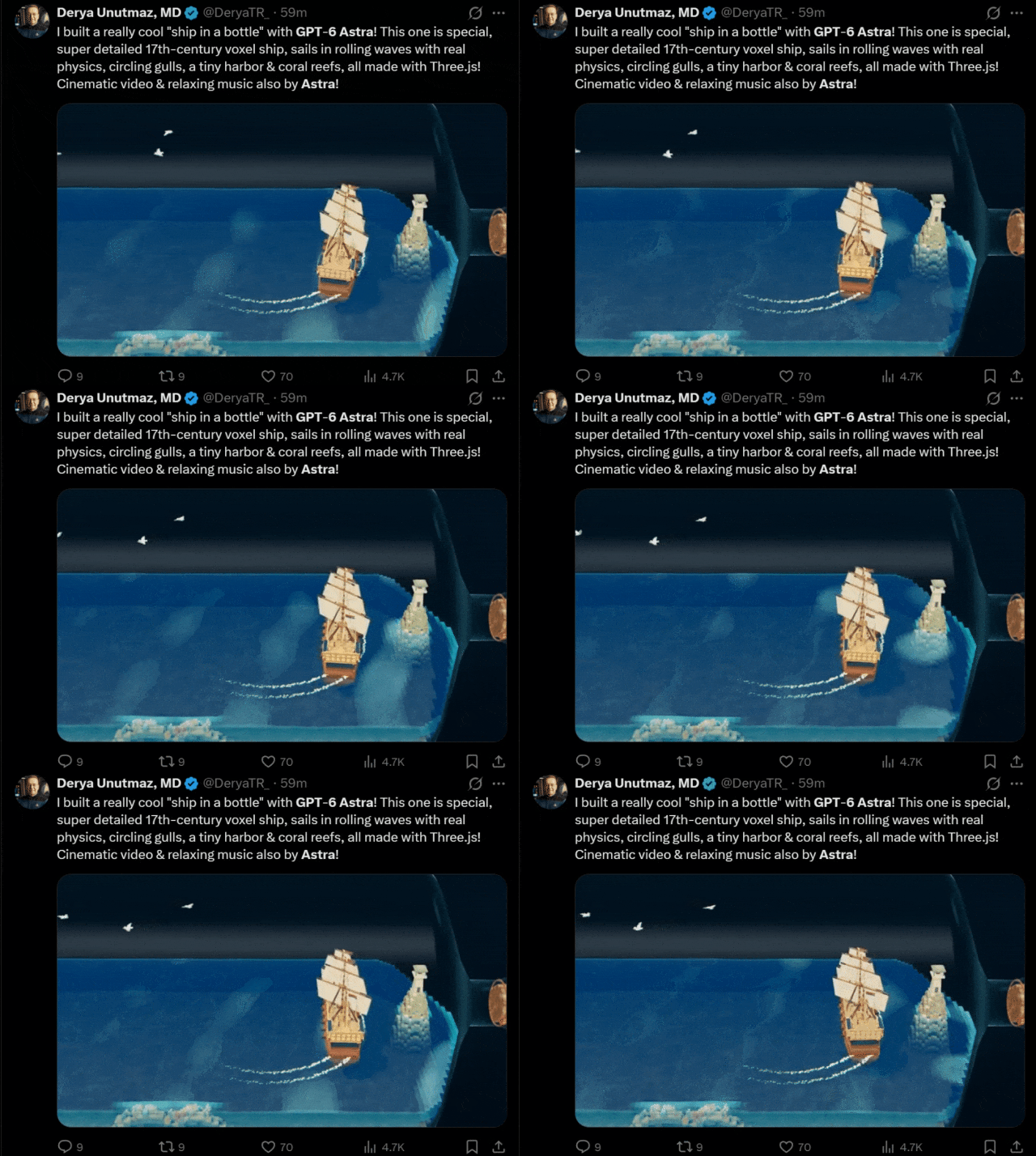
A ship-in-a-bottle scene combining Three.js geometry, a physics simulation, video and a music track in one deliverable.
What it shows: four output types coordinated into one artefact. Each is easy alone; keeping them in sync is not.
OpenAI put Astra at 72.6% on the OSWorld 2.0 computer-use benchmark

OpenAI reported 72.6% on OSWorld 2.0 Offline, alongside a demo of front-end UI work with self-correction loops.
What it shows: the number that anchors every demo above — and roughly one task in four still fails. I have written separately on why these scores carry asterisks.
What the builds have in common
Twenty-plus demos in, some things are consistent enough to be worth naming.
1. The winning demos are cross-application, not single-prompt. Blender into Unreal. Flora into Figma. The impressive part is never the generation — it is the handoff, which is exactly where scripted automation has always broken.
2. Self-verification is the real capability. Riley Brown's 80 automated checks and Mehul Mohan's tested tickets matter more than any render. A model that checks its own work can be left alone; one that cannot, cannot.
3. Editability separates a demo from a deliverable. Tom Krcha's 3,295 individually editable objects is the most quietly important number here. Generated output nobody can modify is a screenshot, not an asset.
4. Almost nobody published a control. Karan's side-by-side and Playco's 50%-fewer-fixes figure are the exceptions. Everything else is an unbaselined single run, which is why none of it belongs in a business case on its own.
If you are working out what this means for search and content specifically — agents that operate sites rather than read them — that argument is in what Astra changes for SEO and building an agent-ready website.
Update log
This page is rebuilt every week alongside the weekly roundup. New builds are added at the top of their section; nothing is removed, so the record of what looked impressive in week one stays honest as the novelty wears off.
| Date | Change |
|---|---|
| 5 September 2026 | First edition — 24 builds from launch week, across 3D, games, agents, creative tools, business automation and teaching. |
Built something with Astra, or seen a build worth adding? Send it over with a link to the original post. Credit goes to the builder, and links out are nofollow as a matter of policy — inclusion here is editorial, never traded.
FAQ
What is the most impressive thing built with GPT-6 Astra so far?
By reach, Riley Brown's 28-minute unattended build of a first-person shooter map, which produced 20 files and ran 80 automated checks without supervision. By substance, Derya Unutmaz's five-minute immunology teaching video is stronger evidence, because a practising immunologist verified the content in his own field rather than judging it on how it looked.
Can GPT-6 Astra really use Blender and Unreal Engine?
Yes — it operates the applications directly rather than writing scripts for them, moving through menus and manipulating objects the way a person does. Multiple independent creators demonstrated this in launch week, including exports carried from Blender into Unreal Engine 5.
Are these demos reliable?
Treat them as evidence of a ceiling, not a floor. Almost all are self-published screen recordings by the builder, with no independent reproduction and no baseline. You are seeing the take they chose to publish. OpenAI's own 72.6% on OSWorld 2.0 Offline implies roughly one task in four still fails.
How long does GPT-6 Astra take to build a game?
Reported runs range from single-prompt playable prototypes to Riley Brown's 28-minute autonomous session for a complete FPS map. Playco reported roughly 50% fewer manual fixes than with the previous model when generating three themed kart games from one prototype — the only figure in this list measured against the builder's own baseline.
How often is this page updated?
Weekly, alongside the Saturday roundup. New builds are added to the top of their section and the update log records what changed, so you can see what is new without rereading the page.
Do you get paid to include a build here?
No. Everything here was found on X or in published write-ups, and every outbound link carries rel="nofollow". Inclusion is editorial and cannot be bought.
Every build above belongs to the person credited beside it. Images are the creators' own, linked from their original posts, and each figure links back to the source. If you are one of them and would rather not appear here, tell me and I will remove it.

Jayant Solanki
AI-Ready SEO, GEO & AIO strategist based in Indore, India. I keep this index current every week, credit every builder, and link the original post so you can watch the clip rather than trust the summary.
More about Jayant →