
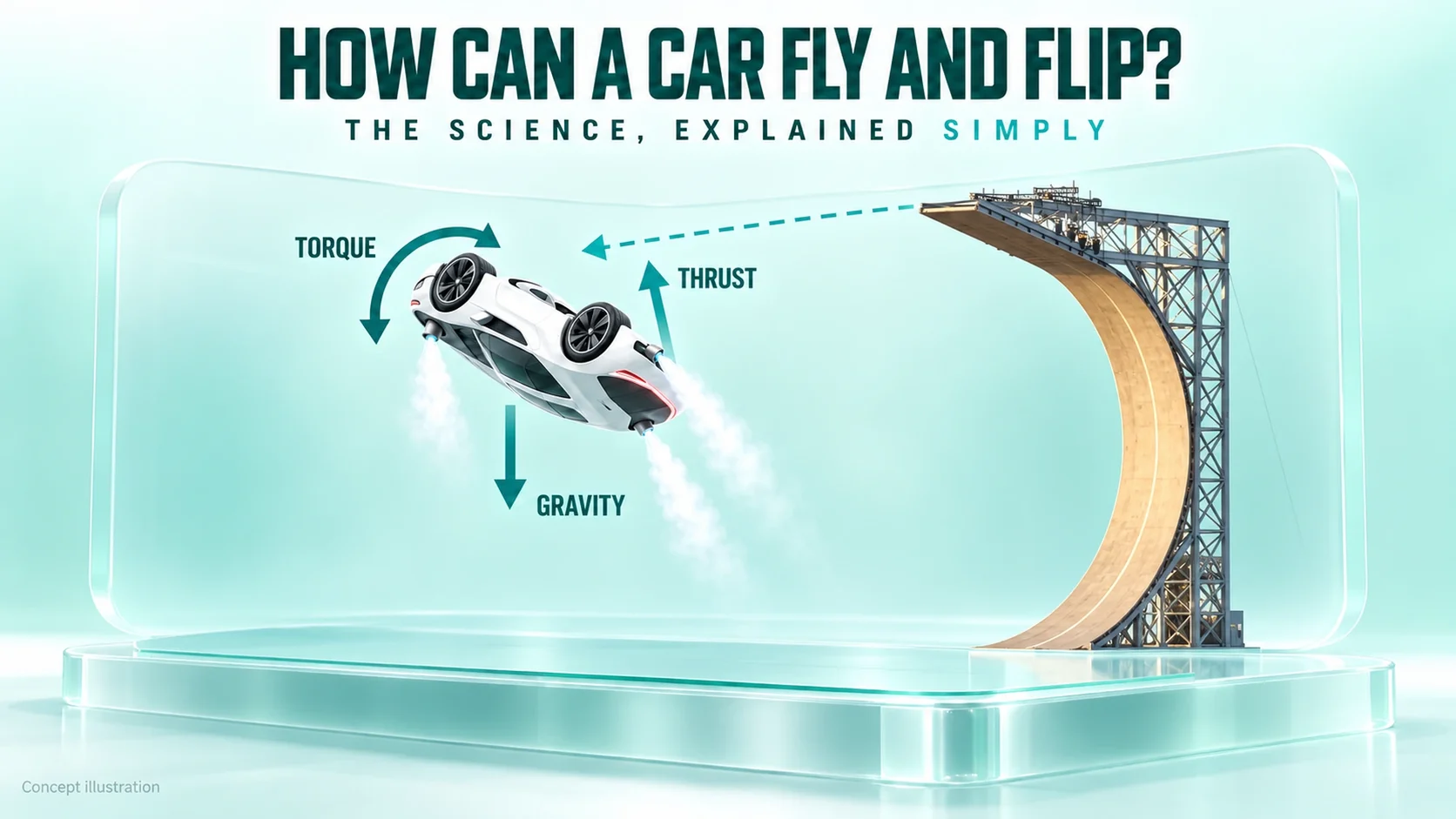


A car climbs a curved ramp. It turns upside down. Then it leaves the surface, rotates in the air and comes back towards the ground on its wheels.
It looks like something from a video game. But the basic ideas behind the manoeuvre are things you can understand without an engineering degree.
Three different effects explain the idea: fans can help hold a car against a surface, escaping compressed gas can push it through the air, and carefully placed pushes can turn it. None of these switches off gravity.
The important distinction is that a short airborne stunt is not the same achievement as a car cruising through the sky like an aircraft.
Here is what the Tesla Roadster discussion means, what the science can explain, and what a dramatic demonstration cannot tell us about a finished production vehicle.
The answer in 30 seconds
| Your question | Simple answer |
|---|---|
| How can it lift off? | A sufficiently strong upward push can lift a vehicle; a ramp can also give it upward motion. |
| How can it stay upside down against a surface? | Fans can reduce air pressure between the car and the surface, letting higher surrounding pressure push the car towards it. |
| How can it flip in the air? | A push applied away from the centre of the car can make it rotate. |
| How does it stop rotating? | It needs a turning effect in the opposite direction. |
| Is this anti-gravity? | No. Gravity continues acting throughout. |
| Does a short demo prove practical flying-car travel? | No. Duration, control, safety and operating approval are separate questions. |
Watch the whole stunt, step by step
Press play, drag the slider or jump to a step. Each step shows which forces are doing the work at that moment.
An explanatory illustration drawn for this article, slowed down and simplified. The ramp and car are modelled on Tesla's demonstration, but positions, timings and jet locations are not taken from Tesla's engineering data. In the real clip the car rolls around its nose-to-tail line; here that roll is shown as the car turning edge-on and back.
What happened—and what should we avoid claiming?
Coverage of Tesla's October 2026 Roadster reveal describes inverted-ramp and airborne demonstrations. Tesla has published clips titled “The Kickflip” and “The 0–60.” Its public Roadster page also distinguishes equipment associated with particular upgrades rather than one identical capability across every version.[1][2][3]
The videos load from YouTube only when you press play. Watch them with the three questions at the end of this article in mind: what holds the car to the surface, what pushes it once it leaves, and what turns it back?
That is a reason to be precise. “Tesla showed an airborne manoeuvre” and “every Roadster buyer can fly over traffic” are very different statements.
For this article, keep three labels in mind:
- Demonstration or company claim: what Tesla presents about a particular vehicle or configuration.
- Established physics: how pressure, thrust and turning forces work.
- Unresolved detail: something that needs technical documentation or independent testing.
What Tesla showed, sorted by evidence
Here is what the launch coverage adds, with each claim labelled by how well it is established.
| What was shown or said | Evidence | Source |
|---|---|---|
| The Roadster drove up a curved ramp until fully inverted, left it, rotated in the air and came down on its wheels. | Tesla's video | Tesla, The Kickflip |
| The reveal was livestreamed on 15 October 2026 from a SpaceX test site in McGregor, Texas. Lars Moravy, Tesla's vice president of vehicle engineering, said: "Flying cars are real." | Reported | Fox Business |
| Grip comes from a "multi-mode suction system": four fans of about 20 kW each, with adjustable skirts that seal the underbody. Tesla says it can hold the car upside down even when stationary. | Reported | Electrek, Electrek |
| Cold-gas thrusters, linked to SpaceX, run on compressed air stored at about 10,000 psi: about 200 litres in the Thrust trim and about 600 litres in the Rocket trim, which gives up its second seat for the extra tank. | Reported | Electrek, Fox Business |
| Tesla says the thrusters produce "4–5x the force the tires can". | Reported | Fox Business |
| Three trims: Performance, Thrust and Rocket. Only Rocket has the full flight system; Tesla says it is invite-only and not approved for public road use. | Reported | Electrek, Tesla |
| Refilling the air tanks takes six to seven hours today; Tesla's target is 30 minutes. | Reported | Electrek |
| How long the thrusters can run at full power. | Not published | Electrek infers "a few seconds" |
| The kickflip car may have been a lightened mock-up built for the stunt rather than a production-spec car. | Speculation | SlashGear |
I have not independently tested the Roadster. The explanation below describes the principles behind the reported mechanisms, not a verified drawing of Tesla's complete internal system.
1. How can air push a heavy car upwards?
Imagine inflating a balloon and releasing it without tying the end. Air escapes one way, and the balloon moves the other way.
The balloon does not need to push against a wall. It moves because it throws air out.
A compressed-gas thruster uses the same broad principle, with a strong tank, a controlled valve and a shaped outlet called a nozzle. Gas leaves the nozzle, and the vehicle receives a push in the opposite direction.
That push is called thrust. NASA explains rocket motion through Newton's third law: forces occur in equal and opposite pairs.[4]
Where does the push point?
The direction matters:
- Send gas backwards and the vehicle gets a forward push.
- Send gas downwards and the vehicle gets an upward push.
- Apply the push off-centre and it can also turn the vehicle.
For a level vehicle to begin lifting from rest without help from a ramp, its upward thrust must exceed its weight. To hover steadily, the upward and downward forces must balance, while the control system also keeps the vehicle stable.
Air can provide a large force. The engineering challenge is producing, directing and controlling enough of it for long enough.
2. Does a cold-gas thruster burn rocket fuel?
A cold-gas thruster produces its push by releasing stored pressurised gas rather than creating thrust through combustion inside the thruster. NASA describes a prototype system using a high-pressure nitrogen tank, regulation and multiple thrusters; that is an example of the general technology, not Tesla's specified hardware.[7]
“Cold” does not mean that the car is powered by ice. It distinguishes this propulsion approach from a hot combustion-based rocket engine.
A useful comparison is a controlled, much more powerful version of the escaping-air balloon. That comparison explains the direction of the push; it does not mean a party balloon and a vehicle pressure system have the same performance or design.
Where does its energy come from?
Putting gas under high pressure takes energy. The tank stores that pressurised gas, and releasing it uses the available supply.
If an electric compressor replenishes a system, it needs time and energy to do so. Releasing gas does not create free energy or an unlimited supply of thrust.
The practical questions include tank capacity, pressure, flow rate, equipment mass and how quickly the system can replenish or recharge. Do not turn a few seconds of visible thrust into an assumed flight time.
3. Why does a ramp matter?
A ramp can redirect forward motion upwards. Once a car leaves its edge, it may already be moving upwards or along another direction set by the ramp.
That means being in the air is not, by itself, evidence that thrusters are supporting the vehicle's full weight continuously.
Think of a skateboard leaving a ramp. It becomes airborne even without an engine. Gravity then changes its motion.
Thrusters can add force during an airborne manoeuvre, but understanding the total movement requires information about the ramp, entry speed, vehicle orientation and thrust over time.
That is why a single image cannot tell you how much of a manoeuvre came from the ramp and how much came from propulsion.
4. How can a car drive upside down without falling?
The reported Roadster approach involves a fan-assisted suction system. The underlying pressure idea is easier to understand than the stunt looks.
Air presses on objects from all directions. If fans remove enough air from the narrow space between a car's underside and a surface, the pressure there becomes lower than the surrounding pressure.
The higher pressure on the other side then pushes the car towards the surface.
On an ordinary road, that force presses the tyres towards the ground. If the car is inverted against a suitable surface, the same surface-directed force can act upwards, opposing gravity.
Think of a suction cup
A suction cup on smooth glass stays attached because the pressure inside it is lower than outside. The surrounding air helps press it against the glass.
A fan car is not simply a giant rubber suction cup. Fans, airflow, clearances and sealing arrangements are involved. But the comparison helps explain why a pressure difference can hold something against a surface.
Is this only a Tesla idea?
No. McMurtry published an upside-down driving demonstration in April 2025 using its Spéirling and a purpose-built rotating platform. Its account explains that fan-generated downforce held the vehicle against the inverted surface, including from a standstill.[5]
That is evidence of the broader engineering principle in another vehicle. It does not independently validate every Tesla design or performance claim.
5. Why is it called downforce if the car is upside down?
In car discussions, downforce usually means an aerodynamic force pressing the car towards the track.
The name can be confusing when the car turns over. What matters is the force's actual direction, not whether the word contains “down.”
For an inverted vehicle, the holding force must point towards the overhead surface. Gravity still points towards Earth. The vehicle needs enough holding force to oppose its weight and maintain useful tyre contact.
While moving through a curve, the forces also have to produce the required change in direction. Merely matching the car's weight is not a complete calculation for a moving stunt.
You do not need the equations to understand the key point: the vehicle stays against the surface because of the combined forces, not because gravity has stopped.
Do the maths: how strong do these forces need to be?
You can check the scale of the problem yourself. Move the sliders to see how much force it takes to hover a car, and how much lower the air pressure under it must be to hold it on a ceiling.
Weight = mass × 9.81 m/s². Pressure drop = weight ÷ sealed area. Sea-level air pressure = 101.3 kPa. A moving car on a curve needs more than its weight in holding force, and real fans leak air at the edges, so treat these as the bare minimum.
The surprising part is how small the pressure drop is. Holding a car of about 1,700 kg against a ceiling needs the air under it to be only a few per cent below normal, if the fans can seal a large enough area. The hard part is keeping that seal while moving, and keeping a margin for curves, bumps and leaks.
For comparison, Electrek reports that Tesla claims a holding force equivalent to about 4,700 kg, nearly three times the car's weight, and questions whether that figure is realistic.[8]
6. Can it stick to any ceiling or wall?
Do not draw that conclusion from a controlled demonstration.
A pressure-based holding system depends on the surface, airflow and the vehicle's ability to maintain a sufficient pressure difference.
Large gaps, uneven surfaces or loss of the relevant system can change the available holding force. A demonstration surface also does not establish that an ordinary ceiling can carry a car or provide a safe driving path.
The useful engineering questions are:
- What surface conditions are required?
- How is the pressure difference maintained?
- What margin exists beyond the minimum holding force?
- What happens if airflow, power or control is interrupted?
Those questions need specific test data. The basic physics does not answer them for a production Roadster.
7. What is the difference between fan grip and airborne thrust?
They perform different jobs.
| Mechanism | Basic idea | Main job in this explanation |
|---|---|---|
| Fan-assisted surface grip | Maintain lower pressure between the car and a nearby surface | Press the tyres towards that surface |
| Compressed-gas thrust | Expel stored gas through nozzles | Push or turn the vehicle |
| Ramp motion | Redirect the vehicle's existing motion | Establish the direction as it leaves the surface |
A surface-dependent suction effect cannot keep gripping a ramp after the car has left it and the pressure region is no longer maintained.
Airborne control therefore needs a different force mechanism. Do not describe “suction” as if it lets a car hang from empty space.
8. How can the Roadster flip in mid-air?
A push can move an object. A push applied in the right place can also turn it.
Think about opening a door. Pushing near the handle turns it more easily than pushing near the hinges. The placement of the force changes its turning effect.
That turning effect is called torque.
For an airborne vehicle, a thruster whose force acts away from the centre of mass can create torque. Carefully coordinated forces can change orientation as well as movement through the air.
NASA describes spacecraft thrusters as capable of producing both forces and torques for movement and orientation control. The same broad mechanics applies here; the actual Roadster control system needs its own documentation.[6]
Is it a flip or a roll?
People often call every airborne rotation a “flip,” but the direction matters.
| Motion | Simple description |
|---|---|
| Roll | The car rotates around a line running from its nose to its tail |
| Pitch | The nose rises or falls relative to the tail |
| Yaw | The nose turns left or right |
An end-over-end backflip and a barrel roll are not the same movement. A clear article should describe what the particular clip shows rather than treating every headline label as a precise engineering term.
9. Why does the car not keep spinning?
Starting the turn is only part of the task. The system also needs to slow the rotation at the right moment.
In simple terms, it must create a turning effect in the opposite direction.
Imagine spinning an office chair. Giving it one push starts the rotation. Removing your hand does not automatically stop it. You need another effect to reduce the spin.
A controlled vehicle needs measurements of orientation and rotation, a target position and a way to correct differences. Sensors and control software can coordinate those corrections.
This is the general control problem. It is not evidence that Tesla uses a particular sensor, algorithm or automatic emergency feature unless the company documents it.
10. How can it land without a hard impact?
Landing is about both position and speed.
A car can be upright but still hit the ground too quickly. It can descend slowly while rotating in the wrong direction. Both movement and orientation need control.
Upward thrust can reduce downward speed if it is strong enough and applied at the right time. Suspension can then absorb part of the remaining impact.
A useful comparison is catching a ball: slowing the change in motion over more time can reduce the force involved. The vehicle problem is much more demanding, but the basic reason a softer landing helps is familiar.
A successful landing in a demonstration does not establish performance in crosswinds, with a different load, on an uneven surface or after a system failure. Those are separate engineering tests.
Does it really fly, or does it jump?
It is reasonable in everyday language to call an actively propelled airborne manoeuvre “flight.” But readers need to know what kind of flight is being described.
| Capability | What would need to be established |
|---|---|
| Short hop | Brief departure from the surface |
| Controlled airborne manoeuvre | Directed motion or orientation while airborne |
| Sustained hover | Weight support and stable control for a stated duration |
| Practical aerial travel | Useful range, safe operation, repeatability and applicable approval |
A short clip does not establish all four.
Use “brief airborne manoeuvre” when that is what the evidence shows. It is more informative than leaving the reader to imagine a Roadster flying between cities.
Why can it not just stay in the air indefinitely?
A vehicle must keep producing enough upward force while airborne. If it relies on stored gas for that force, the supply is limited.
More usable gas can increase what is possible, but tanks and other equipment add mass. More mass also requires more force to support it.
Engineers therefore face trade-offs between capacity, weight, pressure, power, space and operating duration.
Without the relevant verified specifications, this article cannot calculate Roadster hover time or the number of repeatable manoeuvres. A claimed acceleration time does not provide enough information to calculate either.
Is compressed air safe because it does not burn?
Not burning fuel in the thruster removes one kind of combustion process. It does not remove every hazard.
High pressure stores energy. Powerful gas jets, vehicle movement, noise and landing loads all require careful engineering and controlled operation.
Pressure vessels, valves and control systems need appropriate design and testing. This is industrial equipment, not a project to reproduce with household containers.
The right question is not simply “does it have flames?” It is whether the complete system can operate safely under its intended conditions.
Is this anti-gravity, magnets or AI magic?
The mechanisms discussed here do not require anti-gravity or a magnetic track. They use ordinary forces in an unusual combination.
Software can help control valves and maintain a target movement. It does not remove the need for enough physical force, energy and control authority.
Nor does a complex control system automatically mean a particular AI model is flying the car. Do not add “AI-powered flight” to the explanation without evidence of what system is actually involved.
Does every Roadster have these abilities?
Do not assume so. Tesla's current public page includes qualifications tied to particular equipment and upgrades. Check the exact configuration associated with each claim.[3]
Before discussing a finished customer vehicle, separately verify availability, production specifications, approved use, market restrictions and delivery information.
A demonstrated capability, an advertised upgrade and an approved customer product are different stages of evidence. The science explanation can remain useful even when those commercial details change.
Frequently asked questions
How does the Tesla Roadster fly without wings?
A wing is not the only way to produce an upward force. Expelling gas downwards can produce upward thrust. A ramp can also make a vehicle airborne. The contribution of each mechanism in a particular manoeuvre needs evidence about that demonstration.
Does the Roadster cancel gravity?
No. Gravity continues pulling the vehicle towards Earth. Other forces can oppose it or change the vehicle's motion.
How does a car stay upside down when it is not moving fast?
A fan-assisted system can maintain a pressure difference near a suitable surface without relying only on forward speed. McMurtry has demonstrated that principle in its own vehicle. Tesla's exact operating limits require separate evidence.[5]
Can suction keep the car flying in open air?
The surface-grip mechanism explained here depends on a pressure region between the car and a nearby surface. It does not provide a surface to cling to in empty space. Airborne support needs another force mechanism.
Why does it use multiple thrusters?
Different force directions and positions can support movement and orientation control. Exact nozzle placement, output and operating sequence should come from vehicle-specific technical evidence rather than guesswork.
How does it stop a flip?
Its rotation must be slowed with an opposing turning effect while its position and speed are also controlled. Starting a rotation and stopping it accurately are separate tasks.
Is the airborne demo the same as a road-ready flying car?
No. A demonstration establishes what occurred under those conditions. Practical operation, durability, repeatability and approval need their own evidence.
Can an ordinary electric car do this with a software update?
No. The mechanisms described need specialised physical equipment. Software cannot add pressure tanks, suitable nozzles, fan systems or the structural provisions needed to support them.
Watch the forces, not just the stunt
When you watch the Roadster clips, ask three questions: what is holding it against the surface, what is pushing it once it leaves, and what is turning it back towards the intended landing position?
That separates one spectacular scene into three understandable engineering problems.
The excitement comes from coordinating those effects in a vehicle—not from breaking the laws of physics.
Want explainers like this for your brand?

I'm Jayant Solanki, an SEO, GEO and automation strategist. I write evidence-labelled explainers and build the interactive diagrams that make complicated products easy to understand, and easy for AI answers to cite.
Ranked #1 for "metal buildings" · +30% YoY organic traffic · Evidence-labelled research
Sources
Checked on 17 October 2026. This is an accessible explanation of established mechanics around Tesla's published demonstration material. It is not an independent performance test or a complete technical specification. Everyday comparisons simplify the principles and should not be treated as scale models of the vehicle.
- Tesla: The Kickflip — Roadster.
- Tesla: The 0–60 — Roadster.
- Tesla: Roadster product page and equipment qualifications.
- NASA: What is a rocket? An introduction for younger readers; Rocket thrust.
- McMurtry Automotive: Upside-down driving demonstration and fan-system explanation.
- NASA: Guidance, navigation and control: forces and torques from thrusters.
- NASA Technical Reports Server: Prototype cold-gas CubeSat propulsion system.
- Electrek (Jameson Dow, 15–16 October 2026): Are Tesla's claims for its new 'flying' Roadster real?.
- Electrek (Fred Lambert, 15 October 2026): Tesla unveils new Roadster that can kickflip.
- Fox Business (Landon Mion, 15 October 2026): Tesla's new Roadster takes flight during dramatic unveiling at SpaceX facility.
- SlashGear (Alex Hevesy, 16 October 2026): Was the Tesla Roadster flip real, or an AI-generated stunt?.
Jayant Solanki
Jayant Solanki writes accessible technology explainers alongside his work in SEO, analytics, website development and automation. This article draws on the engineering sources and launch coverage linked above; it does not claim first-hand vehicle testing.
More about Jayant →