
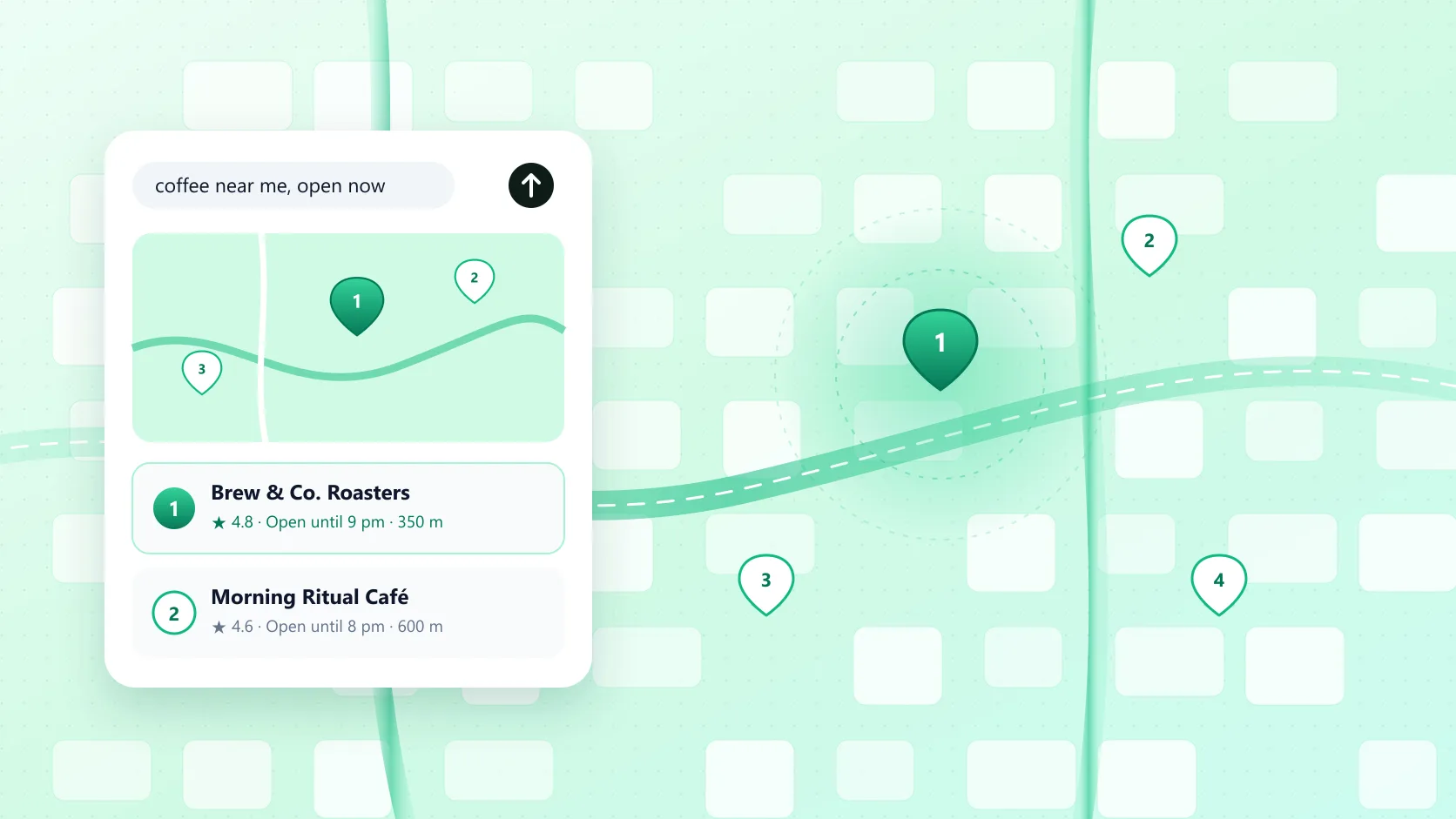
- ChatGPT Maps is the map that appears inside a ChatGPT answer when you ask about places: pins, a list, and a business card with hours, photos and links. OpenAI documents maps in local results Confirmed; a dedicated “Maps” section is being sighted but has not been announced Reported.
- It is a discovery tool, not a navigation app. OpenAI has announced no turn-by-turn directions or live traffic Not announced.
- The listings come from third-party data, not from Google Business Profile alone. OpenAI says it uses “trusted third-party providers” for nearby business listings, and Yelp now licenses its reviews, photos and business data to OpenAI Confirmed.
- To show up, fix your data where ChatGPT reads it: Yelp, Bing Places, Google Business Profile and Apple Business Connect, plus a website that OAI-SearchBot can crawl and that answers local questions plainly Analysis.
ConfirmedStated by OpenAI or a named executive on the record.
ObservedMeasured or seen directly by an independent tester.
ReportedA sighting or claim relayed by press or social media, not verified.
AnalysisMy interpretation or recommendation, not a fact about the product.
Local search is the most commercial corner of search: someone asking for “an emergency plumber open now” is minutes away from paying someone. For fifteen years that corner has belonged to Google Maps. This year ChatGPT started answering the same questions with its own map, and the rules for appearing in it are not the ones most local SEO checklists assume.
This guide separates what OpenAI has actually published from what has only been spotted, then turns it into a practical plan for getting a business into ChatGPT’s local answers.
What is ChatGPT Maps?
ChatGPT Maps is the interactive map that ChatGPT shows inside an answer when a question is about physical places, such as restaurants, shops or service businesses near a location. It plots results as pins beside a list, and tapping a business opens a card with details like hours, photos, contact links and, for some restaurants, live reservation times.
OpenAI’s own help centre describes it plainly: ChatGPT “can also use location information to find local results”, and on iOS and Android “relevant results may also include a map” Confirmed. OpenAI has not published a product page called “ChatGPT Maps”; the name comes from the people tracking the rollout, and from a Maps section that users began reporting in the ChatGPT interface in September 2026 Reported.
When a feature has no official page, most coverage blurs “OpenAI said” into “someone saw”. Everything below carries a label so you can tell which is which before you change your local SEO plan.
How ChatGPT Maps got here: a timeline
Maps did not arrive in one launch. It has been assembled piece by piece since ChatGPT search went live:
| Date | What happened | Status |
|---|---|---|
| 31 Oct 2024 | ChatGPT search launches; OpenAI says it partnered with data providers for new visual designs in categories including maps. | Confirmed |
| 16 Dec 2024 | Search opens to all logged-in users. Local queries start returning listings on a map with a list view. | Reported |
| 25 Nov 2025 | Voice mode can show “widgets (maps, weather, etc.)” and map cards in the same chat thread. | Confirmed |
| Dec 2025 | Clicking a business opens a local knowledge panel on the right-hand side. | Observed |
| 26 Mar 2026 | Optional device location sharing, including precise location, for local recommendations. | Confirmed |
| 23 Jul 2026 | Yelp licenses reviews, photos and business information to OpenAI. | Confirmed |
| 27 Jul 2026 | Code references to a section called “Places”: “explore places, weather, and trip ideas”. | Reported |
| 9 Aug 2026 | ChatGPT Maps sighted on European Union accounts, reachable with a /maps command. | Reported |
| 25 Sep 2026 | Users post a ChatGPT interface refresh with a dedicated Maps section. | Reported |
The pattern is familiar from other OpenAI features: capabilities ship quietly to cohorts, and official documentation follows later, if at all. Until OpenAI publishes a Maps announcement, treat the standalone section as a staged rollout rather than a finished product Analysis.
How ChatGPT Maps works
Three things decide what appears on the map: where ChatGPT thinks you are, which data sources it pulls businesses from, and how it presents each business once you tap it.
1. Your location: approximate or precise
Without any permission, ChatGPT “may use your IP address to estimate your general location, such as your country, state, or city” Confirmed. Since 26 March 2026 you can also share your device location. OpenAI’s release notes say that enabling it turns on precise location, which “means ChatGPT can use your device’s specific location, such as an exact address”, and that on mobile you can switch precise location off while keeping approximate location on Confirmed.
This matters for businesses more than it looks. A “near me” question answered from an IP address is answered at city level; the same question with precise location is answered at street level. Proximity becomes a real ranking input only for users who share location Analysis.
2. Where the listings come from
This is the question every local marketer asks, and the answer is less tidy than most guides claim.
- OpenAI confirms third-party providers, without naming them. Its help centre says ChatGPT “may share your location with trusted third-party providers that help provide more local information, such as nearby business listings or weather reports” Confirmed.
- Yelp is a named, licensed source. Yelp CEO Jeremy Stoppelman told Axios on 23 July 2026 that ChatGPT will surface Yelp reviews, ratings, photos and business details, with Yelp branding and links, and that Yelp’s Request a Quote feature will be added soon Confirmed. The deal is non-exclusive.
- Yelp dominates the business cards in current tests. An August 2026 study by Steady Demand ran 2,880 prompts across 12 US metros and found Yelp grounding 95.83% of structured business cards, with Foursquare at 0% Observed.
- Google Business Profile edits sometimes show up quickly. One practitioner reported that changing the website URL in a Google Business Profile updated the ChatGPT panel almost immediately Reported. That is a single report, not a documented data feed.
That figure traces back to a May 2025 test of first-ranked results in five Spanish cities. It was repeated as a universal fact, and a larger August 2026 US study measured Foursquare at zero Observed. Sources shift over time and by country, so optimise across several data providers rather than betting on one.
3. The map, the list and the business card
A local answer shows a map with pins and a list of the same places, and you can switch between map and list Observed. Tapping a pin or name opens a card that testers describe as showing photos, a short description, address, opening hours, ratings and links to call or visit the website Observed. Maps stay in your chat history, but OpenAI says your precise location is removed from the saved map Confirmed.
4. Reservations inside the answer
For restaurants, ChatGPT can show available reservation times and let you book. OpenAI lists three providers: OpenTable (available globally), Resy (United States) and Yelp (United States and Canada) Confirmed. If a restaurant is not on one of them, no booking button appears, which makes these platforms a direct conversion lever for restaurants in ChatGPT Analysis.
ChatGPT Maps vs Google Maps
They overlap on discovery and differ almost everywhere else:
| Capability | ChatGPT Maps | Google Maps |
|---|---|---|
| Answers a complex, multi-condition question | Yes, in conversation | Partly, with filters |
| Turn-by-turn navigation | No Not announced | Yes |
| Live traffic | No Not announced | Yes |
| Business data source | Third-party providers, including Yelp | Google Business Profile |
| Owner-managed profile | None of its own | Yes, Google Business Profile |
| Restaurant booking | OpenTable, Resy, Yelp | Reserve with Google partners |
| Ads beside results | Yes, labelled and separate from the answer | Yes, Local Search Ads |
The practical difference for a business owner: there is no “ChatGPT Business Profile” to claim. You cannot log in and edit your ChatGPT listing. You influence it only through the sources it reads Analysis.
How to get your business into ChatGPT Maps
There is no official ranking guide for ChatGPT’s local answers, so this checklist is built from the confirmed data sources above and from how ChatGPT search retrieves the web Analysis. Work through it in order; the first three items carry most of the weight.
Data sources ChatGPT is known or likely to read
- Claim and complete your Yelp listing. It is the only named, licensed source. Match categories, hours, photos and service areas to reality, and respond to reviews.
- Claim Bing Places for Business. ChatGPT search has used third-party search providers, and Bing is widely reported among them; Bing Places can also import straight from Google Business Profile.
- Keep Google Business Profile accurate. Google remains the biggest local surface, and edits have been reported flowing through to ChatGPT panels.
- Claim Apple Business Connect, the source behind Apple Maps, which Yelp also supplies.
- Make your name, address and phone number identical everywhere, including smaller directories and industry sites, and remove duplicate or old listings.
Your own website
- Allow OAI-SearchBot in robots.txt. It is the crawler OpenAI uses to surface sites in ChatGPT search answers, and it is controlled separately from GPTBot, which collects training data.
- Add LocalBusiness schema with name, address, geo coordinates, opening hours, phone, price range and
sameAslinks to your Yelp, Google and Apple profiles. - Publish one page per service and location that answers the questions people ask ChatGPT: what you do, where, for whom, from what price, and how fast.
- Earn reviews that mention specifics: the service, the neighbourhood and the outcome. Conversational questions are specific, and specific reviews match them.
- Refresh photos on every listing. Testers have found panels showing images years out of date.
Write pages that answer local questions
People ask ChatGPT full questions: “Which dentist near Vijay Nagar takes walk-ins on Saturday and is good with anxious kids?” A page that states those facts in plain sentences gives ChatGPT something to quote; a page that only says “quality dental care” does not. Lead each service page with a two-sentence answer, then support it with hours, prices, areas served and a short FAQ written in your customers’ words Analysis.
A minimal LocalBusiness block for the page’s <head> looks like this:
{
  "@context": "https://schema.org",
  "@type": "Dentist",
  "name": "Example Family Dental",
  "address": {
    "@type": "PostalAddress",
    "streetAddress": "12 Scheme 54, Vijay Nagar",
    "addressLocality": "Indore",
    "postalCode": "452010",
    "addressCountry": "IN"
  },
  "geo": { "@type": "GeoCoordinates", "latitude": 22.7533, "longitude": 75.8937 },
  "telephone": "+91-00000-00000",
  "openingHours": ["Mo-Fr 09:00-19:00", "Sa 10:00-14:00"],
  "priceRange": "₹₹",
  "sameAs": [
    "https://www.yelp.com/biz/example-family-dental",
    "https://maps.app.goo.gl/example"
  ]
}
Schema does not guarantee a place on the map. What it does is make your facts unambiguous for any system that reads your page, which is exactly what an AI answer needs. For the wider picture, see what schema markup actually does for AI search.
Want to know how ChatGPT sees your business?
I run local AI-visibility audits for service businesses in India, the UAE and the US: every data source ChatGPT reads, what each one says about you, and the fixes in priority order.
Request a local AI audit →How to test your visibility in ChatGPT Maps
You cannot see a ChatGPT ranking report, so you have to sample it. This is the method I use, and it takes about thirty minutes a month:
- Write ten real questions a customer would ask, from broad (“best physiotherapist in Indore”) to specific (“physio near Palasia open on Sunday for a sports injury”).
- Ask each one twice in a fresh chat: once naming the city with location sharing off, once with location sharing on from inside your service area.
- Record four things: whether a map appears, whether you are on it, your position in the list, and which competitors appear instead.
- Open your business card if you appear and check every field against reality: hours, phone, photos, website and category.
- Note the source links the answer cites. They tell you which listing ChatGPT trusted, and so which one to fix first.
Answers vary between runs, so look for patterns over several months rather than reacting to a single test Analysis. The same approach works for general AI citations; the full version is in how to get cited by ChatGPT, AI Overviews and Perplexity.
Organic listings vs ChatGPT ads
ChatGPT now carries ads for some users, and local businesses are among the advertisers. OpenAI’s stated rules are specific: “Ads do not influence the answers ChatGPT gives you”, and ads are “always clearly labeled” and “visually separated from the organic answer” Confirmed. Ads run for logged-in adults on the Free and Go tiers, and on 11 August 2026 OpenAI said they had launched in the United Kingdom, Mexico, Brazil, Japan and South Korea, after the United States Confirmed.
So a local business now has two separate routes into a ChatGPT answer: earning a place in the organic map, and paying for an ad beside it. They are not interchangeable. If OpenAI’s separation holds, buying ads will not lift your organic position, and fixing your listings will not be undone by a competitor’s budget Analysis.
What users should know about location and privacy
- Location sharing is optional and off by default Confirmed.
- Precise location is deleted after use, but anything in the answer, such as the names of nearby places, stays in your chat history until you delete the conversation Confirmed.
- A VPN changes your approximate location, and saved memories can also influence local results Confirmed.
- ChatGPT does not share your IP address or account details with its search providers Confirmed.
What is confirmed and what is still rumour
| Claim | Status |
|---|---|
| ChatGPT shows maps in local results on iOS and Android | Confirmed |
| Optional approximate and precise device location | Confirmed |
| Third-party providers supply nearby business listings | Confirmed |
| Yelp reviews, photos and business data appear in ChatGPT | Confirmed |
| Reservations through OpenTable, Resy and Yelp | Confirmed |
| Ads are separate from, and do not influence, answers | Confirmed |
| Local knowledge panels open from the map | Observed |
| Yelp grounds most business cards in the US | Observed |
A dedicated Maps section and /maps command | Reported |
| Google Business Profile edits feed ChatGPT directly | Reported |
| Turn-by-turn navigation or live traffic | Not announced |
FAQ
What is ChatGPT Maps?
ChatGPT Maps is the interactive map ChatGPT shows inside an answer when you ask about places. It plots businesses as pins beside a list, and tapping one opens a card with details such as hours, photos, links and, for some restaurants, reservation times.
Is ChatGPT Maps available everywhere?
Maps in local results are documented for ChatGPT on iOS and Android. A dedicated Maps section is rolling out gradually and was reported on European Union accounts in August 2026, but OpenAI has not published an official launch or a list of countries.
Can ChatGPT Maps give directions like Google Maps?
No. OpenAI has not announced turn-by-turn navigation or live traffic. ChatGPT Maps is built for finding and comparing places; for getting there you still need a navigation app.
Where does ChatGPT get local business information?
OpenAI says it uses trusted third-party providers for nearby business listings, and Yelp licenses its reviews, photos and business data to OpenAI. In an August 2026 US study, Yelp grounded almost all business cards. Other sources, including Google Business Profile and business websites, are reported but not confirmed.
How do I add my business to ChatGPT Maps?
There is no ChatGPT business profile to claim. Keep your Yelp, Bing Places, Google Business Profile and Apple Business Connect listings complete and consistent, allow OAI-SearchBot to crawl your website, add LocalBusiness schema, and publish pages that answer the specific questions customers ask.
Do ChatGPT ads affect which businesses appear on the map?
OpenAI says ads do not influence ChatGPT’s answers and are always labelled and shown separately from the organic answer. Paying for an ad should not change your organic position.
Does ChatGPT store my precise location?
OpenAI says precise location is deleted after it is used for a response and removed from maps saved in your history. Any place names in the answer stay in the conversation until you delete it.
Sources
- OpenAI Help Center: Searching the web with ChatGPT
- OpenAI: ChatGPT release notes (26 March 2026; 25 November 2025)
- OpenAI: Introducing ChatGPT search
- OpenAI: Testing ads in ChatGPT
- OpenAI: Crawlers and user agents
- Axios: Yelp partners with ChatGPT to surface reviews (23 July 2026)
- Search Engine Roundtable: OpenAI adds local knowledge panels (22 December 2025)
- Steady Demand: ChatGPT’s local results and Foursquare (21 August 2026)
- Pasquale Pillitteri: ChatGPT Maps in the EU (10 August 2026)