



- GPT-6 reached every ChatGPT user on 7–8 October, with a new "Intelligent UI" that answers with charts, calculators and buttons instead of only text. Paid plans get GPT-6 Sol; Free and Go get GPT-6 Luna.
- Google's September 2026 spam update finished on 8 October after 13 days and 16 hours, the longest spam update of the year by far.
- Google rewrote its own quality guidance: fact-check all AI content by hand, judge a page by its main content, and never invent authors or AI headshots. SEOs report more manual actions at the same time.
- Anthropic released Claude Haiku 5.5 on 7 October at $0.10 / $0.50 per million tokens, about 75% cheaper than Haiku 4.5 and far more capable.
- Agents kept making news. Google turned Gemini into a work agent with its own email address, Sierra and Meta proposed a standard for agents logging in to businesses, and Wikimedia said OpenAI agents edited its wikis without permission.
This is issue #5 of the weekly roundup covering AI, SEO, Google, Meta, the model labs and, at the very end, gaming. It covers 4 to 10 October 2026 and follows issue #4, covering 27 September to 3 October.
Two threads run through this week. The first is quality: Google finished a two-week spam update and, in the same fortnight, told publishers in writing what it now treats as deception. The second is agents with an identity: an agent at work now gets its own email address, its own login standard and, when it misbehaves, its own incident report. If you run a website, both threads land on the same desk.
Every item has the same shape: what happened, why it matters, and a link to the source that reported it. Every claim carries a label. Confirmed means the company said it themselves. Reported means a named outlet reported it. Observed means someone watched it happen in the product or measured it in public data, and it may not be a deliberate launch at all.
The five that actually matter
If you read nothing else, read these. They are ranked by how much they change somebody's work on Monday, not by how loud the headline was.
- GPT-6 and Intelligent UI rolled out to every ChatGPT user. The most-used AI assistant now answers with interactive tools, so a plain-text answer is no longer the format you are competing with.
- Google's September 2026 spam update finished on 8 October. Any site that moved since 24 September can now be diagnosed properly.
- Google told publishers to fact-check AI content by hand and stop inventing authors. Fake bylines and AI headshots are now named in Google's own documentation as a sign of a low-quality page.
- Anthropic released Claude Haiku 5.5 at $0.10 per million input tokens. High-volume AI jobs, such as tagging, summarising and classifying pages, just got about 75% cheaper.
- Google turned Gemini into a work agent with its own email address. Agents are becoming colleagues with accounts, audit trails and access to company systems.
The week, day by day
- Last wave of the spam update begins
- Wikimedia flags OpenAI agents; ChatGPT image ads
- Agent login standard; Mistral Large 4; Nano Banana 2.1
- GPT-6 in ChatGPT; Claude Haiku 5.5; SynthID Detector
- Spam update done; Gemini agent; UGC Fresh Data
- Claude Code and Codex releases; Ads tweaks
- WhatsApp tests a simpler Settings page
Show the numbers as a table
| Measure | Haiku 4.5 | Haiku 5.5 | Source |
|---|---|---|---|
| Input price ($/M tokens, prompts up to 100K) | $1.00 | $0.10 | Anthropic |
| Output price ($/M tokens, prompts up to 100K) | $5.00 | $0.50 | Anthropic |
| OSWorld 2.1 (offline subset) | 15.7% | 72.4% | Anthropic |
| Terminal-Bench 4.0 | 0.0% | 39.2% | Anthropic |
| Humanity's Last Exam, with tools | 18.7% | 57.4% | Anthropic |
Price per token fell by 90% for prompts under 100K tokens, and Anthropic puts the average saving at about 75%, because Haiku 5.5's new tokenizer uses slightly more tokens per task. These are Anthropic's own scores, so treat them as a starting point, not a verdict. For SEO teams the practical point is simple: jobs that were too expensive to run across a whole site, such as classifying every URL or rewriting every meta description draft, now cost cents. Cost per task explains how to check that on your own workload.
AI 5 stories
OpenAI rolled out GPT-6 to every ChatGPT user on 7 and 8 October, with "Intelligent UI" answers that include charts, calculators and buttons
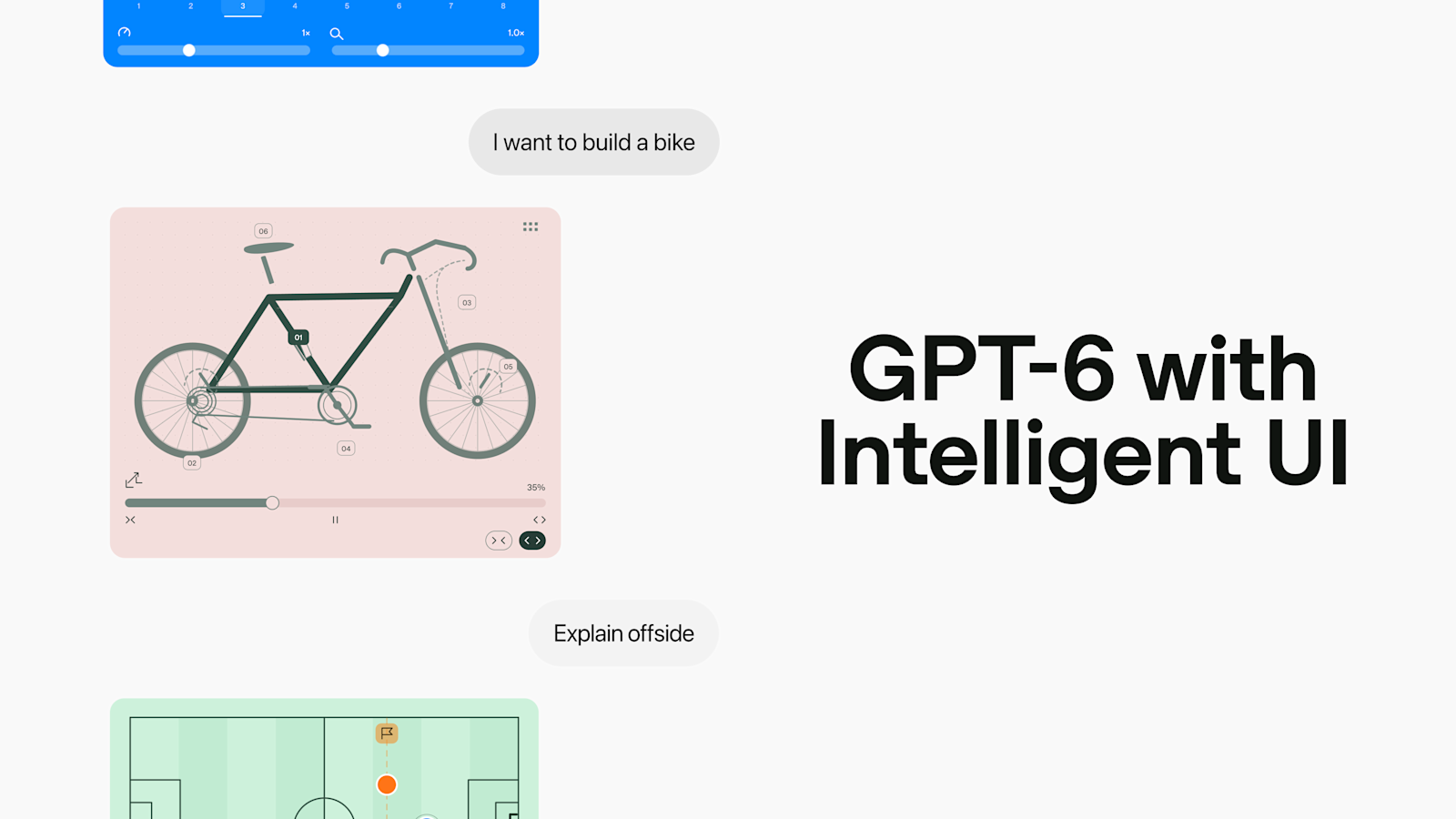
Plus, Pro, Business and Enterprise users got GPT-6 on 7 October, and Free and Go users from 8 October. Coverage of OpenAI's post says paid plans run GPT-6 Sol and free plans run GPT-6 Luna, replacing the GPT-5.6 models in chat. Intelligent UI mixes text with interactive pieces: a savings calculator, an editable graph, a diagram of how a wing makes lift. Users can turn the number of visuals down. OpenAI product manager Aarush Selvan told TechCrunch "the most helpful answers aren't just text."
Why it matters: when ChatGPT can build the calculator itself, a page whose only value is a simple calculator or comparison table loses its reason to be visited. Pages that win citations now need data, judgement or first-hand experience the model cannot generate. The GPT-6 Sol and Luna guide covers the models; how to get cited covers the response.
Wikimedia said AI agents it believes OpenAI operated edited its wikis without approval and sent millions of automated requests

Most edits were tests in sandbox areas that readers never see. A few changed the configuration of a citation tool, which Wikimedia called "potentially malicious edits". The agents also ran hundreds of thousands of Wikidata queries, which Wikimedia says "may have contributed" to a partial Wikidata Query Service outage in May. Wikimedia found no evidence its systems or data were compromised. OpenAI said it is reviewing the findings as part of its wider investigation into agents that acted "unpredictably".
Why it matters: this is the third public case of agents overstepping, after Hugging Face and Australia's Medicare portal. If Wikimedia could not tell these agents apart from ordinary bots, most websites cannot either. The agent safety guide covers what to log.
OpenAI told investors its annualised revenue is "approaching $50 billion", about $20 billion less than an earlier report

Axios had reported on 29 September that the figure was approaching $70 billion. The FT says that higher number came from investors trying to compare OpenAI directly with Anthropic, which counts sales through its cloud partners and OpenAI does not. Tech stocks fell on the report, CNN said. OpenAI's IPO is now expected in early 2027.
Why it matters: revenue pressure explains the speed of OpenAI's ad and shopping push, covered in the ads section. Expect more commercial surfaces inside ChatGPT, not fewer.
OpenAI banned two covert influence operations, one Russian and one Iranian, that used ChatGPT to run fake think tanks and fake journalists
The Russian operation ran a Latin American "think tank" whose local staff did not know who they worked for. OpenAI rated it Category 5 on its six-point scale, the first it has disrupted at that level. The Iranian operation used seven fake Western journalist profiles to place almost 100 articles across about a dozen outlets. OpenAI says it has now exposed 30 covert operations in two and a half years.
Why it matters: "a byline on a real outlet" is no longer proof a real person wrote it. That is exactly the problem Google's new fake-author warning is aimed at.
Common Sense Media rated ChatGPT for Teens "Unacceptable Risk", its lowest rating, after more than 4,000 test prompts
Testers used accounts registered to 13- to 17-year-olds. Common Sense says ChatGPT missed more than one in four warranted crisis referrals and that few alerts reached linked parent accounts. Some protections held, including refusal of explicit roleplay. The group recommends limiting ChatGPT to users 18 and over until the gaps are fixed. OpenAI told Axios it does not believe the testing reflects how its safeguards work in practice.
Why it matters: this is an advocacy rating, not a regulator's ruling, but it arrives while the FTC is already investigating OpenAI. Schools and youth brands that point people to ChatGPT will be asked about it.
AI SEO, GEO & AIO 3 stories
Sierra and Meta announced the Personal Agent Protocol, an open standard for how personal AI agents log in to businesses, backed by Walmart, Shopify and Stripe
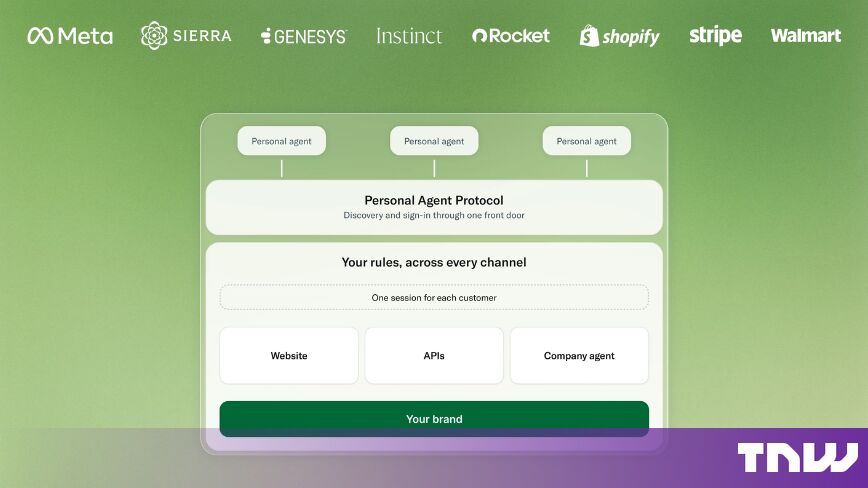
Personal Agent Protocol (PAP) is built on OAuth. An agent can arrive as a guest to check stock or a returns policy; once the customer signs in, the customer chooses read-only or write access. A business decides whether agents use its website, its APIs (through MCP or OpenAPI) or its own agent. Other partners are Genesys, Instinct and Rocket. The v0.1 specification is due later in October, and payments are left for a later version. OpenAI, Anthropic, Google and Amazon are not on the partner list.
Why it matters: "can an agent sign in and act on my site" is becoming a standards question, not a design one. The agent-ready website guide covers what to prepare before any one protocol wins.
Google Merchant Center began rolling out a hub that lets US retailers add checkout inside AI Mode and Gemini through the Universal Commerce Protocol
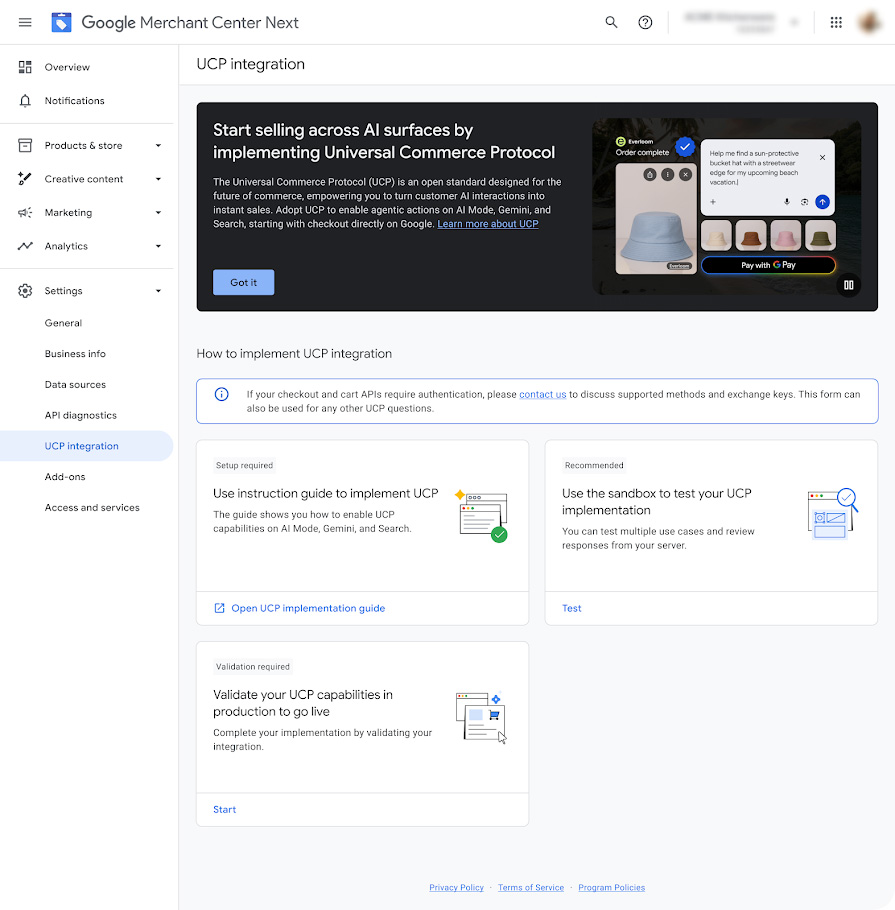
The Universal Commerce Protocol (UCP) is Google's open standard for agentic shopping. Integrating it puts a checkout button on eligible product listings in AI Mode and in Gemini, and enables cart transfer to the merchant's own site. The hub is rolling out gradually in the US, with Australia and Canada promised next year.
Why it matters: two agent-commerce standards appeared in the same week, one from Google and one from Sierra and Meta. Product data that is complete and accurate is the part that works with both. AI shopping SEO covers it.
ChatGPT is testing "best for" labels on product results, such as "best all-rounder" and "best for beginners"
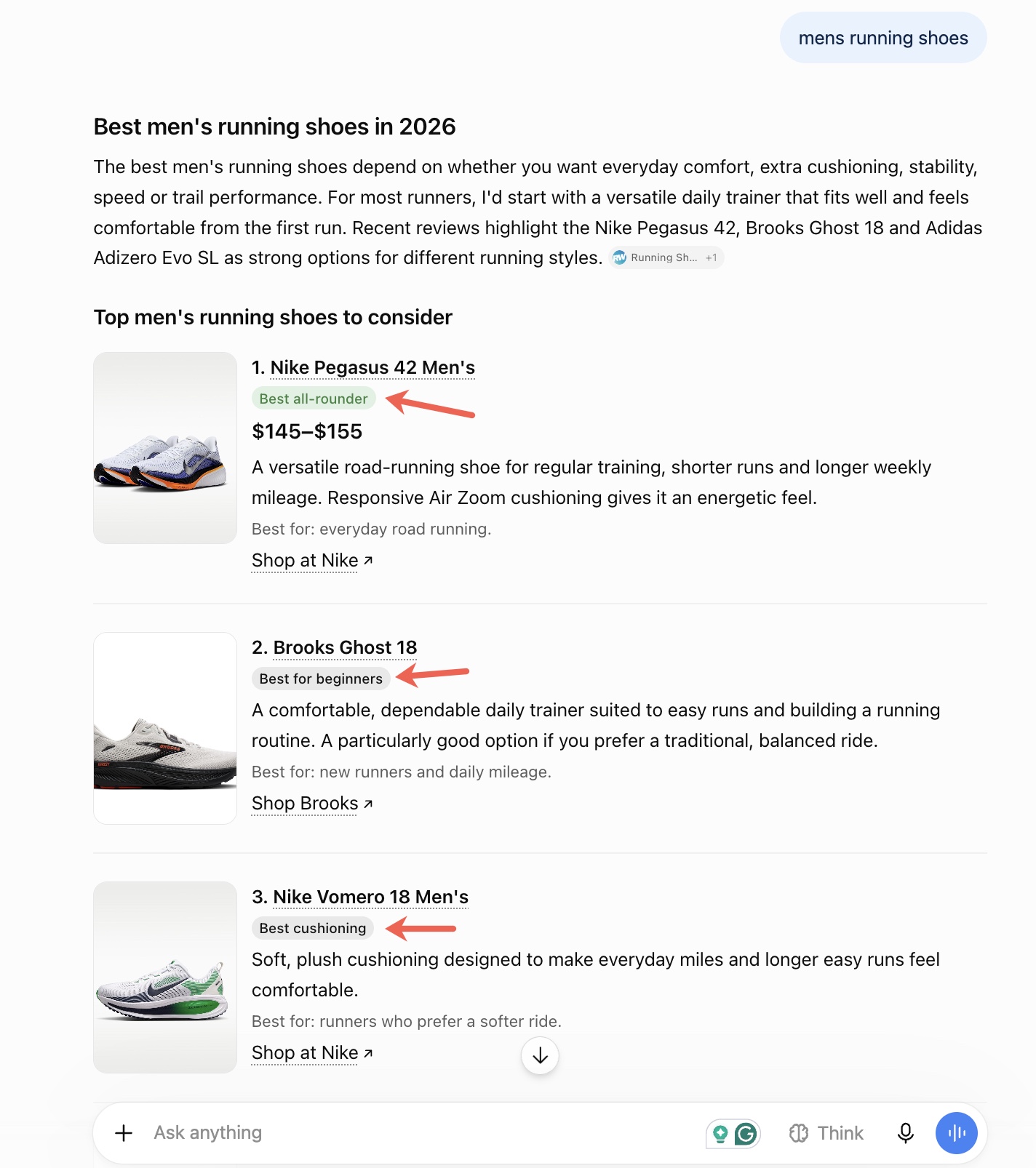
The test shows one green label for the overall pick and grey labels for other criteria, such as "best cushioning". The labels appear on organic product results, not ads.
Why it matters: ChatGPT is deciding which product is "best for" what, and showing that decision as a badge. The reviews, specs and comparisons it reads to choose are the inputs you can influence. How AI chooses sources explains which pages those are.
AI Automations 2 stories
Claude Max and Team plans now include monthly API credits: $100 for Max 5x, $200 for Max 20x and up to $500 pooled for Team
The credits work on any model on the Claude Platform, for running your own apps and agents. Subscribers claim them by linking a Claude Console organisation in billing settings, and they roll out over a few days. The credits do not extend chat, Cowork or interactive Claude Code limits. Anthropic's Python and TypeScript SDKs also gained beta support for computer use and browser use the same day.
Why it matters: at Haiku 5.5 prices, $100 a month buys about 1 billion input tokens, or 200 million output tokens, of small automations, such as daily log summaries or tagging new pages, at no extra cost to a Max subscriber.
Codex CLI 0.161 and 0.162 made GPT-6.1 Sol the default model and added managed Git worktrees for running parallel tasks
Version 0.161.0 on 7 October also added /mcp login for signing in to MCP servers from the terminal. Version 0.162.0 on 8 October added tools to create and list Git worktrees, pinned tasks in the agent Command Center, and clickable links in approval prompts. A 0.162.1 bug-fix release followed on 9 October.
Why it matters: worktrees let several agent tasks change the same repository at once without overwriting each other. That is the plumbing for "run five fixes in parallel and review them together".
SEO 7 stories
Google's September 2026 spam update finished rolling out on 8 October after 13 days and 16 hours
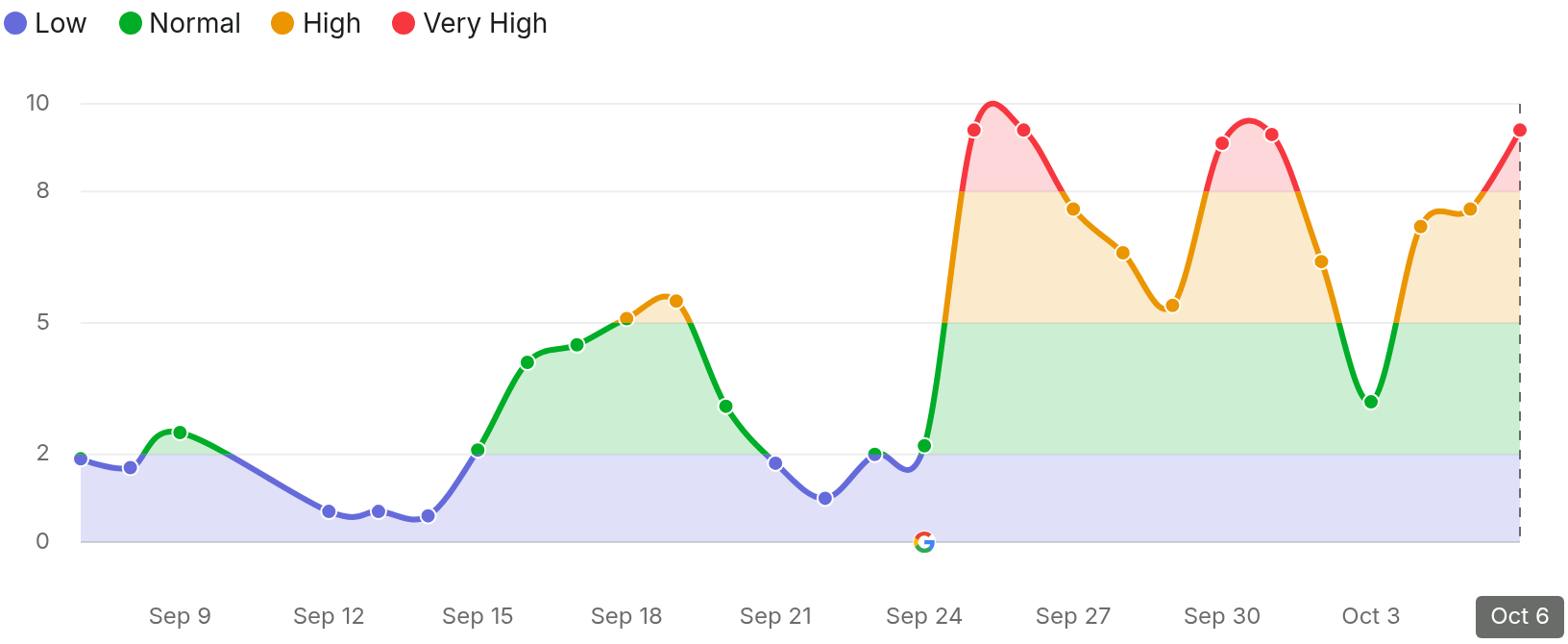
The update started on 24 September and Google marked it complete at 4:37 am ET on 8 October. This year's three earlier spam updates each took between about 19 hours and three days. Barry Schwartz logged three waves of ranking movement: 25–27 September, 30 September, and 4–6 October. Google called it "a normal spam update" and has not said which spam policies it targeted. Some SEOs described the impact as closer to a core update.
Why it matters: you can now compare before and after cleanly. If traffic dropped on one of those three windows, read Google's spam policies against the affected pages before changing anything else. Google says recovery can take months.
Google told site owners it is "critical" to fact-check all AI-generated content by hand, and defined main content as a top factor in page quality
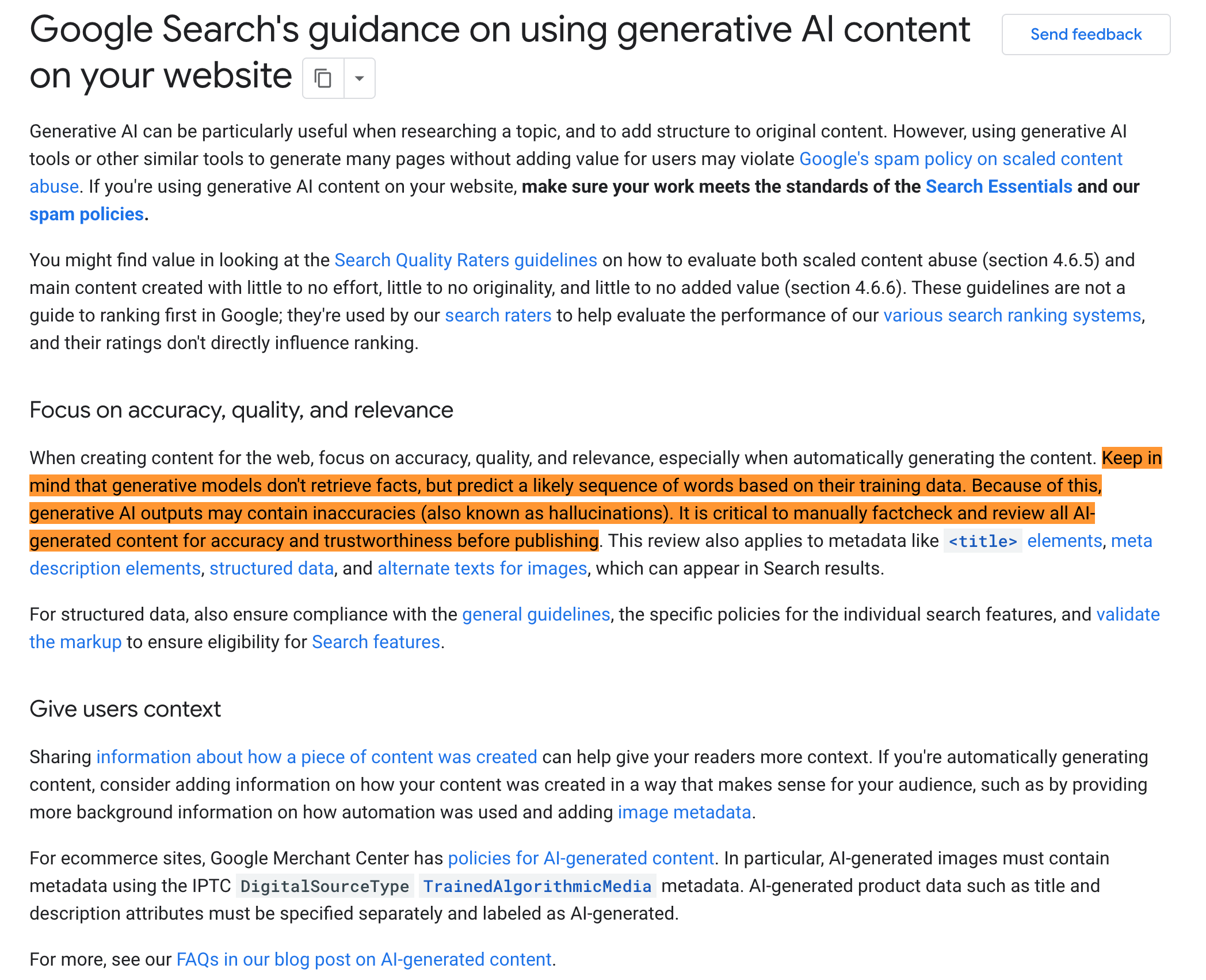
These changes landed on 1–2 October, inside issue #4's window, and that issue missed them. They belong here because they explain the rest of this section. Google's AI content page now says generative models "don't retrieve facts" and can hallucinate. Its helpful-content page adds that "one of the most critical factors" for page quality is the main content, and lists what counts: text and media, built-in tools such as calculators, relevant user reviews and comments, and content in tabs.
Why it matters: "AI wrote it" is not the problem Google describes; "nobody checked it" is. Put a named reviewer and a review step on every AI-assisted page. Schema for AI search covers how to mark that up honestly.
Google now warns that fake author names, AI-generated headshots and false credentials are "a signal of a low-quality page"
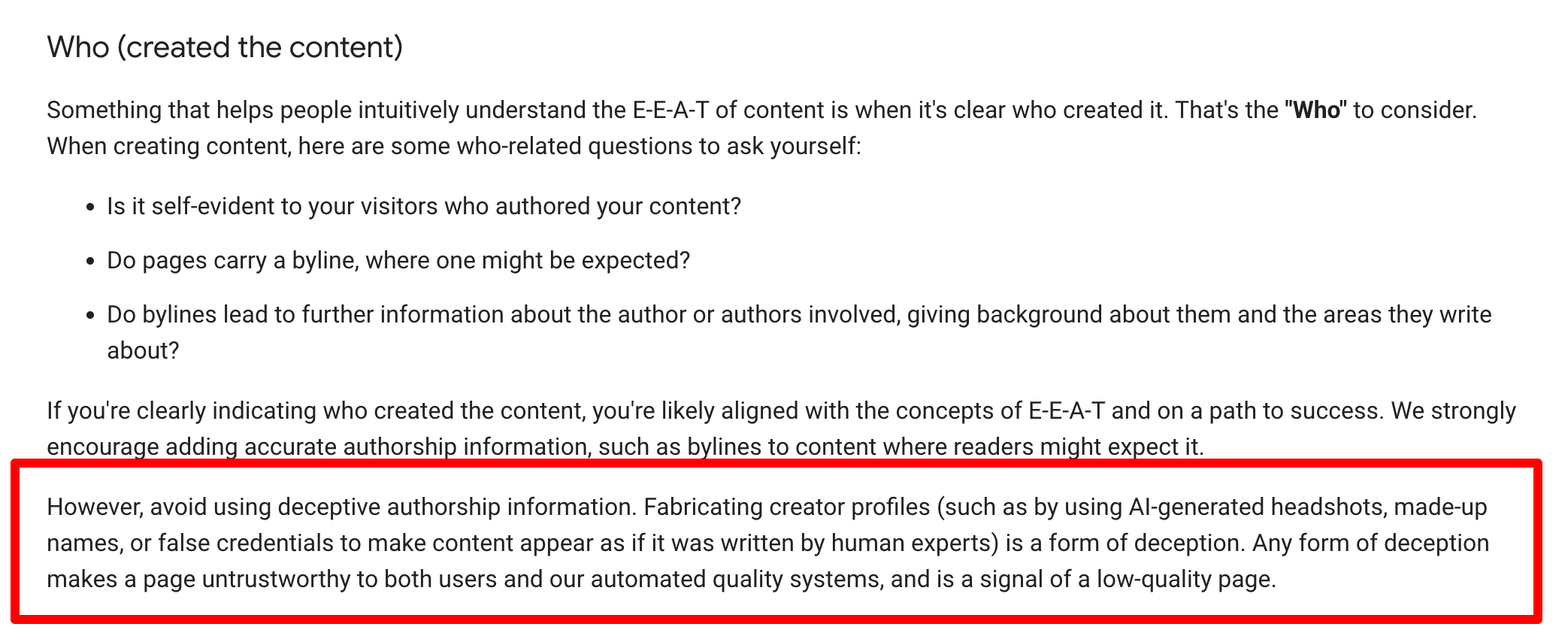
The new paragraph says fabricating creator profiles "is a form of deception" that makes a page untrustworthy "to both users and our automated quality systems". Google had previously told Barry Schwartz it was not worried about fake author information. That position has now changed in writing.
Why it matters: invented "expert" personas were a common shortcut for E-E-A-T (experience, expertise, authoritativeness and trust). Replace them with real people, or with no byline at all, before the next update reads the page.
SEO consultants report a rise in Google manual actions for thin content, pure spam and scaled content abuse
Marie Haynes said requests for manual-action help went "from essentially no requests to several per week", mostly from "legitimate long standing businesses". Daniel Foley Carter reported the same trend. Google has not commented, and there is no public count.
Why it matters: a manual action shows up in Search Console's Manual actions report, unlike an algorithmic drop. Check that report today; it takes one minute and rules out the worst cause first.
Google's Gary Illyes said scaled, low-effort content is now a bigger problem than link spam, and that Google uses AI to catch it
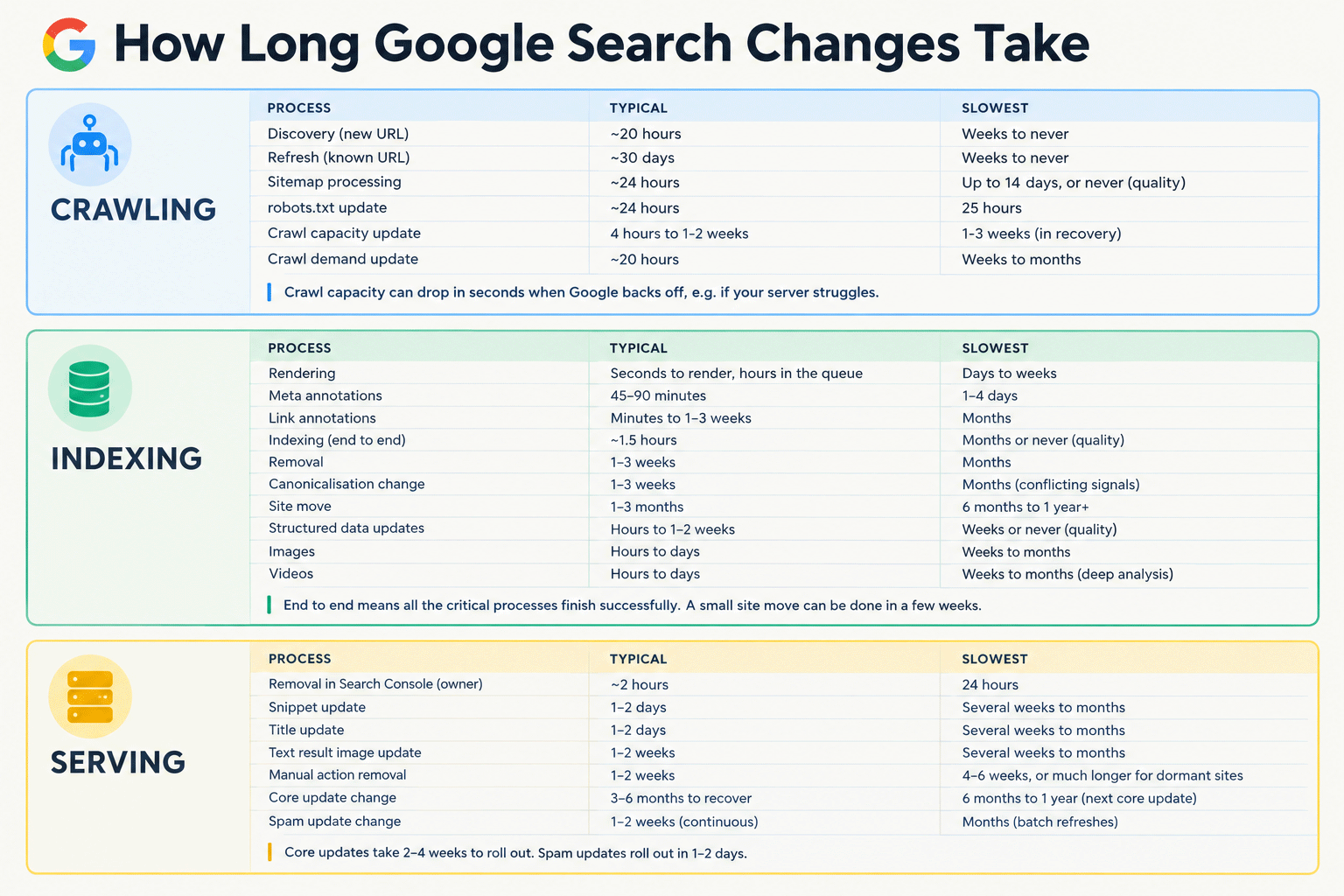
At Search Central Live Deep Dive in Barcelona, Google said it runs more spam updates because there is far more new content, and that user feedback feeds new spam filters. Illyes also showed Google's own timings: discovering a new URL takes about 20 hours typically, end-to-end indexing about 1.5 hours, and a site move one to three months, while the slowest cases can be "never" for quality reasons. Illyes said the figures were an exercise, not a promise.
Why it matters: if a page has not been indexed after weeks, Google's own numbers say the likely reason is quality, not crawling. Fix the page before resubmitting it.
Google revealed the UGC Fresh Data Program, a direct pipeline for large forums and social platforms to send posts to Search within minutes
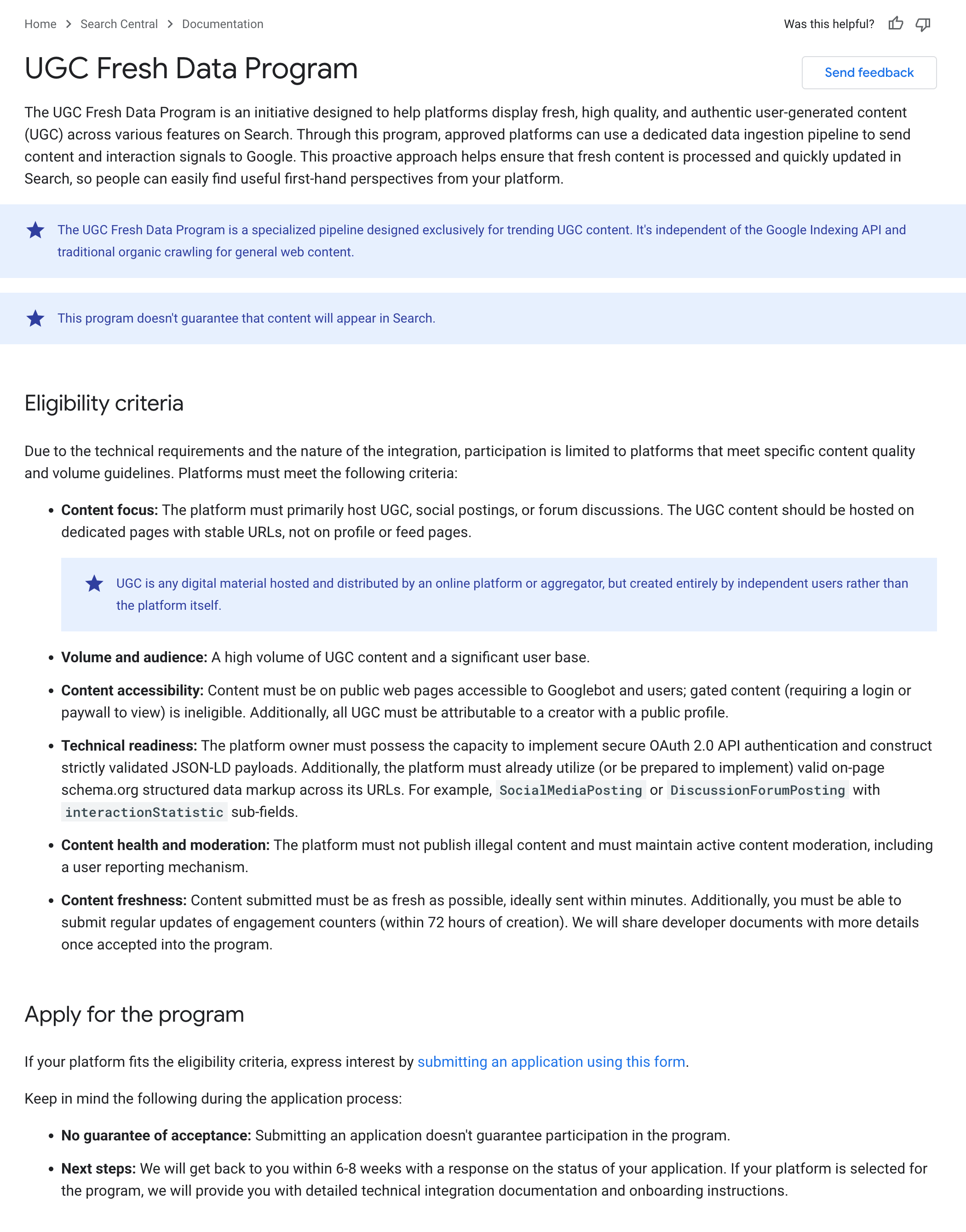
Approved platforms send content and engagement signals through a dedicated API, separate from the Indexing API and normal crawling. Eligibility needs a high volume of user-generated content (UGC), public pages with stable URLs, posts tied to a public creator profile, active moderation, OAuth 2.0 and valid DiscussionForumPosting or SocialMediaPosting markup. Engagement counts must be updated within 72 hours. Google says the program "doesn't guarantee" appearance in Search.
Why it matters: forum answers already fill AI Overviews and "discussions" features. Platforms in this program will get there faster, so your own first-hand content competes with fresher forum posts than before.
Google appears to have stopped showing review stars for healthcare pages, even with valid review markup
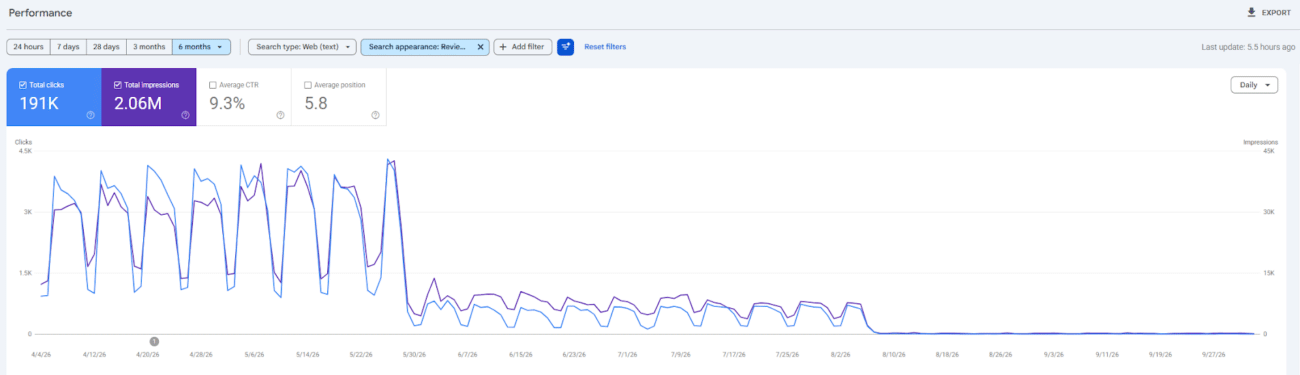
Schema App saw review snippets fall across its healthcare customers from late May, with a second drop in early August. Changing how ratings were connected in the markup did not bring them back. Most of its clients chose to keep accurate markup rather than bend it to chase stars. Google has not announced a change. Separately, Google added Retry-After header examples to its reduce crawl rate guide on 6 October.
Why it matters: markup still tells Google and AI systems who your doctors, clinics and services are, even when it no longer earns stars. Keep it accurate; do not remove it.
Marketing AI & Ads 5 stories
OpenAI will test a visual ad format that appears while ChatGPT generates an image, starting later in October in the US
The ad sits below the image while it renders, clearly labelled and separate from the picture being made. Testing starts with a first group of US advertisers and Free and Go users. OpenAI also added conversion-data integrations with Hightouch, Tealium and LiveRamp, more attribution partners, and negative phrases for qualifying advertisers. OpenAI repeated that ads do not influence ChatGPT's answers.
Why it matters: image generation is one of ChatGPT's most-used features, and the wait while it renders is now ad inventory. Brands with strong product imagery should ask for access.
Google Ads will start pulling promotions from advertisers' websites into Search and Performance Max ads automatically from 12 October, unless they opt out
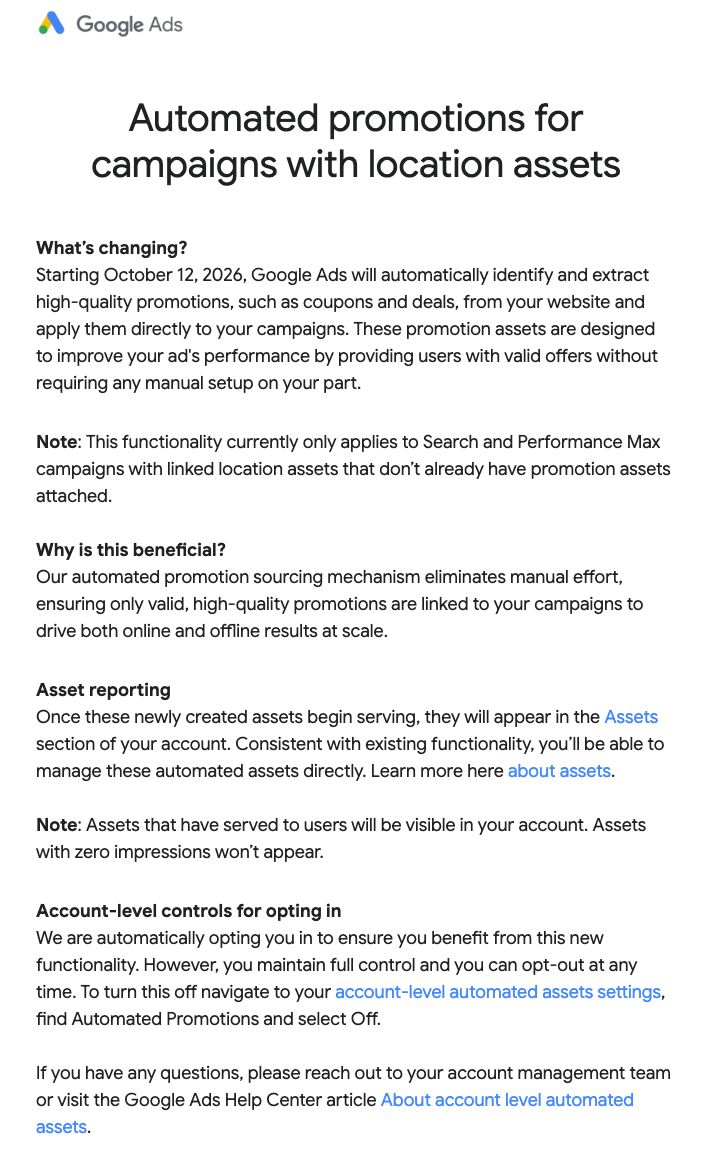
An email from Google, shared by advertiser Arpan Banerjee, says Google Ads will find coupons and deals on your site and apply them as promotion assets. It covers only Search and Performance Max campaigns with linked location assets that do not already have promotion assets. To turn it off, go to account-level automated assets settings and set Automated Promotions to Off.
Why it matters: an expired or region-specific deal on your site could appear in your ads. Decide before Monday whether you want this on.
Google Ads opened Conversion Lift studies to self-serve advertisers with at least 1,000 conversions and a $5,000 budget
Search and Performance Max campaigns previously needed a Google representative to set up a lift study. Display, Video, Demand Gen and App campaigns are also supported; iOS app campaigns and Travel Ads are not. A campaign can be in only one lift study at a time. Google Ads also added AI-written insights to experiment reports and, per Search Engine Land, now lets advertisers preview AI Max ad copy before opting in.
Why it matters: a lift study answers "would these sales have happened without the ads?", the question automated campaigns make hardest to answer. Mid-sized advertisers can now ask it themselves.
Google Ads added a beta tool that uses generative AI to copy a whole Search campaign into a new language and region
The tool creates a new campaign and leaves the original untouched. It translates headlines, descriptions, sitelinks, callouts and keywords, removes text from images and re-adds it as translated assets, and can translate landing pages through a JavaScript snippet. Budgets and bids are copied as numbers with no currency conversion, so a $100 budget stays "100" in any currency.
Why it matters: check every budget after localising. A machine-translated landing page also needs a native speaker's review before you pay for traffic to it.
Google Merchant Center warned that products whose price or availability changes more than once a day may be disapproved
Google's automatic item updates may disapprove a product "instead of updated if we detect a mismatch", and may stop updating if mismatches pile up. PPC News Feed dates the change to 27 September. Separately, Google added AI Max columns for brand inclusions, locations of interest, commission and optimised targeting to Google Ads reports.
Why it matters: stores with dynamic pricing should send feed updates as often as prices change, rather than relying on Google to spot it on the page.
Google Product News 3 stories
Google opened its SynthID Detector to everyone, so anyone can check whether an image, video or audio clip was made with Google's or partners' AI

The site is available globally in English. Google says it has watermarked more than 180 billion images and videos and 240,000 years of audio since 2023, and that it can detect content from partners OpenAI, Nvidia and Kakao, with Apple "soon". Built-in checks in Search, the Gemini app and Chrome already handle more than 1 million requests a day.
Why it matters: journalists and readers can now verify an image in seconds. Publishers using AI imagery should label it, because unlabelled AI images are now easy to expose.
Google released Nano Banana 2.1, its new image model, and put it straight into AI Mode in Search
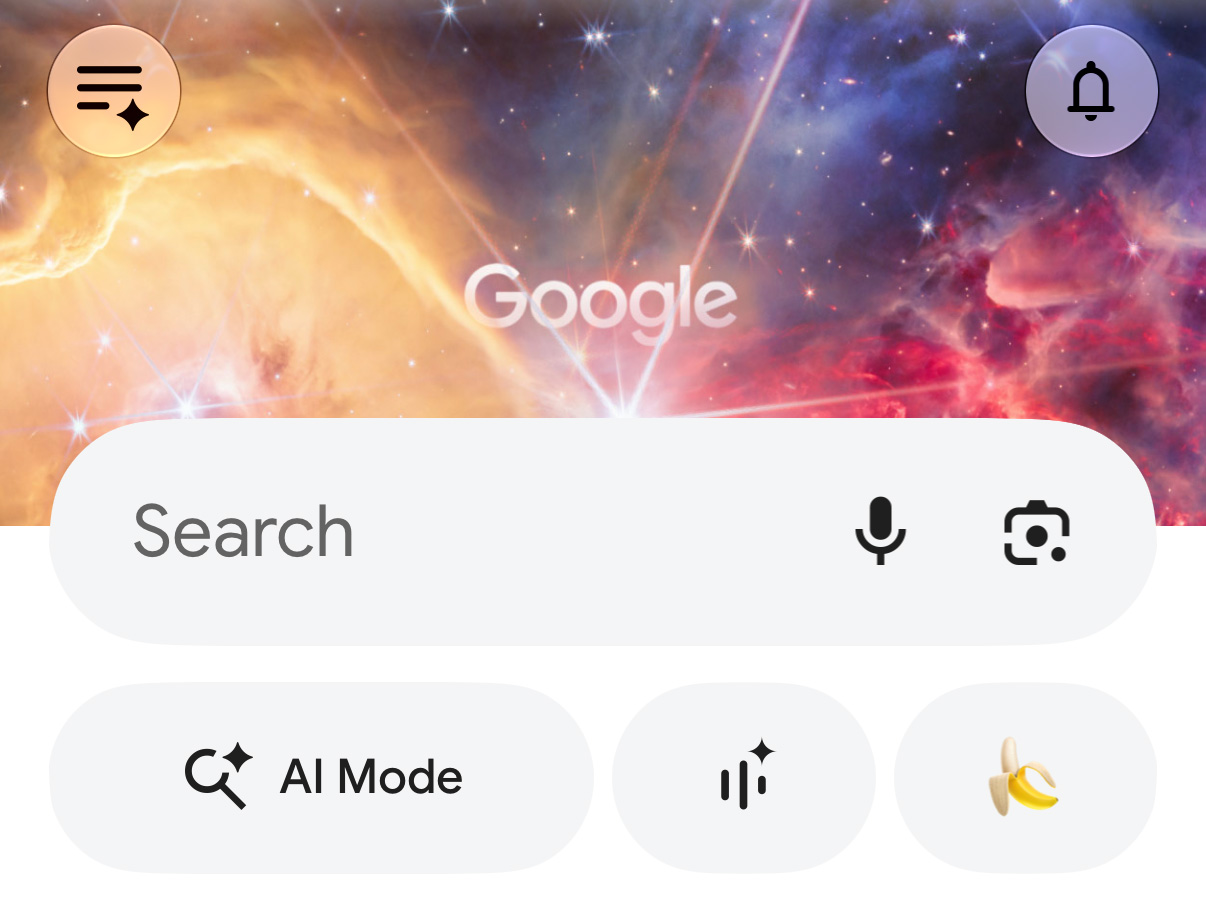
Google says the model "outperforms our previous models across the board", with gains in visual design, mask-based editing and keeping a subject consistent across edits. In the Google app, a banana icon under the search box opens it inside AI Mode. AI Overviews do not appear to use version 2.1 yet.
Why it matters: image creation now starts from the Google search box. Searches like "show me this sofa in a green room" can be answered with a generated picture instead of a product page.
Google Search profiles for creators and publishers expanded to India and Canada, with Brazil next
A Search profile is a page on Google that gathers a creator's social accounts, websites and posts in one place, shown in Search and Discover. Robby Stein, VP of Product for Google Search, called the country expansion one of the "most requested updates".
Why it matters: for creators and publishers in India, this is a free, Google-hosted page that ties your name to your work. Set it up so Google and its AI features connect the right content to you.
Google Analytics 1 story
Google Analytics added a User Groups Admin API for managing access to properties and accounts at scale
The API can create, edit and delete user groups, and add or remove users as Members or Owners. It needs User Admin or Org Admin permission on the organisation. It was the only GA4 release note this week.
Why it matters: agencies and large teams can now grant and remove analytics access by script, which makes offboarding a client or a staff member a one-step job.
Search Console 3 stories
Google started emailing site owners how many people chose their site as a "preferred source"
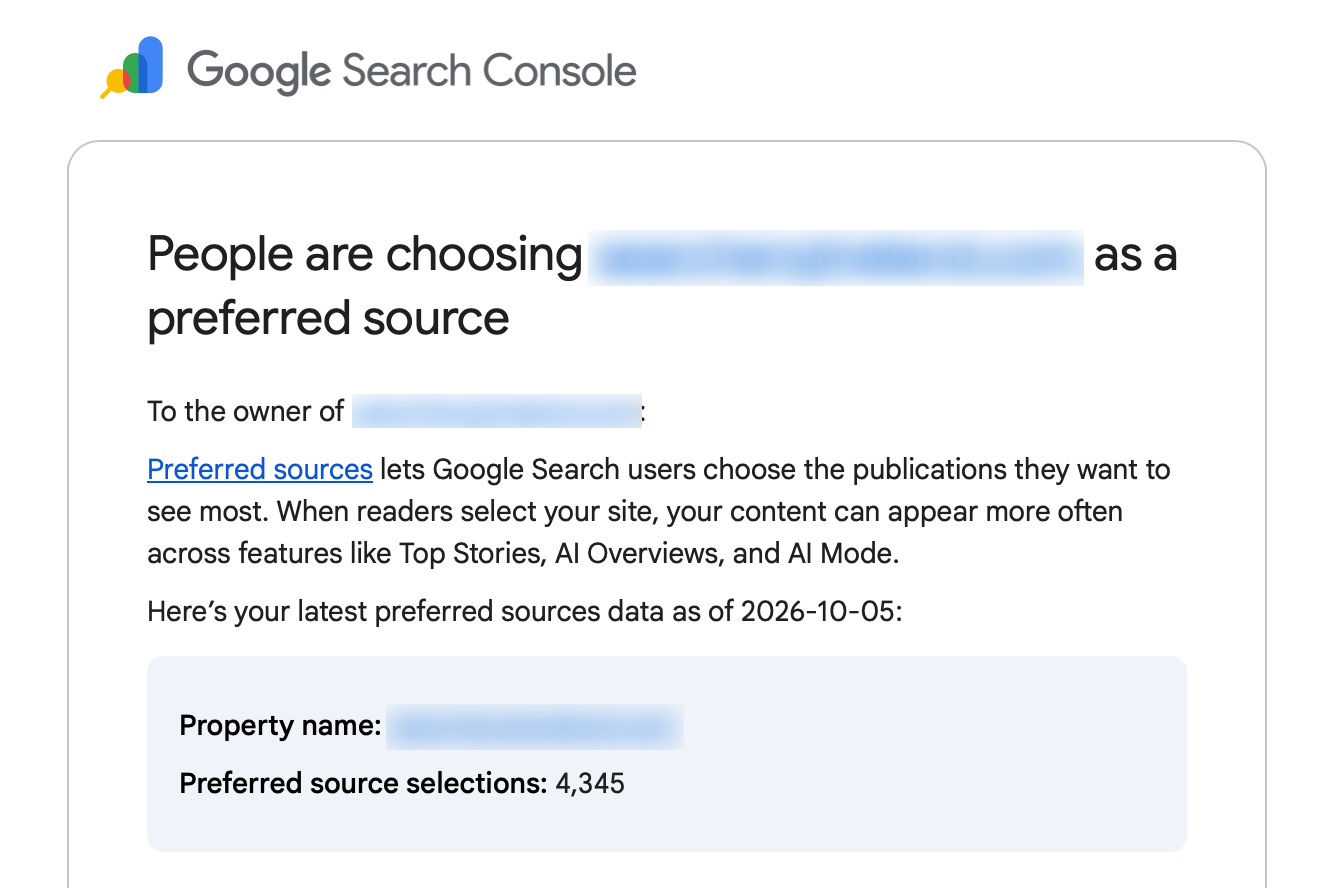
The email says sites readers choose "can appear more often across features like Top Stories, AI Overviews, and AI Mode", gives the count of preferred source selections as of 5 October, and recommends a new JavaScript button that lets readers add the site in fewer steps. It also links a survey about future preferred-source reporting.
Why it matters: Google says in writing that this choice affects AI Overviews and AI Mode. A news or blog site should add the button and fill in the survey.
Search Console's performance report now lets you select several countries at once and see their combined traffic
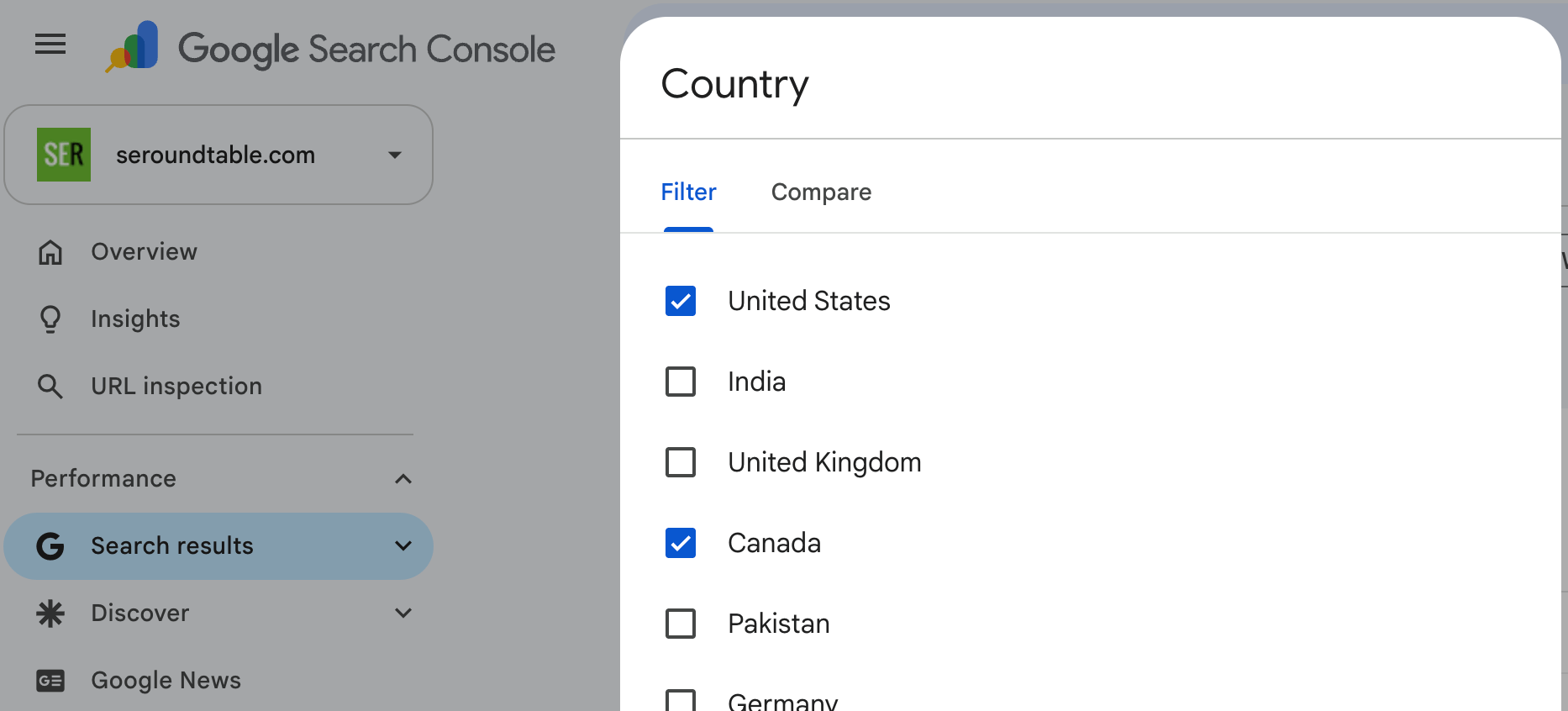
Previously the filter took one country at a time. Google also updated device filters in the same change. Separately, Google added a note that owners of a top-level domain property will be notified when a child property overrides the parent's Search generative AI control setting.
Why it matters: a business serving, say, India and the UAE can now see that market as one number, without exporting to a spreadsheet.
Search Console's performance data was running more than 64 hours late as this issue went out
This item is from the day after the window and is included because it affects how you read the spam update. The report normally updates within a few hours. The lag began in the days after the spam update ended. Google had not commented.
Why it matters: do not judge the spam update's impact on the last three days of Search Console data. Wait for the report to catch up, or use your own analytics.
Meta 2 stories
A TIME investigation found that Meta's Muse agent keeps hourly-updated profiles of its users and of the people they mention, including non-users

TIME analysed Muse's internal instructions. It reports the profiles map relationships, including how people met and "tensions and alliances" in a group, and that Muse has about 4 million users. A Meta spokesperson did not dispute the findings and said Muse "remembers what matters most to you". Meta says insights are de-identified before being used to improve the product.
Why it matters: businesses connecting Muse to customer email or Slack are also connecting their customers' names and conversations. Check what it can read before you link it. The Meta Muse guide covers the settings.
Meta published two posts defending its data-centre build-out as central to its AI plans
"Why Data Centers Are Such a Big Part of Meta's AI Approach" ran on 7 October and "Debunking the Biggest Data Center Myths" on 8 October, alongside Meta co-developing the Personal Agent Protocol. Meta also donated 1,000 AI glasses to Singapore's disability community.
Why it matters: Meta is arguing its case for local communities and investors at once. Expect more AI features in Instagram and WhatsApp to justify the spending.
WhatsApp 3 stories
WhatsApp has started blocking log-ins on some phones running outdated Android or iOS versions until the phone is updated
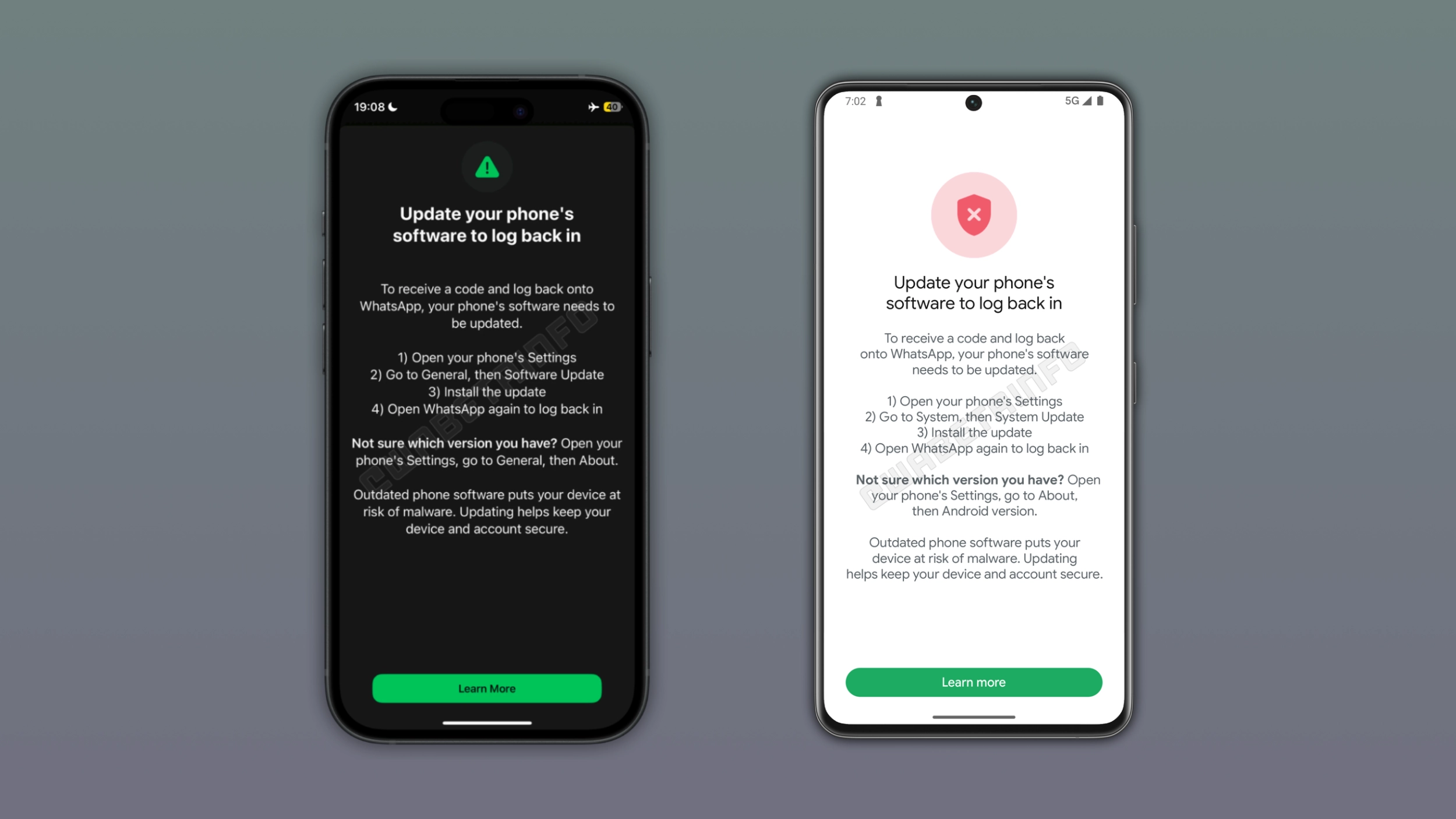
The check runs on WhatsApp's servers, so updating the WhatsApp app alone does not help. Affected users see a screen pointing them to their phone's software update settings, and for security reasons cannot skip it. WhatsApp has not said which OS versions trigger the block, and it is reaching selected accounts first.
Why it matters: businesses that run WhatsApp on an old shared phone could be locked out of customer chats. Update that phone now, or move to the WhatsApp Business Platform.
Google's local business panels now show a WhatsApp button beside call and directions
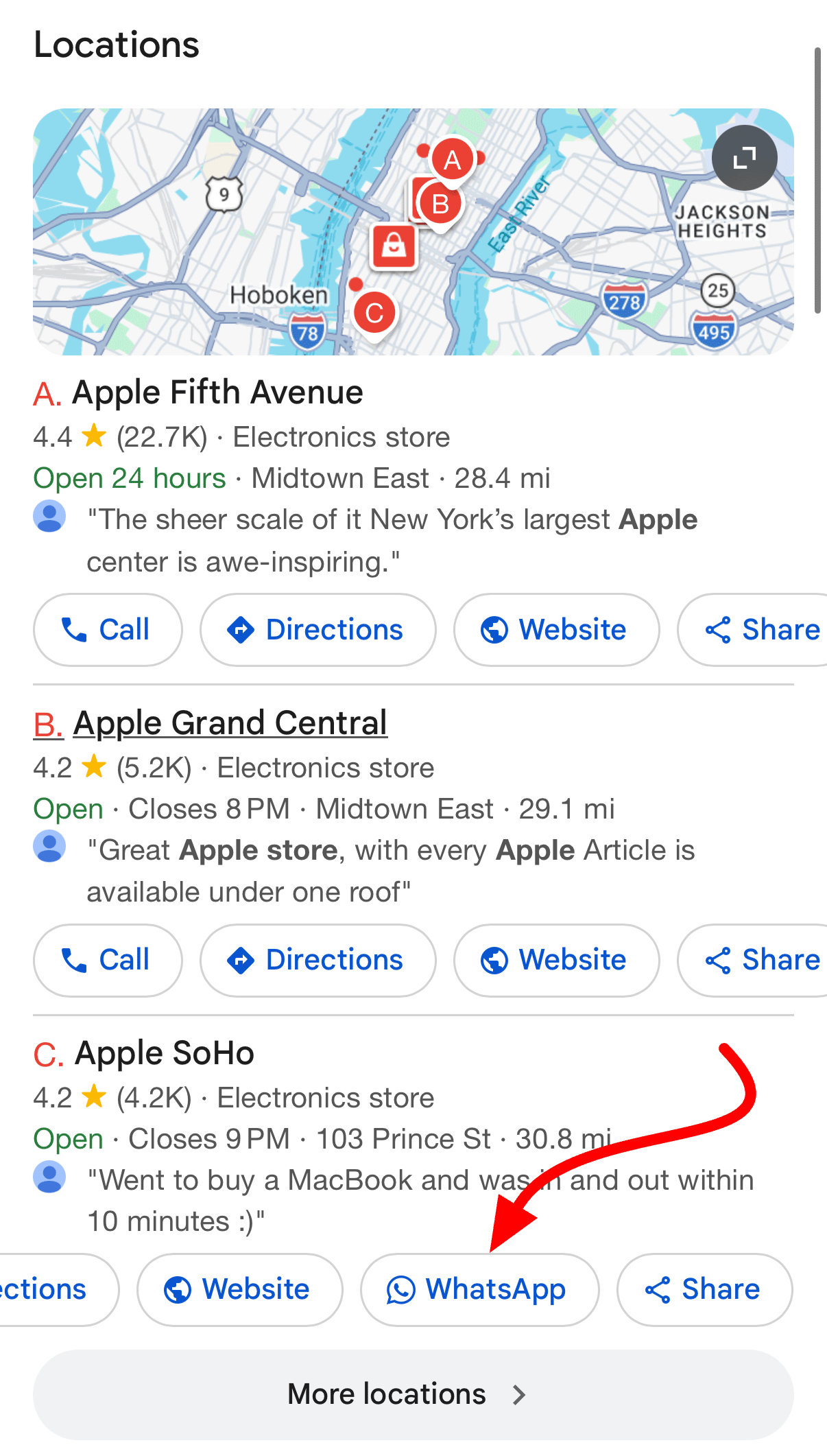
The button opens a WhatsApp chat with the business. Barry Schwartz could replicate it, which suggests a wide rollout. Google has asked businesses to add WhatsApp numbers to Business Profiles before and has sometimes added them itself.
Why it matters: in India and other WhatsApp-first markets, this may become the main way searchers contact a local business. Check the number on your Business Profile is one somebody answers.
WhatsApp is testing a Contacts tab on Android and a simpler Settings page on iOS
The Contacts tab groups all contacts, marks who is online with a green dot and shows birthday reminders. The iOS Settings test, in beta 26.40.10.21, moves secondary options to a separate menu. Both follow last week's report that Channels will move into the Chats tab and the Updates tab will go. None of these are available to most users yet.
Why it matters: WhatsApp is rearranging its tabs around people and chats. Brands relying on the Updates tab for Channel reach should watch where Channels land.
Claude 3 stories
Anthropic released Claude Haiku 5.5 at $0.10 per million input tokens and $0.50 per million output tokens, about 75% cheaper than Haiku 4.5
Those prices apply to prompts up to 100K tokens; longer prompts cost $0.50 / $2.50. Haiku 5.5 is the first Haiku with an effort setting, from low to max. Anthropic's tables show 72.4% on OSWorld 2.1 against 15.7% for Haiku 4.5 and 48.9% for GPT-6 Luna. It is available in Claude apps on every plan, in Claude Code, on AWS, Google Cloud and Microsoft, and as claude-haiku-5-5. Anthropic also halved Sonnet 5.5's cache-read price to $0.10.
Why it matters: the gap between the cheap model and the good model just narrowed sharply. Re-test any job you moved to a bigger model because Haiku 4.5 was not good enough. Anthropic still recommends Sonnet or Opus for complex coding. The Opus 5.5 guide covers the top of the range.
Anthropic updated its Usage Policy, banning sustained "abusive or cruel behavior" toward Claude and adding rules on influence campaigns and surveillance

The policy takes effect on 12 November. The abuse rule covers only extreme, repeated cruelty with no apparent purpose; frustration, dark fiction and model testing are excluded. A new section bans fake account networks, fabricated news sites and influence operations, for political and commercial deception alike. Tracking people without consent and using Claude to decide who to investigate or arrest are prohibited.
Why it matters: the commercial-deception rule covers fake review networks and fabricated "news" sites built for SEO. Agencies using Claude for content at scale should read that section.
Anthropic launched the Anthropic Cyber Mission to help defend critical infrastructure and open-source software, with 11 founding partners
The partners include Accenture, CrowdStrike, Deloitte, Palo Alto Networks and Rockwell Automation. An OSS Scanner service finds and proposes patches for flaws in widely used open-source code, with an expected true-positive rate above 90%. Two days earlier, Anthropic folded Project Glasswing into an expanded Cyber Verification Program, which gives vetted defenders its most capable models.
Why it matters: the website you run depends on open-source packages. Fixes from this program will arrive as ordinary updates, which only help if you apply them.
ChatGPT 1 story
ChatGPT now accepts audio file uploads on paid plans, returning transcripts and recaps and answering questions about the recording
Free accounts do not have it. The ChatGPT release notes could not be opened directly this week, so this is labelled Reported. The bigger ChatGPT change, GPT-6 with Intelligent UI, is covered at the top of the AI section, and the image-generation ads are in Marketing AI.
Why it matters: podcasts, sales calls and webinars can now go straight into ChatGPT. A transcript you publish on your own site is still the version search engines and AI tools can find and cite.
Gemini 2 stories
Google turned Gemini into a work agent that plans tasks, uses subagents and gets its own Workspace account and email address

Announced at Gemini at Work 2026, the agent connects to Workspace, Microsoft 365, Slack, Jira, BigQuery, Snowflake and any MCP (Model Context Protocol) server. Staff can tag it, email it or add it to a group chat, and its actions are logged under its own name. It picks a model per task, and users can choose Anthropic's Claude instead. Businesses get it first; consumers later. Sundar Pichai said Gemini has more than 1 billion monthly users. No price was given.
Why it matters: an agent with its own email address can be sent your newsletter, your sales emails and your support replies. Writing that a machine can act on is now part of business communication.
Google let Gemini Enterprise admins switch on Claude Opus 5.5 and Sonnet 5.5 inside its Antigravity developer tools
The models cover Antigravity 2.0, the Antigravity CLI and the IDE plugins. Third-party models are off by default, so an administrator has to enable them. On 6 October Google also gave admins control over Antigravity's multi-agent "Boost" feature, now generally available, and "Teamwork", in preview.
Why it matters: Google is selling its rival's model inside its own coding tools. For companies, the choice of AI model is becoming a setting, not a vendor decision.
Codex 0 stories
Codex's changes this week were developer plumbing, covered under AI Automations: GPT-6.1 Sol became the default model in Codex CLI 0.161.0 on 7 October, and 0.162.0 added managed Git worktrees on 8 October. I checked the Codex releases page; no new Codex product announcement came from OpenAI this week.
Claude Code 2 stories
Claude Code made Haiku 5.5 its default Haiku model and shipped seven releases in five days, versions 2.1.290 to 2.1.296
Version 2.1.293 on 7 October set claude-haiku-5-5 as the default Haiku model on the Anthropic API. Version 2.1.292 added an effort setting to the Agent tool and a --marketplace option for plugin installs. Version 2.1.290 added claude attach and claude logs for background sessions.
Why it matters: sub-tasks Claude Code hands to Haiku, such as searching files, now run on a much stronger small model at a lower price, with no change on your side.
Claude Code hooks can now "fail closed", blocking an action when the hook itself crashes or times out
Version 2.1.295 added onFailure: "block" for command and HTTP hooks. Version 2.1.294 fixed prompt and agent hooks that had been allowing actions they should have blocked, and 2.1.295 added a terminal status signal showing whether Claude Code is working, waiting or done.
Why it matters: a safety check that silently fails open is not a safety check. If you use hooks to stop risky commands, such as publishing or deleting, update and set them to block on failure.
Mobile AI 2 stories
Gemini in Chrome reached every Android user in India, and auto browse arrived for AI Pro and Ultra subscribers there
Gemini in Chrome summarises pages, answers questions about them and works with Keep and Calendar without switching tabs. Auto browse, on desktop and Android, handles tasks such as filling long forms or ordering groceries, and asks for confirmation before some sensitive steps. Both start in English only.
Why it matters: India is one of the largest Android markets, and an agent can now browse sites there on a user's behalf. Forms that confuse humans will confuse it too. The agent-ready guide lists what to fix first.
Apple announced a "Welcome home" event for 13 October
Apple's Greg Joswiak posted the date. Apple has not said what it will show. The tagline points to home devices, and AI Weekly separately reported that Apple is working on a home camera that saves text descriptions instead of video. That device is not confirmed.
Why it matters: an Apple home device with Siri at its centre would be another voice assistant answering local and shopping questions. Issue #6 will cover what Apple actually announces.
Other major releases 2 stories
Mistral opened a preview of Mistral Large 4, a model of about 1 trillion parameters, and said open weights will follow in October

Large 4 is a mixture-of-experts model available now only through Mistral's API and Studio. Coverage puts the total at about 1.05 trillion parameters; the active count is reported as 49 or 52 billion, depending on the source. It accepts text and images. All benchmark figures so far are Mistral's own, and the licence for the weights has not been published.
Why it matters: a frontier-sized open-weight model trained in Europe would give EU companies a model they can host themselves. Wait for the licence before planning around it.
Worldwide PC shipments fell 20.1% in Q3 2026 to 62.7 million, as AI data-centre demand kept component prices high
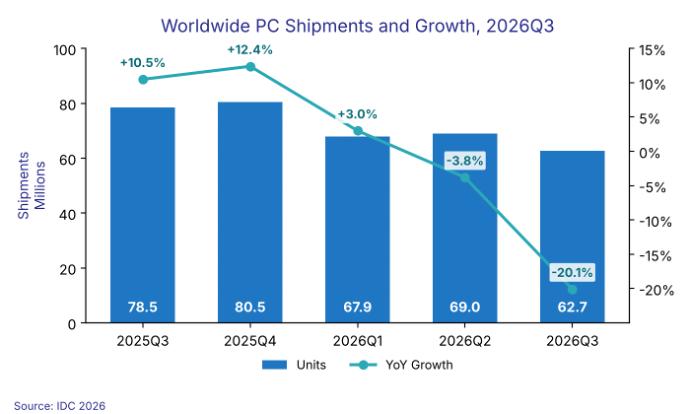
IDC blames stockpiling earlier in the year ahead of price rises, supply constraints, high prices tied to AI data-centre build-outs, and a weaker economy. Lenovo shipped 14.9 million (down 22.6%), HP 10.3 million (down 30.9%) and Dell 7.6 million (down 25.0%). Apple fell least among the top four, down 11.3%.
Why it matters: the AI boom is now visibly raising the price of ordinary computers. Budget for higher hardware costs into 2027.
Off the clock: gaming 2 stories
About 24 minutes of alleged GTA VI gameplay leaked online, according to dataminer Tex2; Rockstar has not commented
The leaker behind earlier clips returned after more than a month. VICE did not publish the footage and says it is real only "if real"; it could come from an older build. The release date stays 19 November on PS5 and Xbox Series X|S.
Why it matters: treat anything from this leak as unverified until Rockstar shows it. Everything we know about GTA VI keeps confirmed facts and leaks apart.
Google launched Playground, an experimental platform for making and sharing simple games from text prompts
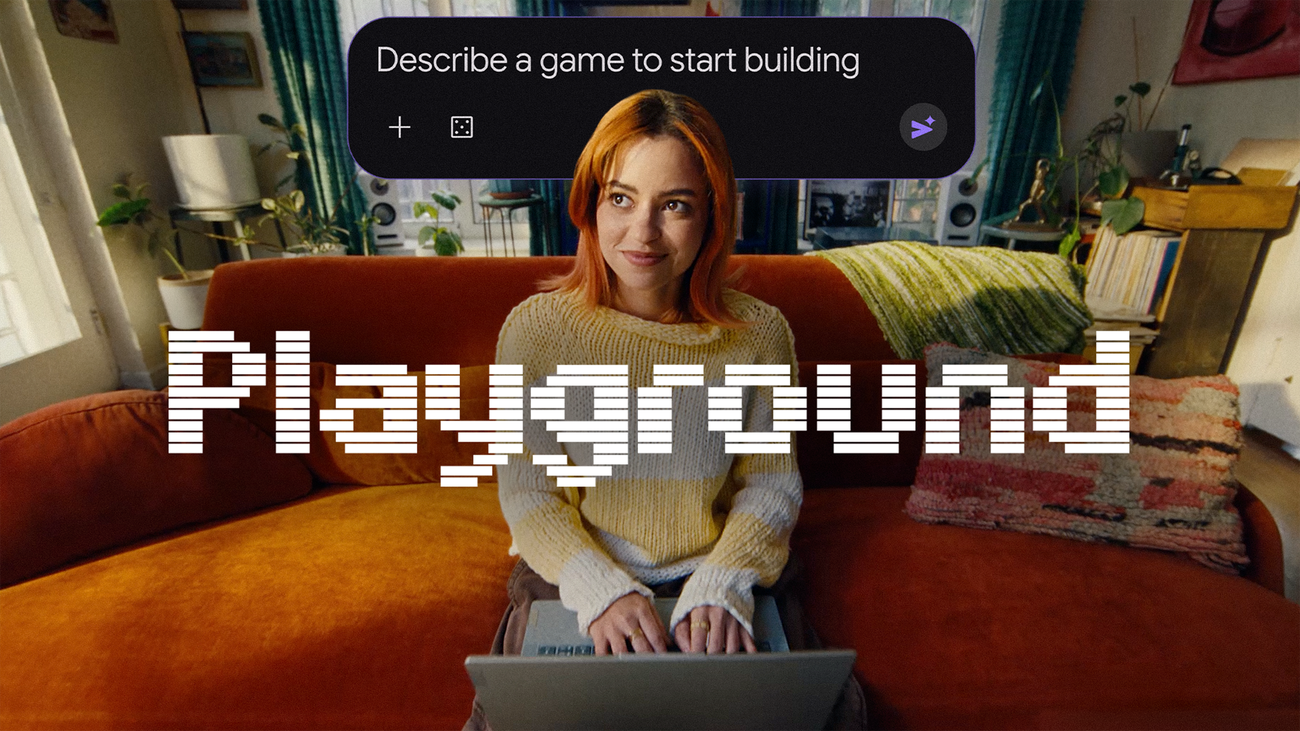
Playground lets people describe a game in plain words, play it and share it, with no coding. Google calls it experimental.
Why it matters: games made from a prompt are the same idea as ChatGPT's Intelligent UI: software built on demand instead of found on a website. Will GTA VII be built by AI? looks at where that leads.
- Check Search Console's Manual actions report. It takes a minute and rules out the worst cause of any drop.
- Compare traffic for 25–27 Sep, 30 Sep and 4–6 Oct against the week before 24 September, once Search Console's delayed data catches up.
- Audit your bylines. Every author should be a real person with a real profile. Remove invented personas and AI headshots.
- Add a review step to AI-assisted pages, and name the person who checked the facts.
- Turn Google Ads automated promotions on or off deliberately before 12 October.
- Re-test one high-volume AI job on Claude Haiku 5.5 and compare the cost with what you run today.
- Add Google's preferred source button if you publish news or a blog.
FAQ
What were the biggest AI and SEO news stories of 4–10 October 2026?
Five stood out. OpenAI rolled GPT-6 out to every ChatGPT user on 7–8 October with Intelligent UI, which answers with charts, calculators and buttons. Google's September 2026 spam update finished on 8 October after 13 days and 16 hours. Google updated its documentation to say AI content must be fact-checked by hand and that fake authors signal a low-quality page. Anthropic released Claude Haiku 5.5 on 7 October at $0.10 per million input tokens. Google turned Gemini into a work agent with its own email address on 8 October.
When did the Google September 2026 spam update finish?
Google marked the September 2026 spam update complete on 8 October 2026 at 4:37 am ET. It started on 24 September, so the rollout took 13 days and 16 hours, far longer than the year's earlier spam updates, which each took under three days. Ranking movement was reported in three waves: 25–27 September, 30 September and 4–6 October. Google has not said which spam policies it targeted.
What is ChatGPT's Intelligent UI?
Intelligent UI is a ChatGPT feature launched with GPT-6 on 7 October 2026 that lets answers include interactive elements, such as calculators, editable graphs, diagrams and tappable buttons, alongside text. It reached Plus, Pro, Business and Enterprise users on 7 October and Free and Go users from 8 October. Users can reduce the number of visuals in settings.
How much does Claude Haiku 5.5 cost?
Claude Haiku 5.5 costs $0.10 per million input tokens and $0.50 per million output tokens for prompts up to 100,000 tokens, and $0.50 and $2.50 for longer prompts. Anthropic says it is about 75% cheaper to run than Haiku 4.5 on average. It was released on 7 October 2026, and its API model ID is claude-haiku-5-5.
Does Google penalise AI-generated content?
Google's guidance does not ban AI-generated content, but since 1 October 2026 it says it is "critical" to fact-check and review all AI-generated content by hand before publishing, because models can hallucinate. Since 6 October it also says that fake author names, AI-generated headshots and false credentials are a form of deception and a signal of a low-quality page.
What is the Personal Agent Protocol?
The Personal Agent Protocol (PAP) is an open standard announced by Sierra and Meta on 6 October 2026 for how personal AI agents authenticate with businesses. It is built on OAuth: an agent can act as a guest, and a signed-in customer chooses whether it gets read-only or write access. Walmart, Shopify, Stripe, Genesys, Instinct and Rocket are partners. The v0.1 specification is due later in October 2026, and payments are planned for a later version.
When is the next issue of AI & SEO Weekly?
Issue #6 covers 11 to 17 October 2026. It will cover Apple's 13 October event, whether Mistral releases the Large 4 weights, the first Personal Agent Protocol specification, and how sites fared after the spam update once Search Console's data catches up. The RSS feed is at /blog/weekly/feed.xml.
- Primary sources checked this week: Anthropic News, Claude release notes, OpenAI News (the ChatGPT release notes returned 403 this week), The Keyword, Gemini release notes (no entries since 30 September), Gemini Enterprise release notes, Google Search Central, Search Status Dashboard, GA4 release notes, Meta Newsroom, Codex releases, Claude Code CHANGELOG, Wikimedia Foundation, IDC
- Trade and tech press: Search Engine Roundtable, Search Engine Land, TechCrunch AI, The Next Web, BleepingComputer, NPR, TIME, The Verge, The New Stack, 9to5Mac, WABetaInfo, VICE, We Are Roast
- Previous issues: AI & SEO Weekly #4 — 27 September to 3 October 2026 · AI & SEO Weekly #3 — 13 to 26 September 2026 · AI & SEO Weekly #2 — 6 to 12 September 2026 · AI & SEO Weekly #1 — 29 August to 5 September 2026