
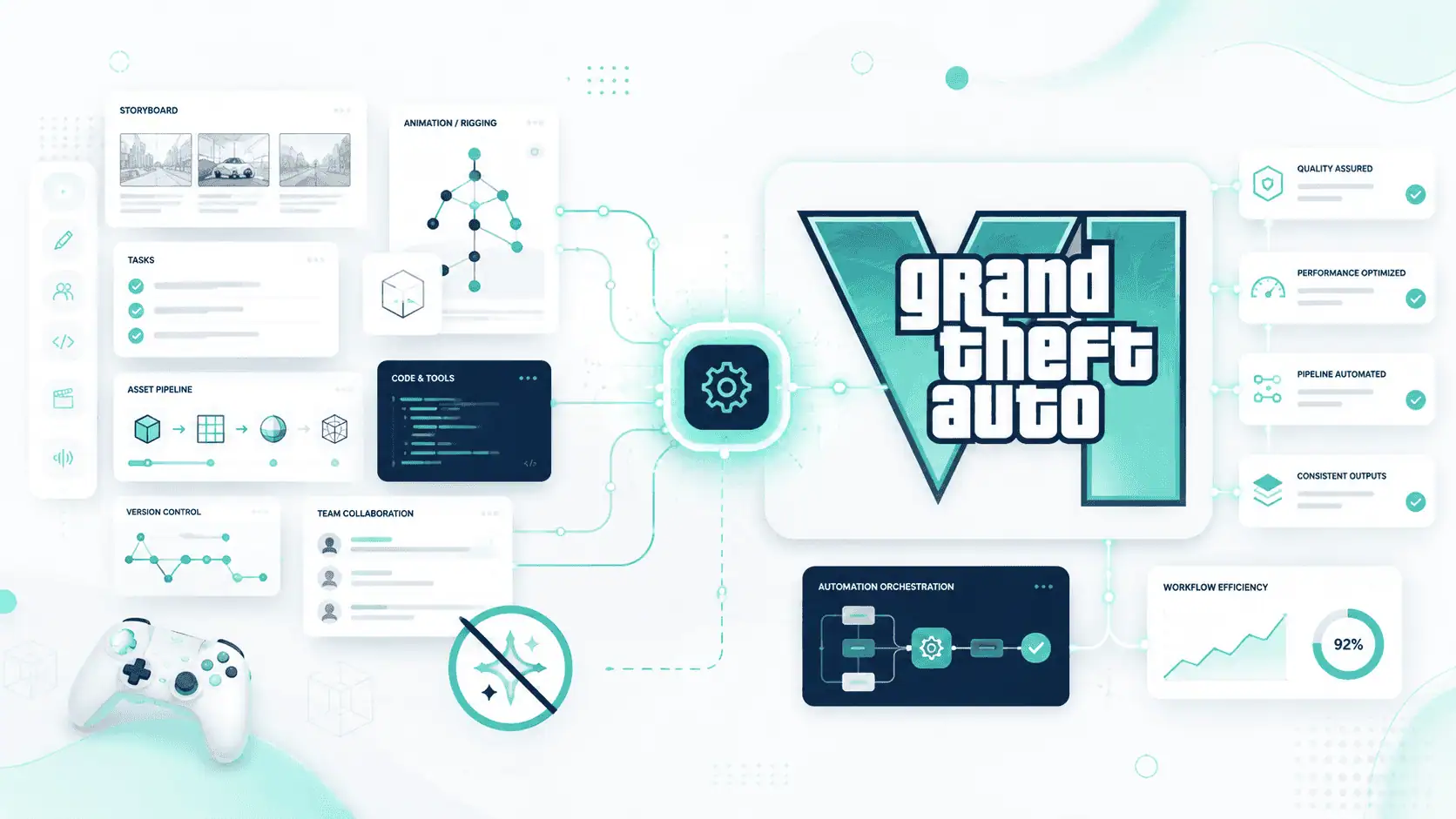


- Take-Two runs hundreds of internal AI pilots and put none of them in GTA VI's creative core.
- That's not a contradiction. It's a line drawn between production process and creative differentiation.
- The rule generalises: automate the process, not the advantage.
- Most businesses get this backwards — automating the judgement that differentiates them while doing the repetitive work by hand.
- The test is simple: if a competitor bought the same tool tomorrow, would you still be different?
The interesting thing about Take-Two's AI position isn't the headline everybody ran. "Generative AI has zero part in GTA VI" reads as a rejection. The full picture is stranger and much more useful: the same company describes hundreds of AI pilots running across the business, gives staff enterprise AI tools, and talks openly about driving cost and time efficiencies with them.
A company doing both at once has thought about where the line goes. Most companies haven't — which is why so much AI adoption produces activity without advantage.
1. What the position actually is
Two statements, from the same executive, that people quote separately:
"Generative AI has zero part in what Rockstar Games is building… Their worlds are handcrafted. That's what differentiates them."
Strauss Zelnick, Take-Two CEO, February 2026
And, in the same period, the company embracing generative AI with hundreds of pilots testing implementations across the business, including within its studios — with Zelnick adding: "Do I think tools by themselves create great entertainment properties? No, there's no evidence that's the case."
Note the exact wording of the first quote. He doesn't say generative AI is bad, or inaccurate, or too expensive. He says handcrafting is what differentiates them. The argument is competitive, not technical.
Rockstar's position isn't "AI is useless." It's closer to: AI can improve production, but it shouldn't replace the thing customers are actually buying. For GTA, customers are buying a specific human sensibility — the satire, the density of authored detail, the jokes on the billboards. Generate that and you have sold something else.
The full evidence for the AI claims, and the distinction between generative AI and the game AI GTA VI certainly does use, is in does GTA VI use AI? This article takes the position as given and asks what it means for everyone else.
2. Automate the process, not the advantage
Here is the framework in one question:
If your closest competitor bought the same AI tool tomorrow, would you still be different?
- Yes → that work is process. Automate it, aggressively.
- No → that work is advantage. Automating it converts your differentiation into a commodity anyone can buy.
The trap is that advantage work is usually the annoying, slow, judgement-heavy work — which is exactly what you most want to hand off. Meanwhile the genuinely automatable work is often invisible, because it's spread across ten people's Tuesday afternoons.
| Process work | Advantage work |
|---|---|
| Repetitive and rule-shaped | Judgement-shaped |
| Output is verifiable | Output is arguable |
| Errors are cheap and visible | Errors are expensive and delayed |
| Every competitor does it identically | Your version differs from theirs |
| Nobody buys from you because of it | People buy from you because of it |
There's a second-order reason to respect the line, beyond differentiation: automating advantage work destroys the feedback loop that produced the judgement. A strategist who stops reading raw data stops noticing anomalies. An editor who stops drafting loses their ear. The capability decays quietly, and you find out during the quarter when the tool's default answer is wrong.
3. How it looks in game development
Take Rockstar's own domain first, because the split is unusually clear.
| Automate — process | Protect — advantage |
|---|---|
| QA sweeps and automated exploration for geometry holes | World design and layout |
| Bug triage and classification | Story and characters |
| Code assistance and boilerplate | Art direction |
| Analytics and playtest telemetry | Creative judgement about what's fun |
| Asset organisation and tagging | Humour and satire |
| Localisation first drafts | Cultural specificity |
| Documentation and production scheduling | Which details earn a place in the world |
Nothing on the left changes what the game is. Everything on the right is what people queue up for. A studio that automated the left column entirely would ship faster with the same soul; one that automated the right would ship a competent, forgettable open world.
Note also that the left column is where the money actually leaks. Bug triage on a project this size is thousands of hours. That's the boring, enormous saving — and it's available without touching the thing customers pay for.
4. Applied to SEO
This is my own field, and the misallocation here is severe. The industry has largely automated the analysis and kept doing the data collection by hand — precisely backwards.
| Automate | Protect |
|---|---|
| Search Console data pulls and week-on-week deltas | Strategy and prioritisation |
| Scheduled reporting and anomaly alerts | Original research and testing |
| Keyword clustering and intent grouping at scale | Positioning and messaging |
| Rank, index and Core Web Vitals monitoring | Deciding what a page should argue |
| Crawl diffing and structured-data validation | Judging whether a fix is worth the sprint |
| Log-file parsing for crawler behaviour | Interpreting why traffic actually moved |
The tell that you've crossed the line: an "AI SEO strategy" that produces the same recommendations for every client. If the output doesn't change when the business changes, it isn't strategy — it's a template with a model attached, and your competitor has the same one.
The other reliable tell is content generated at volume to hit a publishing target. Google's own guidance names chasing scale over substance as ineffective, and an answer engine deciding whom to cite has no reason to prefer your synthesis of public knowledge over anyone else's. Original data is the one thing that can't be sourced from a competitor.
5. Applied to content
| Automate | Protect |
|---|---|
| Transcription of calls and interviews | Experience and first-hand accounts |
| Research organisation and source collection | Opinion and argument |
| Data extraction from documents | Original ideas and framing |
| Formatting, metadata, alt text drafts | Case studies and results |
| Repurposing into other formats | The voice people subscribed for |
A useful heuristic: automate everything up to the first sentence only you could write, and nothing after it. Research gathering, transcript cleanup, source formatting — all process. The argument, the thing you learned from a client that nobody else knows, the opinion you'd defend in a room — all advantage.
6. Applied to development
| Automate | Protect |
|---|---|
| Boilerplate and scaffolding | Architecture decisions |
| Test generation and coverage gaps | Security judgement |
| Debugging assistance and log analysis | UX thinking and interaction design |
| Dependency updates and migrations | Data model design |
| Documentation drafts | Deciding what not to build |
The pattern that holds here: automate the work with a fast, objective verification signal. Tests pass or fail. A build succeeds or breaks. Architecture has no such signal for eighteen months — which is exactly why it needs a human who will still be there when the consequences land.
7. Applied to marketing
| Automate | Protect |
|---|---|
| Lead routing and assignment | Strategy and channel choice |
| Reporting and dashboards | Messaging and positioning |
| Data enrichment and deduplication | Customer understanding |
| Monitoring, alerting and review responses triage | Brand voice |
| Campaign QA — links, tags, UTMs | Deciding what to say and to whom |
I've built a fair number of these — Apps Script and Gemini pipelines for reporting, Make.com and n8n flows for routing and enrichment. The consistent result is the same shape as Take-Two's: a recurring report drops from three hours a week to about ten minutes, and the hours freed go into the judgement work that was previously getting squeezed.
8. Four questions before you automate anything
- The competitor test. If a rival bought this tool tomorrow, would you still be different? If no, you're automating your moat.
- The verification test. Can you tell quickly and objectively whether the output is right? If not, you've automated the work of producing errors you'll find later.
- The decay test. If you stop doing this by hand for a year, does a capability you need atrophy? Judgement is maintained by practice.
- The failure test. When this breaks silently — and it will — what's the cost? Silent failure in reporting is an inconvenience. Silent failure in lead routing is lost revenue nobody notices for a quarter.
An automation that saves two hours a week and introduces one unmonitored failure point. Six months later it has been quietly wrong for five of them, and the cost of the wrongness exceeds every hour saved. Every automation needs a check that fires when it stops working — not when its output looks odd, but when it stops running at all.
Confirmed vs speculation
This article draws a business conclusion from a small number of factual claims. Here is exactly which is which.
| Claim | Status |
|---|---|
| Generative AI had "zero part" in GTA VI | Confirmed |
| Rockstar's worlds are handcrafted, not procedurally generated | Confirmed |
| Take-Two runs hundreds of internal AI pilots | Reported |
| Take-Two provides staff enterprise AI tools | Reported |
| "Automate the process, not the advantage" as Rockstar's stated policy | My framing — Zelnick described differentiation, not a framework |
| The four tests in section 8 | My analysis |
| Which specific tools Rockstar uses internally | Not announced |
9. Frequently asked questions
Did Rockstar really use no AI in GTA VI?
No generative AI, per Take-Two CEO Strauss Zelnick in February 2026. The game certainly uses traditional game AI — pathfinding, behaviour trees, traffic systems — which is a different technology. The distinction is covered in full in does GTA VI use AI?
Isn't refusing generative AI just going to make Rockstar slower than competitors?
Only if the competitors are competing on volume. Rockstar's release cadence has never been its selling point — GTA V to GTA VI is thirteen years. When your product is differentiated by craft rather than frequency, speed of production is not the axis you're competing on.
How do I tell process work from advantage work in my business?
Ask what customers would notice if it disappeared. Nobody chose you because of how your reports are compiled. People may well have chosen you because of how you interpret them.
Should I automate content production?
Automate everything around it — research gathering, transcription, formatting, repurposing. Protect the parts that carry your experience and opinion. Content that is a synthesis of publicly available knowledge competes against every other such synthesis, including ones a reader can generate themselves in seconds.
What's the highest-return automation for a small marketing team?
Usually reporting. It's recurring, rule-shaped, objectively verifiable, and it eats senior time that should be going into interpretation. It also has a low blast radius when it fails.
Does this mean AI tools aren't worth much?
The opposite — they're worth a lot, applied to the right half of the work. Take-Two isn't running hundreds of pilots for fun. The argument is about placement, not value.
The line worth stealing
A company whose entire product is craft has spent real money working out where AI belongs in its business. It landed on: everywhere in the process, nowhere in the differentiation.
That's a more sophisticated position than either of the loud ones — and unlike most AI takes, it comes with thirteen years of evidence about what the company thinks its advantage actually is.
If you want the forward-looking version of this question — whether the line holds when the technology gets substantially better — that's the piece on AI-generated open worlds.
Automate the process. Keep the part people actually buy.

I'm Jayant Solanki, an SEO, GEO and automation strategist. I build the reporting, routing and monitoring pipelines that give teams their hours back, and I'm equally clear about the work that shouldn't be handed to a model.
3 hours → 10 minutes on a recurring report · 100+ blog topics generated from real sales calls · 25% checkout drop-off found via GA4 funnel rebuild
Sources
Automate the process, not the advantage, is a framework for a studio — but it transfers directly to a career. Will AI take my job? applies it to the 2026 layoff data, which shows the losses concentrated in four specific kinds of work while India’s IT firms kept hiring graduates in tens of thousands.
- TechSpot, Take-Two CEO says the company is embracing generative AI, but promises it has "zero part" in GTA 6 (4 February 2026)
- The Next Web, GTA 6 uses zero generative AI, Take-Two CEO confirms — including the enterprise AI tooling and internal project count
- TechRadar, Take-Two is embracing generative AI as part of its efficiency goal
- Google Search Central, Optimizing your website for generative AI features — on scaled content and inauthentic signals
Jayant Solanki
AI-Ready SEO, GEO & AIO strategist based in Indore, India, working with eCommerce, local service and global brands across India, the UAE and the US. Builds Apps Script, Gemini, Make.com and n8n pipelines for reporting, content and lead routing.
More about Jayant →