
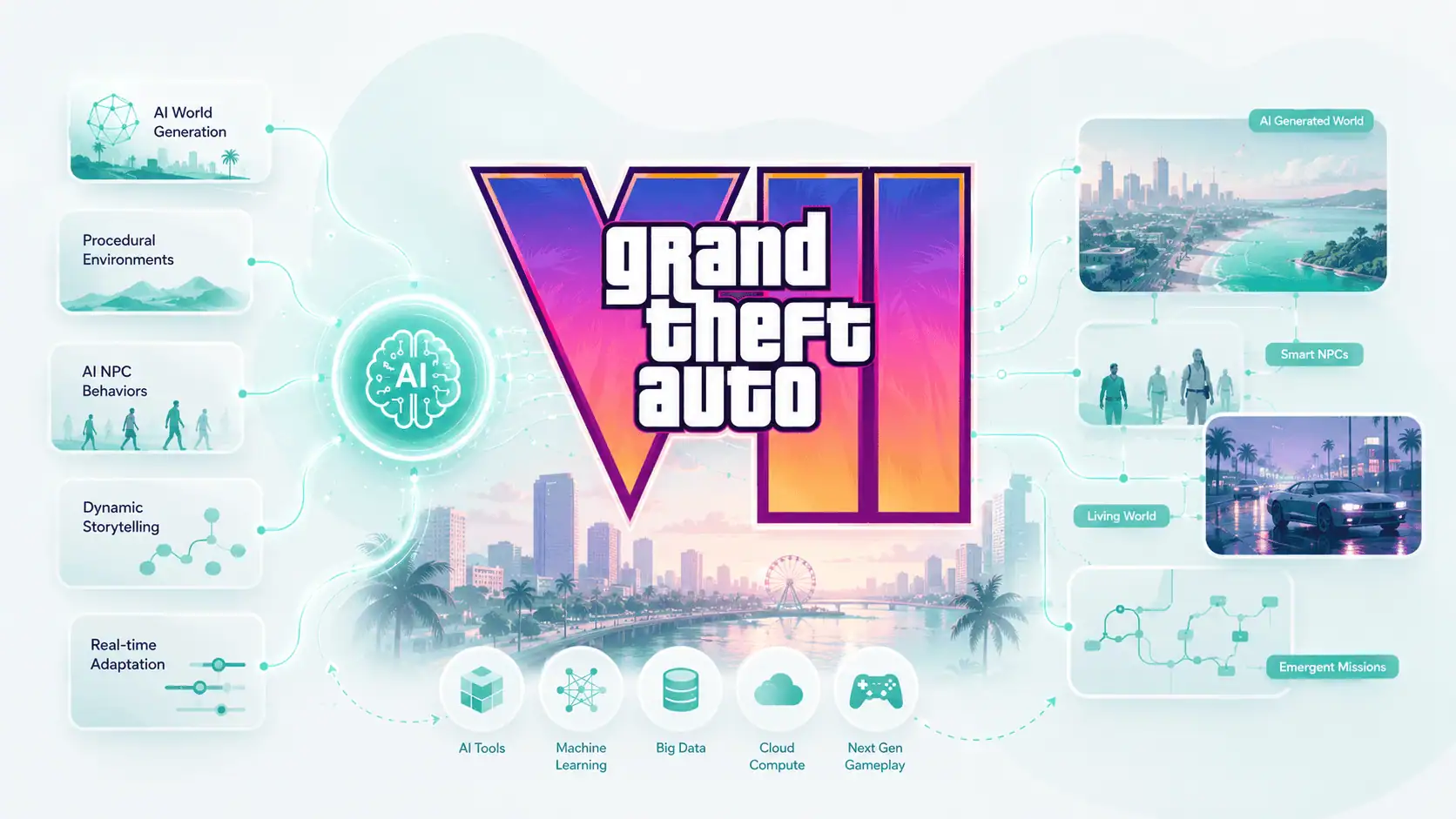


Confirmed On the record from a company that would know.
Speculation Everything about GTA VII, and every timeline in this article. Rockstar has announced nothing beyond GTA VI.
Start ten years ahead.
An NPC you robbed three weeks ago recognises you in a bar and reacts — not with a barked line from a pool of twelve, but with a specific reference to what happened. A side mission generates around the state of your world: the businesses you burned, the people you alienated, the part of the map you never visit. A designer types a description of a coastal town and gets a playable one back.
Every element of that is describable with technology that exists in some form today. None of it is close to shippable in a game like GTA, and the reasons why are considerably more interesting than the demos.
For what is actually confirmed about the game shipping in November, rather than the games that might follow it, start with the GTA VI complete guide.
Rockstar has announced nothing about GTA VII. No title, no development confirmation, no timeline. Every forward-looking statement in this article is analysis of technology trends, not reporting about a game. Take-Two has said generative AI had zero part in GTA VI — that's the only firm data point, and it's about the present. Speculation throughout
1. What "AI-built" would actually mean
"AI-generated game" collapses at least five separate capabilities that have almost nothing to do with each other:
| Capability | What it replaces | Maturity for AAA use |
|---|---|---|
| LLM dialogue | Written and recorded lines | Demonstrated, not shipped at scale |
| Agentic NPCs | Scripted behaviour | Research and indie experiments |
| Generated missions | Designed quests | Early |
| Voice synthesis | Voice actors | Technically capable, legally contested |
| Text-to-3D | Modelling and texturing | Usable for concepts, weak for final assets |
| World models | Level design | Impressive demos, unclear as a pipeline |
These have different economics, different failure modes and different legal exposure. A studio could adopt three and reject three. Treating them as one thing is why most "AI will make games" arguments go nowhere.
2. LLM-powered NPCs
The most-discussed and the most misunderstood. A properly generative NPC needs four things, and only the first is easy:
- Dialogue generation — a model producing in-character speech. Solved, in the narrow sense.
- Personality persistence — the same character sounding the same way an hour later, and next week. Hard, because prompts drift.
- Memory — recalling your prior interactions specifically, not vaguely. Hard, and expensive to store per player.
- World-state grounding — knowing what has actually happened in the game so it doesn't invent events. Hardest, and the one demos always skip.
That fourth item is the real barrier. An NPC that hallucinates a bank robbery you never committed hasn't added immersion — it has broken the contract that the world is consistent. And unlike a chatbot, a game cannot say "I may be wrong about that."
Per-player, per-NPC memory means writing and retrieving state for potentially thousands of characters across tens of millions of players. That is a database and a running cost attached to a one-time $79.99 purchase. The technology is not the blocker here. The business model is.
3. AI agents: NPCs with goals
This is the direction I find genuinely interesting, and it's a different idea from talking NPCs.
Today, an NPC executes a script:
NPC: follow predefined mission script
     → wait at marker
     → deliver line when player arrives
     → drive to next marker
An agentic NPC would instead pursue a goal:
NPC goal: earn $50,000 before the month ends
        ↓
Observe environment (what's available? who's around?)
        ↓
Plan (rob? deal? borrow? partner up?)
        ↓
Find allies — including, possibly, the player
        ↓
Act, and react to what the player does
        ↓
Modify plan when it fails
        ↓
Remember the outcome, and who helped or betrayed
        ↓
        └──────── loop ────────┘
That's an agent living inside Vice City — and it's the same architecture pattern now being built for the web, where agents observe, plan, act and remember against real sites. I've written about the web-facing version in the agent-readiness guide; the loop is identical, only the environment changes.
Why this is more promising than chat: goals and planning can run on cheap symbolic systems. Goal-oriented action planning has been in shipped games since F.E.A.R. in 2005. You don't need an LLM to give an NPC a goal — you need one only if you want the NPC to explain the goal in natural language. Split those, and most of the value arrives without most of the cost.
Why it's still hard: emergent systems are hostile to authored narrative. If an NPC can genuinely fail at their goal, your story has branches you didn't write. Most studios respond by constraining the agent until it's a scripted sequence again.
4. Generated missions and procedural narrative
Procedurally generated quests have existed for years, and they have a reputation problem earned honestly: they tend to be structurally identical with different nouns. Go here, kill that, return.
What generative systems could add is contextual specificity — a mission built around your actual history rather than a template. The interesting version isn't "generate a mission", it's "generate the reason for a mission, from a world state that already exists."
The unsolved part is quality control. A designed mission is playtested. A generated one is played for the first time by the customer. For a studio whose reputation rests on mission design, shipping an unplaytested experience is a strange trade — and the failure isn't a crash, it's tedium, which no automated test detects.
5. Voice, animation and text-to-3D
Voice synthesis
Technically the most mature item on the list and legally the most contested. Performer unions have negotiated specifically over synthetic replication, consent and compensation. The technology being ready is not the constraint; the rights framework is. Expect this to be settled by contract law rather than by capability.
Animation
Machine learning is already normal here — motion matching against large captured databases is standard in modern games, and learned motion models are an active research area. This is a case where "AI in games" is already true and uncontroversial, because it operates on captured human performance rather than replacing it.
Text-to-3D
Useful for concepting, weak for shipping. Generated meshes tend to arrive with topology no animator wants, UVs that don't unwrap cleanly, and geometry budgets nobody asked for. The realistic near-term use is a starting point an artist rebuilds, which saves less time than it appears to.
6. World models
The most spectacular demos and the biggest gap between demo and pipeline.
The promise looks like this:
Prompt: "A Florida-style coastal town with a marina,
         a nightlife district, and hurricane damage."
        ↓
Terrain
        ↓
Buildings and streets
        ↓
Road network and navigation
        ↓
NPC population and businesses
        ↓
Physics and collision
        ↓
Stories and conflicts
        ↓
Playable environment
Note what happens as you move down that stack. The top is geometry — plausible to generate. Halfway down you hit systems: navigation meshes that must be traversable, collision that must be watertight, businesses that must be enterable, an economy that must be coherent. By the bottom you're generating meaning, and meaning is what the player is buying.
There's also a market truth that gets lost in the excitement: a plausible town is not an interesting one. Vice City is not compelling because it resembles Miami. It's compelling because of a thousand specific authored choices about what to exaggerate. That is the exact thing Take-Two said differentiates Rockstar — and it was said in response to a world-generation demo. Confirmed
7. Could one person eventually build a GTA-sized world?
Probably, for some definition of "GTA-sized". Almost certainly not for "GTA-quality".
Scale and quality are different constraints. Generating a hundred square kilometres of plausible terrain and buildings is a compute problem, and compute problems tend to yield. Making a hundred square kilometres worth exploring is an authorship problem — thousands of decisions about what's funny, what's surprising, what rewards a detour.
Where I'd expect this to land is not "one person makes GTA" but a small team makes something that would previously have needed sixty people. That's the historically normal shape of a tools revolution: the floor rises, the ceiling stays where it is, and the number of viable studios goes up. Game engines did exactly this in the 2010s.
8. The problems nobody has solved
Any honest version of this article spends as long here as on the possibilities.
Rights and law
- Copyright. Training-data provenance remains contested. A studio shipping generated assets inherits whatever the courts eventually decide.
- Artist rights. Whose work trained the model that replaced the concept artist?
- Voice rights. Actively negotiated, not settled. Synthetic replication of a performer's voice is a labour dispute with real leverage behind it.
Economics and engineering
- Compute cost. Per-player inference against a one-time purchase price. Either the model runs locally — competing with rendering for hardware that is already fully committed — or it runs remotely, at a recurring cost per player.
- Latency. Conversation is real-time. Remote inference introduces a delay players read as broken.
- Offline play. A single-player game that requires a connection to talk to NPCs has changed what it is.
Quality and safety
- Moderation. A system that can say anything eventually says something quotable in a headline.
- Ratings. An ESRB or PEGI rating is granted against content the publisher can enumerate. Runtime generation is structurally hard to certify — I'd argue this is the single hardest obstacle to shipping generative dialogue in a mainstream retail game.
- Player safety. Open-ended systems in the hands of a large audience get pushed toward every boundary that exists.
- Consistency and hallucination. An NPC describing a mission that doesn't exist wastes the player's evening.
- Bugs. You cannot QA an infinite output space. Testing shifts from verification to sampling, which is a different discipline with weaker guarantees.
The creative risk
- Homogenisation. Models trained on existing games produce content resembling existing games. An industry that adopts them broadly converges on a shared average — the opposite of what makes any of these worlds worth visiting.
9. What I actually expect
My honest forecast, clearly labelled as forecast: Speculation
| Likely sooner | Likely much later, or never |
|---|---|
| ML in animation and rendering (already normal) | Fully generated worlds in AAA |
| Automated QA and testing at scale | LLM dialogue for named story characters |
| Localisation drafts with human editing | Generated main-story missions |
| Concepting and previsualisation | Synthetic voices replacing lead performers |
| Ambient NPC chatter with no narrative weight | Persistent per-player NPC memory at AAA scale |
| Agentic NPC behaviour without generated dialogue | One person building a GTA-quality world |
The pattern in the left column: production tooling, invisible to the player, verifiable output. The right column: things the player experiences directly, where a failure is a bad review rather than a slow sprint.
Which is exactly the line Take-Two drew for GTA VI — automate the process, not the advantage. The forward-looking question isn't whether AI enters game development. It already has. It's whether the line moves, and how far.
GTA VI may represent the end of an era — not because AI built it, but because future games may be created very differently. A thirteen-year, handcrafted, thousands-of-people production is a specific historical artefact. Whatever follows it will be made with tools that didn't exist when it started.
10. Frequently asked questions
Will GTA 7 be made with AI?
Nobody knows, and Rockstar has announced nothing about GTA VII — no title, no development confirmation, no timeline. What is on record is that Take-Two says generative AI had zero part in GTA VI while the company runs hundreds of internal AI pilots. Production tooling is already AI-assisted across the industry; creative output is where the line currently sits.
Are there games with AI-powered NPCs today?
Experiments and demos exist, mostly in smaller titles and research projects. No AAA open-world game has shipped LLM-generated dialogue for named characters at scale. The obstacles are latency, per-player cost, moderation and ratings certification rather than raw capability.
Could AI generate an entire open world?
It can generate plausible terrain and buildings. The harder layers are systems — traversable navigation, watertight collision, coherent economies — and above those, meaning. A plausible town is not an interesting one, and the interesting part is what players actually pay for.
Will AI replace game developers?
The historical pattern with tools revolutions is that the floor rises and the ceiling doesn't: smaller teams achieve what large ones used to, and more studios become viable. Roles shift toward direction and curation. That is disruptive to specific jobs without being an extinction event for the craft.
What is an AI agent in a game context?
An NPC that pursues a goal rather than executing a script — observing, planning, acting, adapting when the plan fails, and remembering outcomes. Goal-oriented planning has existed in shipped games since 2005; the new part would be an NPC able to explain itself in natural language.
Why don't studios just use AI voices?
Performer unions have negotiated specifically over synthetic voice replication, consent and compensation. The constraint is rights and labour relations, not audio quality.
What's the biggest single obstacle?
Probably ratings certification. A rating is granted against content a publisher can enumerate in advance. A system that can produce novel output at runtime is genuinely difficult to certify, and no rating means no retail shelf and no console storefront.
Is any of this confirmed?
No. Everything in this article about future games is analysis of technology trends. The only confirmed data point is Take-Two's statement that generative AI had no part in GTA VI's creative construction.
The agentic shift is already happening on the web

I'm Jayant Solanki, an SEO, GEO and automation strategist. I make sites ready for the agents already navigating websites, comparing products and checking out on customers' behalf.
Ranked #1 for "metal buildings" · +30% YoY organic traffic · Evidence-labelled research
Sources
- TechSpot, Take-Two CEO on generative AI having "zero part" in GTA 6 (4 February 2026)
- The Next Web, GTA 6 uses zero generative AI, Take-Two CEO confirms
- Notebookcheck, Take-Two stock falls after Project Genie generative AI tool debuts — context for the statement
- web.dev, Build agent-friendly websites — the same agent loop, applied to the web
Jayant Solanki
AI-Ready SEO, GEO & AIO strategist based in Indore, India. Part of a GTA VI cluster written to a stricter evidence standard than most games coverage — with forecasts labelled as forecasts.
More about Jayant →