


Confirmed Stated by Rockstar Games or Take-Two.
Observed Visible in the Extended Look or an official trailer.
Reported Credible press reporting of developer comments.
Speculation Technical inference — how systems like this are normally built, not what Rockstar has said.
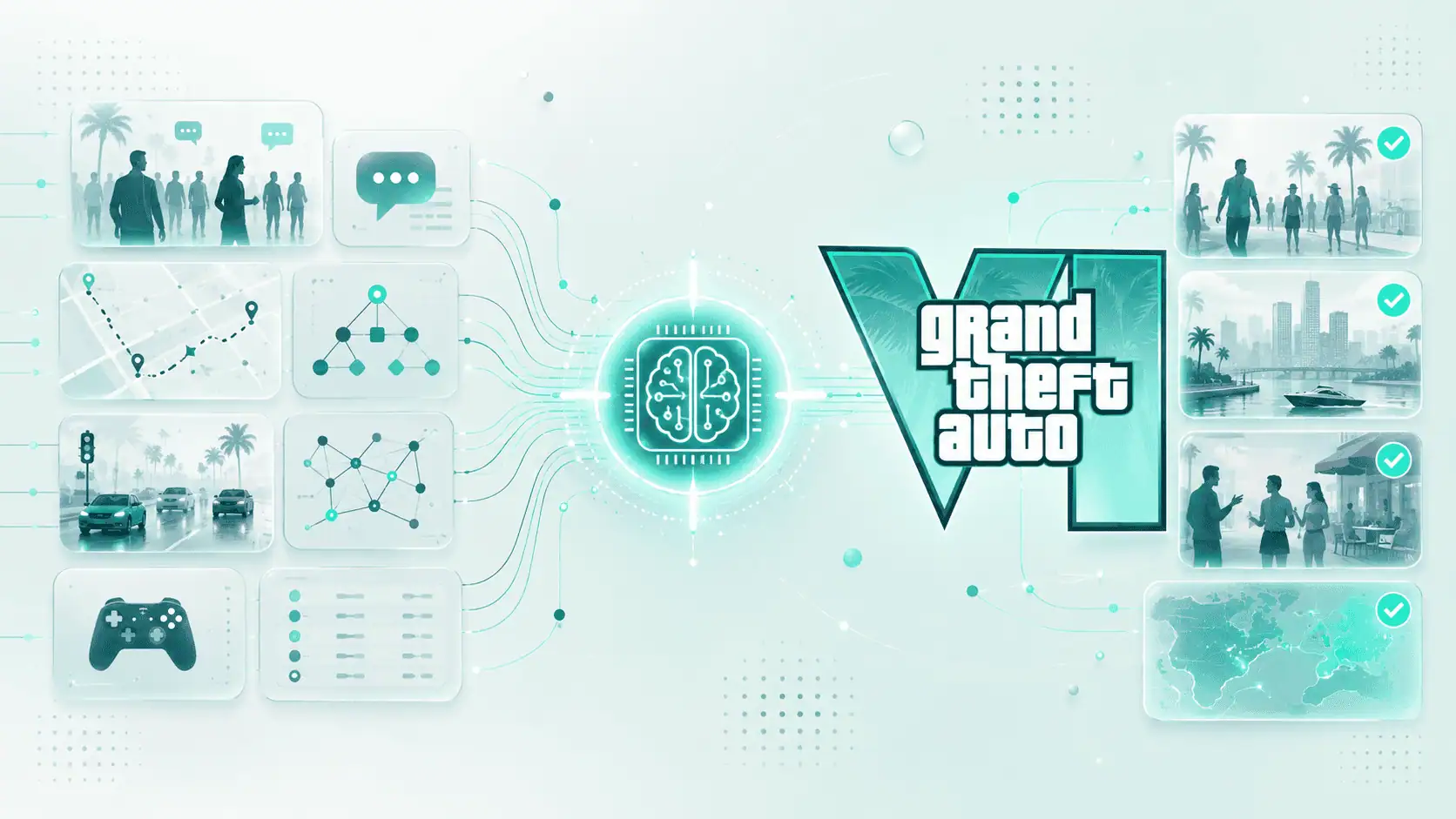
GTA VI doesn't need ChatGPT-powered NPCs to have dramatically smarter characters. That sentence is the whole article, and the rest is the evidence for it.
Almost everything that reads as intelligence in an open world — a pedestrian flinching at a gunshot, police coordinating a search, traffic parting for an ambulance — comes from techniques that have no neural network anywhere near them. They are decades old, they run on a fixed frame budget, and they are the reason a city can feel alive without a data centre behind it.
This piece breaks the systems down one at a time, marks what has actually been shown, and then does the thing most coverage skips: works out what a genuinely generative NPC would cost.
1. Why conventional AI reads as intelligence
Players infer intelligence from appropriate response to context. That's the whole trick. An NPC does not need to understand anything to appear to — it needs to do a fitting thing, quickly, in a situation the player recognises.
Which means the perceived intelligence of a city is mostly a function of three things:
- How many situations the system can distinguish — the granularity of its triggers.
- How many distinct responses exist for each situation.
- How well those responses are animated and voiced.
None of that requires generation. It requires an enormous amount of authored content and very careful engineering — which is exactly what Take-Two describes when it calls Rockstar's worlds handcrafted. Confirmed
Crowd density is high and NPC variety is visibly wide — the footage does not show the obvious clone-repetition that gives most open worlds away. Observed That is a content and streaming achievement rather than an AI one, and it does more for the feeling of a living city than any decision system.
2. NPC perception
Before an NPC can decide anything it must sense something. Perception systems in games are deliberately cheap approximations of senses:
- Sight — a vision cone with a range and an angle, plus a line-of-sight trace to check nothing blocks it. Add reaction delay so NPCs don't notice things instantly.
- Hearing — events broadcast to a radius. A gunshot has a large radius, a footstep a small one.
- Event awareness — a crash, a fire or a body registers as a world event that nearby NPCs can query.
- Threat assessment — is the perceived thing dangerous, and how dangerous relative to this NPC's disposition?
The perception pipeline looks like this:
Event occurs (gunshot, crash, player sprints past)
        ↓
Broadcast to NPCs within radius
        ↓
Each NPC filters: can I sense this? do I care?
        ↓
Threat and relevance scored
        ↓
Decision system invoked
What the footage shows: NPCs reacting to the player's proximity and to events around them, with varied rather than uniform responses. Observed
What it doesn't establish: the granularity of the model — whether NPCs distinguish a holstered from a drawn weapon, or remember a face. Those are plausible and unconfirmed. Speculation
3. Behaviour trees and decision-making
Once an NPC has sensed something, a decision structure picks the response. The dominant pattern in modern games is the behaviour tree — a hierarchy of conditions and actions, evaluated top-down, that produces an action every tick.
Hear gunshot
        ↓
Identify threat direction and distance
        ↓
┌────────────┬──────────────┬───────────────┐
│  Too close │  Mid-range   │   Far away    │
│    ↓       │      ↓       │       ↓       │
│  Cower /   │  Run to      │   Look toward │
│  freeze    │  cover       │   sound, walk │
│            │  ↓           │   away        │
│            │  Call police │               │
└────────────┴──────────────┴───────────────┘
        ↓
Reassess after N seconds — has the threat moved?
The reason behaviour trees dominate is not that they are clever. It is that they are debuggable. A designer can look at a tree, see why an NPC did something, and change one node. That property is worth more in production than sophistication — and it is precisely what a generative system gives up.
Related structures in the same family: finite state machines for simple entities, utility systems that score competing options, and goal-oriented action planning where an NPC searches for a sequence of actions that satisfies a goal.
Which does GTA VI use? Rockstar has not published its architecture. Not announced Any article telling you specifically is guessing.
4. Navigation and pathfinding
Deciding to run somewhere is worthless without the ability to get there. Navigation is usually the largest engineering investment in a game's AI stack.
The standard approach is a navigation mesh — a simplified polygon map of walkable space, generated from the world geometry. Pathfinding runs A* or a variant across it, then a steering layer smooths the result and handles local avoidance so characters don't walk through each other.
What makes it hard in a game like this:
- Scale. A state-sized map cannot hold one navmesh in memory; it has to stream in tiles as the player moves.
- Verticality. Stairs, balconies, rooftops and interiors multiply the connectivity problem.
- Dynamic obstacles. A crashed car has to invalidate paths in real time.
- Interiors. The Extended Look shows frequent interior spaces — apartments, clubs, stores — each needing its own navigable space stitched to the street. Observed
- Crowd density. Hundreds of agents avoiding each other without deadlocking is a genuinely hard problem.
5. Crowd simulation
Crowds are not many individuals simulated fully — that would be unaffordable. They are a level-of-detail system: agents near the player get full behaviour, mid-distance agents get simplified logic, distant agents may be little more than moving billboards.
Typical crowd machinery:
- Density zones — a beach at noon spawns different volumes and types than an industrial road at 4am.
- Archetype spawning — appearance, animation set and behaviour drawn from pools appropriate to the district.
- Flow fields — cheap directional guidance for large groups, instead of individual paths.
- Panic propagation — one NPC's alarm spreading outward through neighbours, which is what makes a crowd react as a crowd.
The Extended Look shows dense crowds in clubs, on streets and at the beach, with wide visual variety. Observed Whether individual crowd NPCs persist when you look away is not established — most games recycle them, and persistence is expensive. Speculation
6. Police AI
The wanted system is the most scrutinised AI in any GTA, because it is the system players interact with most adversarially. It's worth breaking into stages.
Identification
Something must decide a crime occurred and that you did it. That means witnesses, line-of-sight to an officer, or proximity to a reporting NPC. The design question is how forgiving detection is — whether masks, vehicle changes or distance break the association.
Escalation
The star system is a difficulty ladder, changing how many units respond, what they're armed with, and how aggressively they pursue. The Extended Look shows the meter reaching four stars. Observed The maximum has not been confirmed, and claims of a specific ceiling are speculation. Speculation
Pursuit
Pursuit AI is a driving problem before it is a combat problem: police vehicles need to path aggressively, cut corners, ram, and coordinate so they don't collide with each other. Helicopter pursuit appears in the footage. Observed
Search
The most interesting phase, and the one that most changes how a wanted level feels. When police lose you, do they converge on your last known position and expand outward? Do they check nearby buildings? A good search phase creates the tension of hiding; a bad one either finds you instantly or forgets you immediately.
Contact lost
        ↓
Record last known position + heading
        ↓
Units converge, then expand search radius over time
        ↓
Check likely concealment: alleys, interiors, vehicles
        ↓
Re-acquire → pursuit    |    Timeout → de-escalate
What's confirmed about GTA VI's search behaviour: nothing specific. The footage shows police storming buildings during a job, which implies coordinated entry behaviour. Observed Everything about search radii and memory duration is inference. Speculation
Coordination and communication
Whether units share a common knowledge model — one officer's sighting updating everyone — determines whether police feel like a force or like individuals. Shared blackboards are the standard implementation. Not confirmed for GTA VI. Speculation
7. Traffic AI
Traffic is a simulation problem with a hard constraint: it has to look plausible while costing almost nothing, because there is always a lot of it.
The usual approach is spline-following — vehicles track lane paths rather than driving freely — with layers on top for car-following distance, junction negotiation, lane changes, and reactions to the player. Emergency vehicles get priority behaviour, and other cars are meant to yield.
The Extended Look shows traffic that reacts to the player and to collisions. Observed Whether individual vehicles have destinations and persistent routes, or are spawned and despawned around the player, is not established — the latter is far more common. Speculation
8. Wildlife AI
Mount Kalaga National Park is officially described with hunting, fishing and wildlife including deer. Confirmed Wildlife AI is usually simpler than human AI — wander, flee, flock, occasionally hunt — but it does something disproportionate for a world's texture, because animals reacting to you at distance implies a world that exists without you.
Red Dead Redemption 2 set a high bar here within Rockstar's own catalogue. Whether GTA VI's ecology approaches it is unknown. Speculation
9. NPC routines and schedules
Here's the question people actually mean when they ask if NPCs are "smart": do they have lives?
Technically, a schedule system assigns NPCs a daily pattern — home, commute, work, leisure — driven by a world clock. The expensive part isn't the schedule; it's persistence. Remembering that a specific NPC exists, where they are and what they were doing, while the player is thirty kilometres away, costs memory and simulation budget for something the player may never observe.
Most open worlds solve this by faking it: NPCs are recycled, schedules are statistical rather than individual, and a district behaves correctly for the time of day without any specific person being tracked.
| Behaviour | Status for GTA VI |
|---|---|
| NPCs vary by district and time of day | Observed — nightlife, beaches and streets differ |
| NPCs react to weather | Speculation |
| NPCs interact with each other | Observed in crowd and club scenes |
| Named NPCs with persistent daily routines | Not announced |
| NPCs remembering the player between encounters | Not announced |
10. The constraint that shapes everything: the frame budget
Every system above competes for the same 33 milliseconds. At 30fps — which is what GTA VI runs at on a retail PS5 Reported — that is the entire time available to simulate the world, animate it, and draw it.
Roughly how that time gets contested:
| Consumer | Why it is expensive |
|---|---|
| Rendering | Geometry, lighting, reflections, post-processing — usually the largest single claim |
| Physics | Vehicles, ragdolls, destruction, water |
| Animation | Blending and pose evaluation for every visible character |
| Streaming | Loading world tiles, textures and navmesh ahead of the player |
| Audio | Spatialisation, occlusion, radio and dialogue mixing |
| AI | Whatever is left |
This is why level of detail is the central idea in open-world AI. Not every NPC can think every frame, so systems time-slice: full behaviour evaluation for characters near the player, reduced ticks further out, and simple animation-only presence at distance. A crowd of two hundred might contain fifteen genuinely simulated agents.
Two consequences follow, and both explain things players notice:
- Behaviour changes with distance. The pedestrian who reacted intelligently when you were close by may be a much simpler entity once you drive away.
- Persistence is expensive. Remembering that a specific NPC exists while you are on the other side of the map costs memory and simulation for something you may never observe — which is why most open worlds recycle rather than persist.
If the frame budget is already fully committed at 30fps, there is no headroom for running a language model locally. That is not an opinion about generative AI — it is arithmetic. Any generative NPC system would have to run remotely, which brings latency and an internet requirement into a single-player game.
11. What a generative NPC would actually look like
Now the comparison. A truly generative NPC — the thing people imagine when they say "ChatGPT NPCs" — would need a pipeline like this:
Player speaks (or selects intent)
        ↓
Speech recognition
        ↓
Retrieve character memory  ←──┐
        ↓                     │
Retrieve world state          │
        ↓                     │
LLM reasoning + persona prompt│
        ↓                     │
Generated dialogue            │
        ↓                     │
Voice synthesis               │
        ↓                     │
Animation + lip sync          │
        ↓                     │
Memory updated ───────────────┘
Every stage in that diagram is a solved problem in isolation. The difficulty is running the whole chain in under a second, on a console, for one of hundreds of NPCs, without producing anything that breaks the story or the age rating.
To be explicit: nothing resembling this has been confirmed, shown or claimed for GTA VI. Not confirmed Take-Two's position points firmly the other way.
12. Would ChatGPT-style NPCs actually improve GTA?
This is the interesting question, and the answer is less obvious than either camp claims.
The case for
- Genuinely unique conversations. No repeated barks, no hearing the same line for the fortieth time.
- Memory. An NPC who references what you did last week creates a relationship no scripted system can.
- Dynamic missions. Objectives generated around the actual state of your world rather than a fixed list.
- Player expression. Talking your way out of something, in your own words, is a verb games have never really had.
The case against
- Latency. Conversation is a real-time act. A second of delay before every reply is a worse experience than a repeated line, and offline play breaks entirely if inference is remote.
- Cost. Inference per conversation, multiplied by tens of millions of players, against a one-time purchase price. The economics are brutal for a $79.99 game with no subscription.
- Moderation. A system that can say anything will eventually say something that ends up in a headline. In a game already under political scrutiny, that is an unforced risk.
- Ratings compliance. An ESRB rating is granted against enumerable content. Runtime generation is genuinely hard to certify — arguably the hardest structural obstacle of all.
- Story consistency. Rockstar's writing is authored to the line. An NPC improvising can contradict the plot, spoil a reveal, or simply be less funny.
- Hallucination. An NPC confidently describing a mission that doesn't exist sends the player somewhere nothing happens.
- Voice rights. Synthesising a performer's voice at runtime is a live labour dispute, not a technical detail.
- Quality floor. A great authored line beats a good generated one. Generation raises the average and lowers the ceiling — and people remember the ceiling.
The strongest argument against LLM NPCs in a game like this isn't technical, it's editorial. GTA's dialogue is satire — timing-dependent, culturally specific, frequently cruel in a precisely aimed way. That is the hardest thing for a generative system to do well, and it happens to be the exact thing the series is bought for. Rockstar rejecting generative AI for the creative layer while using AI throughout production is a coherent position, not a Luddite one.
For the longer-range version of this question — what would have to be true for agentic, remembering NPCs to actually ship — see the future of AI-generated open worlds.
Where I'd expect generative systems to land first is the boring, valuable middle: ambient chatter with no narrative weight, background radio filler, or localisation drafts a human then edits. Nothing confirmed anywhere — but that's where the risk-to-reward actually works. Speculation
Confirmed vs speculation
Rockstar has published essentially nothing about its AI architecture. That makes labelling more important here than on any other page in this cluster.
| Claim | Status |
|---|---|
| Dense crowds with wide visual variety | Observed |
| Wanted meter reaching four stars | Observed |
| Police storming buildings, helicopter pursuit | Observed |
| Mid-mission protagonist switching | Observed |
| Wildlife in Mount Kalaga National Park | Confirmed |
| 30fps on PS5 at launch | Reported |
| Six-star wanted ceiling | Speculation |
| Behaviour trees as the decision architecture | Industry norm, not stated |
| Police search radii and memory duration | Speculation |
| NPC persistence when out of view | Speculation |
| Traffic with persistent destinations | Speculation |
| LLM-driven NPC dialogue | Not confirmed |
| NPCs remembering the player between encounters | Not announced |
13. Frequently asked questions
Do GTA 6 NPCs use AI?
They use traditional game AI — perception, behaviour trees, navigation and crowd systems. There is no confirmed evidence of a language model generating NPC dialogue, and Take-Two has stated generative AI had no part in the game.
Will GTA 6 NPCs remember me?
Not announced. Persistent per-NPC memory of the player is expensive and rare in open-world games. Nothing shown or stated establishes it for GTA VI.
How many stars is the GTA 6 wanted level?
The Extended Look shows the meter reaching four stars. The maximum has not been confirmed by Rockstar, so any specific ceiling you see quoted is speculation.
Will GTA 6 police be smarter?
The footage shows coordinated behaviour including building entries and helicopter pursuit. Whether search, memory and coordination are deeper than GTA V's is not established — those are exactly the systems footage can't demonstrate.
What is a behaviour tree?
A hierarchy of conditions and actions evaluated each tick to choose an NPC's next action. It is the dominant decision structure in modern games because it is debuggable — a designer can see exactly why an NPC did something and change one node.
Could Rockstar patch in AI NPCs later?
Technically conceivable, practically unlikely for the reasons in section 12 — latency, per-player inference cost, moderation and ratings certification. Nothing has been announced.
Are GTA 6's crowds real individuals?
Crowds in open-world games are level-of-detail systems: full behaviour near the player, simplified further out. The Extended Look shows dense crowds with wide visual variety, which is a content and streaming achievement more than an AI one.
Does better AI need better hardware?
AI competes for CPU with physics, animation and streaming. GTA VI runs at 30fps on a retail PS5, which suggests the budget is fully committed — one practical reason runtime generative systems are difficult on current consoles.
I write about AI systems the way this article writes about NPCs

I'm Jayant Solanki, an SEO, GEO and automation strategist. Most of my work is separating what a system actually does from what it's assumed to do, then building around the real mechanism.
Ranked #1 for "metal buildings" · +30% YoY organic traffic · Evidence-labelled research
Sources
- Rockstar Games, Grand Theft Auto VI official site — location descriptions including Mount Kalaga wildlife
- GamesRadar+, An Extended Look: 26 minutes, captured on a PS5
- VG Times, GTA 6 An Extended Look breakdown — used for observed gameplay detail
- GamesRadar+, GTA 6 at 30fps across PS5 and Xbox Series X
- TechSpot, Take-Two CEO on generative AI having "zero part" in GTA 6
Jayant Solanki
AI-Ready SEO, GEO & AIO strategist based in Indore, India. Part of a GTA VI cluster written to a stricter evidence standard than most games coverage — every claim labelled Confirmed, Observed, Reported or Speculation.
More about Jayant →