
Confirmed Stated by Anthropic or OpenAI in their announcements or API documentation.
Observed Measured by an independent third party (Artificial Analysis, CodeRabbit) or visible in public data.
Reported Press, customer or community claims that nobody has independently checked.
Speculation Analysis, calculation or inference by the author.
- Opus 5.5 is smarter: 58 against 48 on the Artificial Analysis Intelligence Index. Observed
- GPT-6 Sol is cheaper: $2 / $10 per million tokens against $4 / $20. That's exactly half. Confirmed
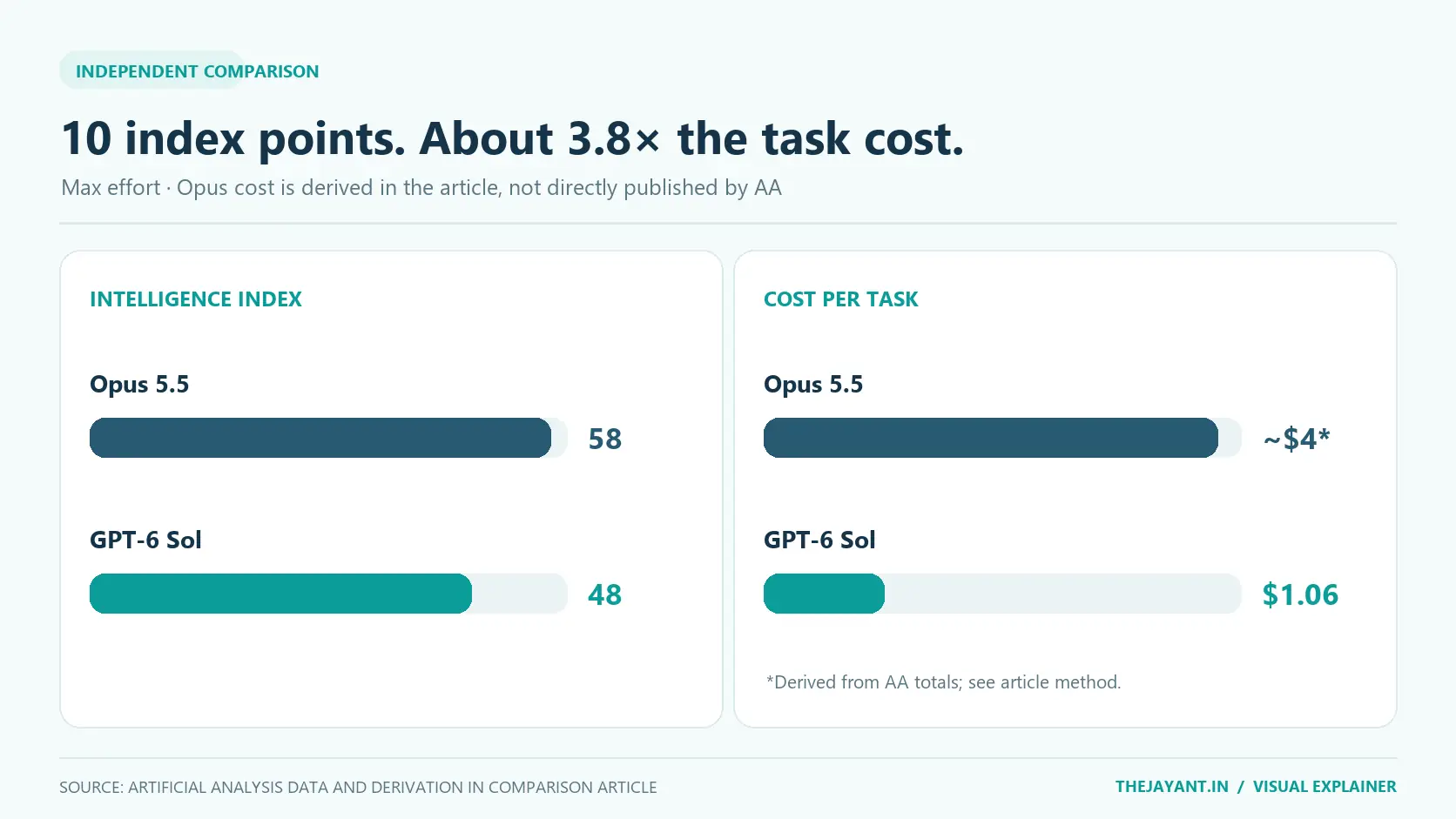
- Per finished task, Sol is roughly 3.8× cheaper on that index: about $1.06 against about $4. Calculated from AA data
- Cache reads cost the same: $0.20 per million on both. For agents with big reused prompts, the gap narrows. Confirmed
- Very long prompts cost about the same: Sol doubles its input price above 272K tokens, while Opus 5.5 bills its full 1M context at standard rates. Confirmed
- On the one benchmark both vendors report comparably, AutomationBench, Opus 5.5 scores 40.0% and Sol at
xhigh33.2%. Cross-vendor reading - Sol hallucinates much less than it used to (60% on AA-Omniscience, down from 92%). Opus 5.5 leads on reasoning, science and long agentic jobs. Observed
- Opus 5.5 has the newer knowledge (June 2026 against April 2026) and the wider cloud availability. Sol has no migration pain. Confirmed
- Pick Opus 5.5 for long-running coding agents, hard knowledge work and anything where a wrong answer is expensive.
- Pick GPT-6 Sol for high-volume agent turns, cost-capped products and factual Q&A. Better still, route between them (section 8).
On 22 September 2026, Anthropic released Claude Opus 5.5. About ninety minutes later, OpenAI released GPT-6 Sol and its smaller sibling GPT-6 Luna. Both launches promised more intelligence for less money. Neither launch compared against the other, because neither model existed publicly when the charts were drawn.
This page does that comparison. It draws on the two full breakdowns on this site, Claude Opus 5.5 and GPT-6 Sol and Luna, and puts the two models side by side on the things that decide which one to pay for.
1. Same day, two different bets
The two launches make opposite bets about what the market wants.
| Claude Opus 5.5 | GPT-6 Sol | |
|---|---|---|
| The bet | Top-tier (Fable-class) capability at a mid-tier price | Mid-tier capability at a budget price |
| Headline claim | "Performs at the level of Claude Fable 5.1 on most work" | "Advancing the frontier on cost efficiency" |
| Price move | −20% per token; −40% per workload (Anthropic's claim) | −50% per token |
| Where it sits | Below Fable 5.1 ($10 / $50) | Below GPT-6 Astra ($10 / $50) |
| Rivals in the launch charts | Fable 5.1, Opus 5, GPT-6 Astra, GPT-5.6 Sol | Claude Opus 5, Fable 5 / 5.1, GPT-6 Astra (low effort) |
Both flagships above them, Fable 5.1 and GPT-6 Astra, cost the same $10 / $50. The real contest is one level down, and the two labs have placed their mid-level models at very different prices. Opus 5.5 is aimed up at the flagships, while Sol is aimed down at volume. Analysis
2. Side-by-side spec sheet
| Spec | Claude Opus 5.5 | GPT-6 Sol |
|---|---|---|
| Released | 22 Sep 2026 | 22 Sep 2026 |
| API ID | claude-opus-5-5 | gpt-6-sol |
| Context window | 1,000,000 | 1,050,000 |
| Max output | 128K (300K on Batch, beta) | 128K |
| Knowledge cutoff | June 2026 | 20 April 2026 |
| Input / output per MTok | $4 / $20 | $2 / $10 |
| Cache read | $0.20 | $0.20 |
| Cache write | $5 (5 min) / $8 (1 h) | $2.50 |
| Long-prompt surcharge | None across 1M | 2× input, 1.5× output above 272K |
| Batch | 50% off | 50% off (Batch and Flex) |
| Fast mode | $8 / $40, up to 2.5× faster (Claude API) | 2× standard rates |
| Thinking / effort | Always on; low → max; default medium | none → max; default medium |
| Can reasoning be switched off? | No | Yes (none) |
| Modalities | Text and images in, text out | Text and images in, text out |
| Clouds | Claude API, Bedrock, Google Cloud, Microsoft Foundry, Claude Platform on AWS | OpenAI API (others not announced) |
| Consumer apps | Claude apps and Claude Code | ChatGPT Work and Codex (not regular Chat yet) |
| GitHub Copilot | Yes, on launch day | Not announced |
| System card | Yes, dedicated | No; the launch post links to Astra's card |
All from the vendors' documentation. Confirmed The GitHub Copilot and system-card rows reflect what was public on 23 September. Observed
3. Price: the gap is smaller than "half" suggests
Sol's list price is exactly half of Opus 5.5's. What you actually pay depends on the shape of your workload. Here are three common shapes, calculated at list prices. Calculation
Shape A: a coding agent with a big reused prompt
1,000 turns, each with a 50K-token cached prefix, 10K fresh input tokens and 3K output tokens.
| Model | Cached | Fresh | Output | Total |
|---|---|---|---|---|
| Claude Opus 5.5 | $10 | $40 | $60 | $110 |
| GPT-6 Sol | $10 | $20 | $30 | $60 (−45%) |
| GPT-6 Luna | $0.50 | $1 | $1.50 | $3 |
Shape B: output-heavy generation
1,000 requests with 20K input and 20K output tokens each (reports, long code files, content drafts).
| Model | Input | Output | Total |
|---|---|---|---|
| Claude Opus 5.5 | $80 | $400 | $480 |
| GPT-6 Sol | $40 | $200 | $240 (−50%) |
Shape C: one huge document
A single 400K-token prompt with a 5K-token answer.
| Model | Input | Output | Total |
|---|---|---|---|
| Claude Opus 5.5 | 400K × $4 = $1.60 | 5K × $20 = $0.10 | $1.70 |
| GPT-6 Sol (>272K rate) | 400K × $4 = $1.60 | 5K × $15 = $0.075 | $1.675 (−1.5%) |
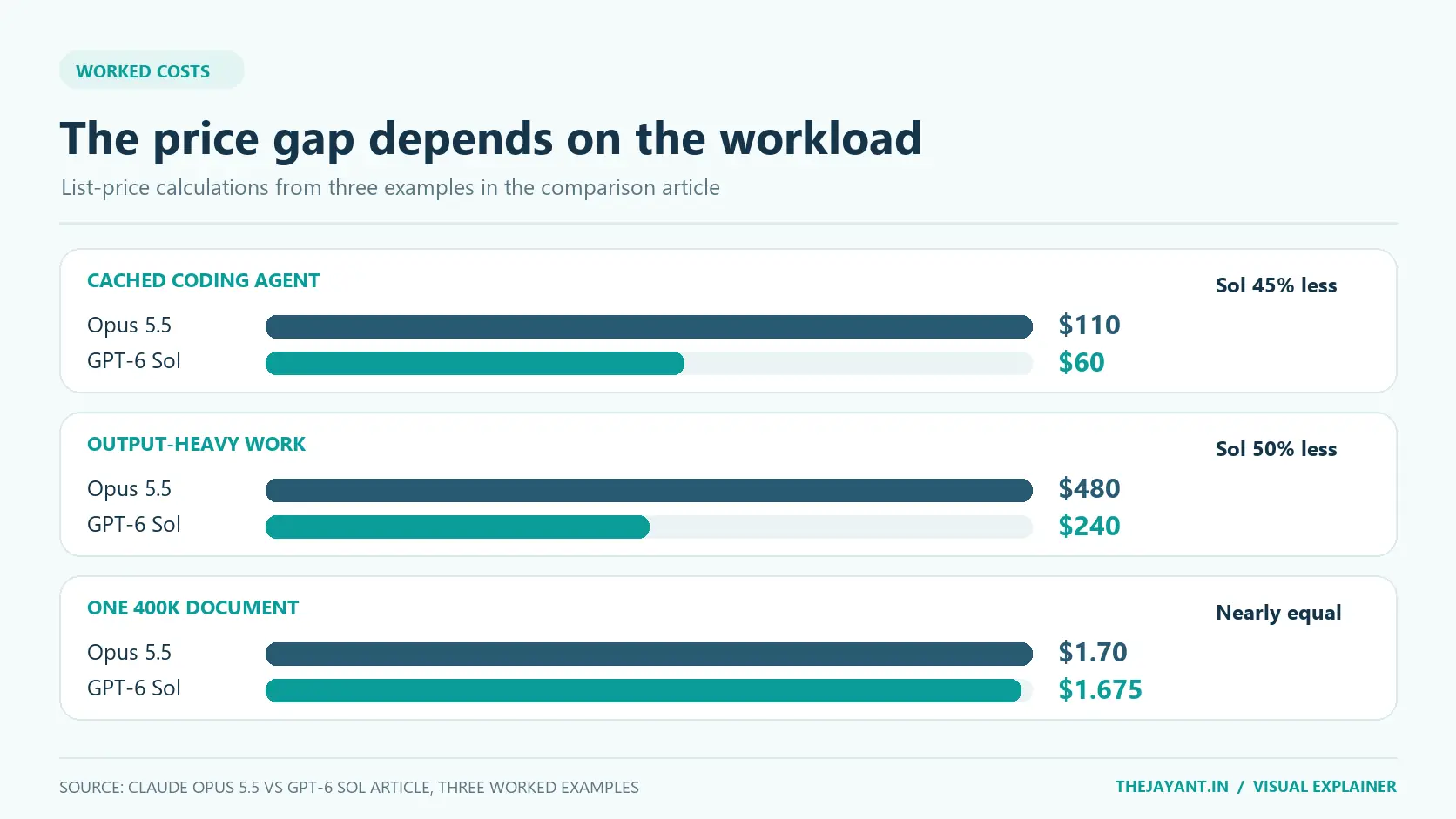
Sol's advantage is largest on output-heavy work (50%), smaller for cached agents (45%), and almost nothing on single prompts above 272K tokens. And none of this counts how many tokens each model needs to finish the job, which is where the next section changes the picture again.
To run these numbers with your own token counts, use the Opus 5.5 vs GPT-6 Sol cost calculator.
Anthropic and OpenAI use different tokenizers, so "a million tokens" isn't the same amount of text on each. Anthropic itself notes that its current tokenizer produces about 30% more tokens for the same text than its older one. Confirmed Cross-vendor per-token comparisons are therefore approximate. The only reliable comparison is cost per finished task on your own inputs. Analysis
4. Intelligence per dollar
Artificial Analysis is the one independent source that has run both models through the same ten evaluations. Observed
| Metric (max effort) | Claude Opus 5.5 | GPT-6 Sol |
|---|---|---|
| Intelligence Index | 58 (#1) | 48 |
| Output tokens per task | ~119,000 | ~31,000 |
| Cost per task | ~$4 (derived) | $1.06 |
| Humanity's Last Exam | 61.4% (record) | Not yet published |
| Terminal-Bench 4.0 | 59.6% | Not yet published |
| AA-Omniscience hallucination rate | Not yet published | 60% (answers 83% of questions) |
Opus 5.5's cost per task is derived from AA's published totals: $8,708 to run the index, 260M output tokens, and The Decoder's figure of ~119K output tokens per task, which works out to about $4 per task. Calculation
At max effort, then, Opus 5.5 delivers 10 more index points for about 3.8× the cost per task, mainly because it thinks for about four times as many tokens. Whether that's worth it depends on what a wrong answer costs you:
- If a failed task costs a developer an hour, 10 index points is cheap at $3.
- If you run a million classification calls, it isn't, and even Sol may be overkill next to Luna.
One more nuance: those numbers are at max effort. Both models default to medium, and Anthropic's early-access partners reported Opus 5.5 using 20–60% fewer tokens than Opus 5 at normal settings. Reported At medium effort the per-task gap is probably smaller than 3.8×, but nobody has published independent medium-effort numbers yet. Speculation
5. Benchmarks both sides report
The two launch posts barely overlap. Where they do, the numbers aren't always comparable. Here's everything that can be lined up, with a note on how much weight each comparison can bear.
| Benchmark | Opus 5.5 | GPT-6 Sol | Comparable? |
|---|---|---|---|
| AutomationBench | 40.0% (Anthropic) | 33.2% at xhigh (OpenAI) | Fairly. Both vendors report Opus 5 at exactly 26.9% and Fable 5.1 at 31.4%, which suggests the same benchmark version |
| FrontierCode 1.1 | 54.4% | "Matches Claude Fable 5.1 xhigh" (Anthropic lists Fable 5.1 at 50.3%) | Roughly. Implies Sol at about 50%, but the effort settings may differ |
| OSWorld 2.0 | 81.8% (partial credit) | 60.5% (offline set, partial reward) | No. Different task sets; don't subtract these |
| Terminal-Bench 4.0 | 66.4% (Anthropic) / 59.6% (AA) | Not reported | — |
| GDPval-AA v2.1 | 1846 Elo | ~100 Elo below GPT-5.6 Sol (AA) | Directionally: Opus 5.5 leads clearly |
| DeepSWE v1.1 | Not reported | 68.8% (max) | — |
| Agents' Last Exam | Not reported | 56.4% (max) | — |
Vendor figures: Confirmed. The comparability judgements are editorial: Speculation. OpenAI's chart puts Sol at $0.27 per AutomationBench task. Anthropic didn't publish a per-task cost for Opus 5.5 on that benchmark, so the one clean like-for-like score comes without a price. Observed
Why cross-vendor launch tables can't simply be subtracted, harnesses and all, is covered in the GPT-6 Astra benchmarks teardown. The same rules apply here.
6. Category by category
| Category | Winner | Why |
|---|---|---|
| Long-running coding agents | Opus 5.5 | Top Terminal-Bench and FrontierCode results; migrations run over hours (680K lines in under a day); CodeRabbit measured 76.9% recall on hard bugs, against a 38.5% baseline |
| High-volume coding turns | GPT-6 Sol | Coding index 57 at $2.99 per coding task (AA); half the token price; drop-in API swap |
| Business workflow automation | Opus 5.5 on quality, Sol on cost | AutomationBench 40.0% vs 33.2%; Sol at $0.27 per task |
| Knowledge work (reports, analysis, decks) | Opus 5.5 | GDPval-AA 1846 Elo and AA-Briefcase 1,822; Sol dropped ~100 Elo on GDPval |
| Factual Q&A | GPT-6 Sol (provisional) | Hallucination rate down to 60% and half the factual errors (OpenAI); no matching Opus 5.5 figure published |
| Computer use | Opus 5.5 (provisional) | 81.8% on OSWorld 2.0 on Anthropic's set, though not comparable with Sol's offline 60.5%; OpenAI itself points to Astra for computer use |
| Writing quality | Tie | Both launches promise less jargon and more direct answers; too early to judge |
| Very long documents (>272K) | Opus 5.5 | Same price as Sol above 272K, with the stronger model |
| Recent knowledge | Opus 5.5 | June 2026 cutoff against April 2026 |
| Charts and screenshots | Opus 5.5 (provisional) | Chartography 89.0%; Anthropic reports much better dense-chart reading without tools |
| Migration effort | GPT-6 Sol | Model-ID swap only; Opus 5.5 has four breaking API changes |
| Latency control | GPT-6 Sol | Can switch reasoning off (none); Opus 5.5 always thinks |
| Safety transparency | Opus 5.5 | Dedicated system card and disclosed evaluation-awareness caveat; Sol has no card of its own |
| Security and biology work | Check both | Opus 5.5 reroutes most cyber tasks to Opus 4.8 without verification; Sol's safeguard profile is unpublished |
| Enterprise cloud choice | Opus 5.5 | Available on AWS, Google Cloud and Microsoft from day one |
Evidence levels for each row are given in the two source articles. The "Winner" column is an editorial judgement. Opinion
7. Which one should you use?
| If you're… | Use | Because |
|---|---|---|
| Running overnight or multi-hour coding agents | Opus 5.5 | Failures are expensive; the stronger model finishes more jobs |
| Building an IDE assistant or chat-coding product | GPT-6 Sol | Many short turns; price and latency dominate |
| Producing client-facing reports or analysis | Opus 5.5 | The GDPval lead is large; editing time costs more than tokens |
| Running support or FAQ bots | GPT-6 Sol, or Luna | Better factuality and a cap on per-conversation cost |
| Doing SEO at scale (classification, extraction, meta drafts) | GPT-6 Luna | $0.10 / $0.50; neither big model is needed |
| Doing SEO strategy (audits, content briefs, competitor analysis) | Opus 5.5 | Judgement-heavy; newer knowledge cutoff |
| Analysing 300K+ token documents or codebases | Opus 5.5 | No long-context surcharge, so it costs the same as Sol there |
| A startup on a fixed monthly API budget | GPT-6 Sol | Roughly a quarter of the cost per task at max effort |
| An enterprise standardised on AWS or Google Cloud | Opus 5.5 | Native availability on both |
| A heavy ChatGPT user | GPT-6 Sol in Work and Codex | Included in your plan |
| A heavy Claude user | Opus 5.5 | Already the default, with higher usage limits |
8. The best answer: use both
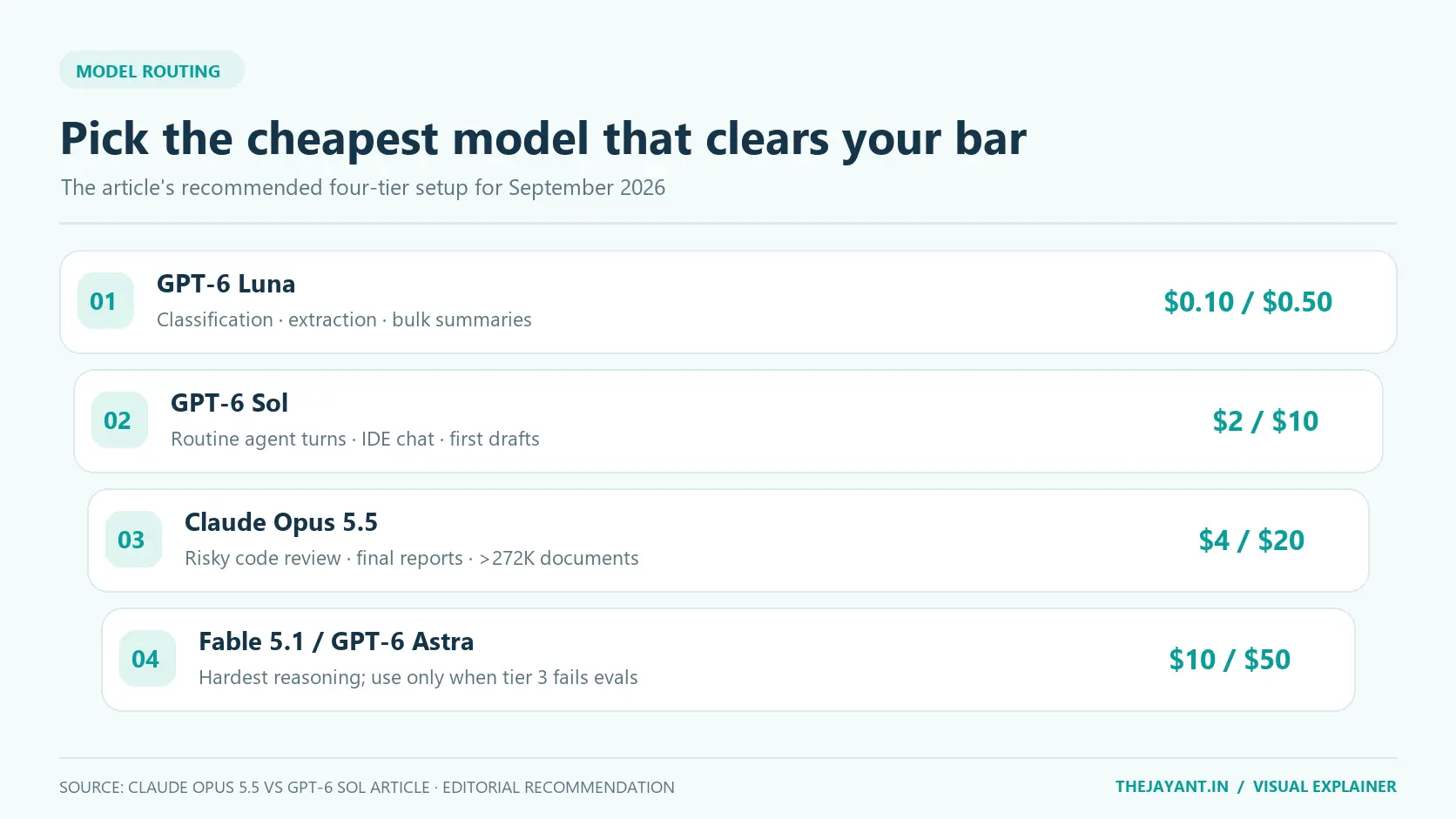
For most teams, the real answer isn't choosing a winner. It's routing each request to the cheapest model that can do it well. A sensible four-tier setup as of September 2026: Recommendation
- GPT-6 Luna ($0.10 / $0.50): classification, extraction, summaries, routing decisions and bulk transforms.
- GPT-6 Sol ($2 / $10): routine agent turns, IDE chat, support answers, first drafts.
- Claude Opus 5.5 ($4 / $20): long-running agents, code review of risky changes, final-quality reports, and documents over 272K tokens.
- Fable 5.1 or GPT-6 Astra ($10 / $50): the hardest reasoning, and Astra for computer use, only when tier 3 fails your evals.
Two practical notes. Opus 5.5's thinking blocks can't be passed to OpenAI models, and model switches drop reasoning context, so route between tasks rather than mid-conversation. Also cache aggressively on both: at $0.20 per million cached tokens, they cost exactly the same for the part of the prompt you reuse. Confirmed pricing
The cost-per-finished-task method behind this setup is explained in what AI models actually cost per task.
9. What the internet is saying about the showdown
- The consensus on Hacker News: Sol wins on price, Opus 5.5 on intelligence, and each has its place. Observed
- The Opus 5.5 thread (about 475 points and 490+ comments) was dominated by scepticism about Anthropic's "pace the frontier" messaging, alongside praise for the price and writing changes. Observed
- The Sol thread was dominated by excitement about pricing, especially for Luna, with scepticism about benchmarks and some nostalgia for GPT-5.6 Sol. Observed
- The New Stack pointed out that OpenAI's comparisons were out of date on arrival, and that Opus 5.5 is still twice Sol's price. Observed
- Artificial Analysis put Opus 5.5 at #1, while OfficeChai called Sol's result a "modest gain" at "a much cheaper price". Observed
The story most people are telling is "Anthropic went for the top, OpenAI went for volume". That's broadly right, as long as you remember that Sol's cheaper sibling, Luna, may end up the more important model of the day. Editorial view
10. A two-hour head-to-head you can run
- Pull 20 real tasks from last month: 10 hard ones and 10 routine ones.
- Run each on Opus 5.5 and GPT-6 Sol at
mediumandhigheffort. That's 80 runs. - Log cached, fresh and output tokens, the number of turns, wall-clock time, and whether each task was actually finished.
- Work out the cost per finished task for each model, effort level and task type.
- Blind-rate the written outputs; both launches claim better writing.
- Note any refusals or silent reroutes, especially for security-adjacent work.
- Set routing rules: the cheapest model that clears your quality bar for each task type.
Expect the hard tasks to favour Opus 5.5 and the routine ones to favour Sol. The value of the exercise is finding exactly where your cut-off lies. Expectation
11. Scorecards side by side
| Category | Claude Opus 5.5 | GPT-6 Sol |
|---|---|---|
| Raw intelligence | 9.5 | 6.5 |
| Agentic coding | 9.5 | 7.5 |
| Knowledge work | 9 | 7 |
| Factuality | 8 (not measured independently yet) | 8.5 |
| Price per token | 7.5 | 9.5 |
| Cost per finished task | 7 | 9 |
| Developer experience | 6.5 | 8.5 |
| Transparency and safety | 8 | 5.5 |
| Availability and ecosystem | 9 | 7 |
| Overall | 8.7 / 10 | 7.8 / 10 |
These are editorial scores on day two, consistent with the scorecards in the two source articles. Opinion A higher overall score doesn't make Opus 5.5 the right choice for every workload: on a volume-and-budget scorecard, Sol wins easily.
12. Frequently asked questions
Is Claude Opus 5.5 better than GPT-6 Sol?
On intelligence, yes. Artificial Analysis scores Opus 5.5 at 58 and GPT-6 Sol at 48, and Opus 5.5 leads on AutomationBench (40.0% vs 33.2%) and knowledge-work benchmarks. GPT-6 Sol is half the price per token and roughly a quarter of the cost per task at max effort, so it's better value for high-volume work.
Which is cheaper, Opus 5.5 or GPT-6 Sol?
GPT-6 Sol: $2 / $10 per million input / output tokens against $4 / $20. Cache reads cost the same ($0.20). Above 272K input tokens, Sol's rates rise to 2× input and 1.5× output, which makes very long prompts cost about the same on both.
Which is better for coding?
Opus 5.5 for long-running, complex agentic coding, where it leads on Terminal-Bench 4.0 and FrontierCode. GPT-6 Sol for high-volume, shorter coding turns, where its coding index of 57 at about $3 per coding task is strong value.
Which has the bigger context window?
GPT-6 Sol, marginally: 1,050,000 tokens against 1,000,000. Both allow 128K output tokens. Opus 5.5 charges the same rate across its whole window; Sol charges more above 272K input tokens.
Which has more recent knowledge?
Claude Opus 5.5, with a June 2026 knowledge cutoff against GPT-6 Sol's 20 April 2026. GPT-6 Luna's cutoff (18 May 2026) is also later than Sol's.
Did OpenAI compare GPT-6 Sol with Opus 5.5?
No. OpenAI published about ninety minutes after Anthropic, and its charts compare Sol with Claude Opus 5, Fable 5 and Fable 5.1. Anthropic's charts compare Opus 5.5 with the older GPT-5.6 Sol, not GPT-6 Sol.
Can I use both Opus 5.5 and GPT-6 Sol together?
Yes, and for most teams that's the best approach: route routine and high-volume work to GPT-6 Sol or Luna, and hard, long-running or high-stakes work to Opus 5.5. Route between tasks rather than mid-conversation, because reasoning context doesn't carry across vendors.
Which is better in the consumer apps?
Opus 5.5 is the default in the Claude apps and Claude Code, with higher usage limits. GPT-6 Sol is available in ChatGPT Work and Codex on paid plans, but not yet in regular ChatGPT conversations, which still use GPT-5.6 Sol.
Be the source both models cite

I'm Jayant Solanki, an SEO, GEO and automation strategist working with eCommerce, local-service and global brands. Claude and ChatGPT pick sources differently, and a brand can be cited in one and invisible in the other. I build sites that work for both.
A GEO engagement typically covers:
- Cross-model visibility: where you're cited in Claude, ChatGPT, Gemini and AI Overviews
- A retrieval audit: crawler access, rendering and indexation on revenue pages
- Content restructured so a model can lift a specific claim cleanly
- Post-cutoff topic mapping for each model's knowledge window
- Measurement that honestly separates agent traffic from human traffic
Ranked #1 for "metal buildings" · +30% YoY organic traffic · Evidence-labelled research
Sources
- Jayant Solanki, Claude Opus 5.5: specs, benchmarks, pricing and the internet's verdict, the full source breakdown for Opus 5.5
- Jayant Solanki, GPT-6 Sol (and Luna): specs, benchmarks, pricing and the internet's verdict, the full source breakdown for Sol and Luna
- Anthropic, Introducing Claude Opus 5.5
- Claude Platform Docs, Claude Opus 5.5 model page and Pricing
- OpenAI, Introducing GPT-6 Sol and Luna
- OpenAI API docs, GPT-6 Sol model
- Artificial Analysis, Claude Opus 5.5 analysis
- OfficeChai, GPT-6 Sol on the Artificial Analysis Intelligence Index
- The Decoder, Claude Opus 5.5 matches Fable 5.1 at 40 percent lower cost
- CodeRabbit, Claude Opus 5.5 code review benchmarks
- The New Stack, OpenAI releases GPT-6 Sol and Luna
- TechCrunch, Opus 5.5 launch and GPT-6 Sol and Luna launch
- Hacker News, Claude Opus 5.5 thread and GPT-6 Sol and Luna thread
Jayant Solanki
AI-Ready SEO, GEO & AIO strategist based in Indore, India, working with eCommerce, local-service and global brands across India, the UAE and the US. This comparison is maintained and will be updated when independent medium-effort results and matched head-to-head tests are published.
More about Jayant →