
Confirmed Prices and rules stated in Anthropic's and OpenAI's API documentation.
Observed Measured by an independent third party (Artificial Analysis).
Speculation Calculation, assumption or inference by the author.
- List price: GPT-6 Sol costs exactly half as much as Claude Opus 5.5 per token ($2 / $10 against $4 / $20). GPT-6 Luna costs 1/40th as much ($0.10 / $0.50). Confirmed
- Cached input costs the same on Opus 5.5 and Sol: $0.20 per million. The more of your prompt you reuse, the smaller Sol's advantage. Confirmed
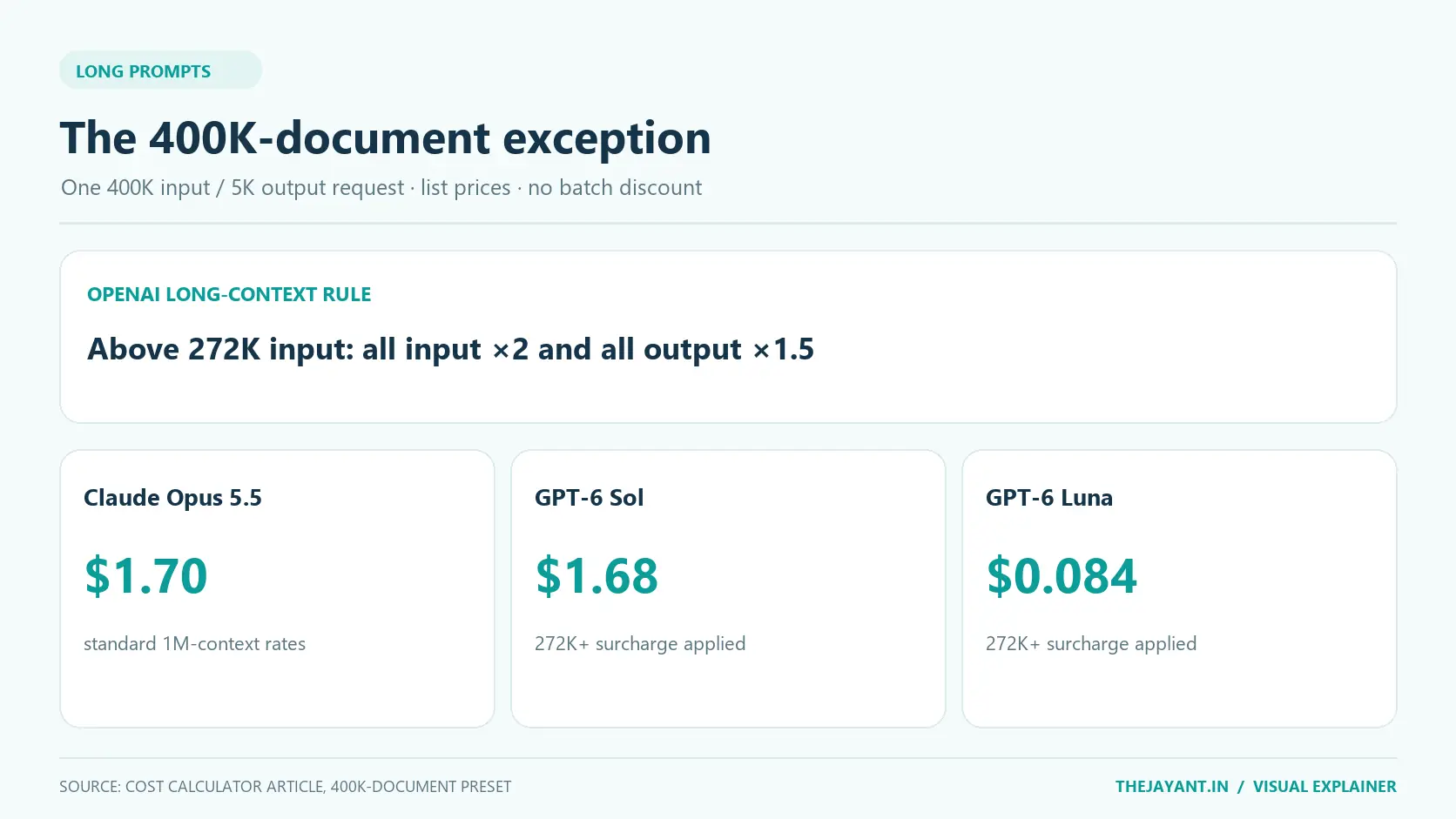
- Above 272K input tokens the gap disappears. OpenAI bills the whole request at 2× input and 1.5× output, so a 400K-token document costs $1.70 on Opus 5.5 and $1.68 on Sol. Calculation
- Per finished task, token counts matter as much as prices. At max effort, Artificial Analysis measured Opus 5.5 using about 119K output tokens per task against Sol's 31K. Observed
This calculator uses the list prices published by Anthropic and OpenAI as of 23 September 2026. For what the models can actually do, see the full breakdowns of Claude Opus 5.5 and GPT-6 Sol and Luna, and the head-to-head comparison.
1. The calculator
Advanced: cache writes and token efficiency
The calculator runs entirely in your browser and sends nothing anywhere. If JavaScript is off, the five worked workloads in section 4 show the same results for the preset inputs.
2. The price sheet behind it
| Model (API ID) | Input | Output | Cache read | Cache write | Long prompts |
|---|---|---|---|---|---|
Claude Opus 5.5 (claude-opus-5-5) | $4.00 | $20.00 | $0.20 | $5.00 (5 min) / $8 (1 h) | Standard rate to 1M |
GPT-6 Sol (gpt-6-sol) | $2.00 | $10.00 | $0.20 | $2.50 | >272K: 2× in, 1.5× out |
GPT-6 Luna (gpt-6-luna) | $0.10 | $0.50 | $0.01 | $0.125 | >272K: 2× in, 1.5× out |
Claude Fable 5.1 (claude-fable-5-1) | $10.00 | $50.00 | $0.25 | $12.50 (5 min) / $20 (1 h) | Standard rate to 1M |
GPT-6 Astra (gpt-6-astra) | $10.00 | $50.00 | $1.00 | $12.50 | >272K: 2× in, 1.5× out |
Claude Opus 5 (claude-opus-5) | $5.00 | $25.00 | $0.50 | $6.25 (5 min) / $10 (1 h) | Standard rate to 1M |
USD per million tokens, from the Claude Platform pricing page and OpenAI's model pages. Confirmed Both companies discount Batch requests by 50%. Both also offer a fast mode at a premium: $8 / $40 for Opus 5.5 on the Claude API, and 2× standard rates for OpenAI models. Confirmed
3. How the calculator works
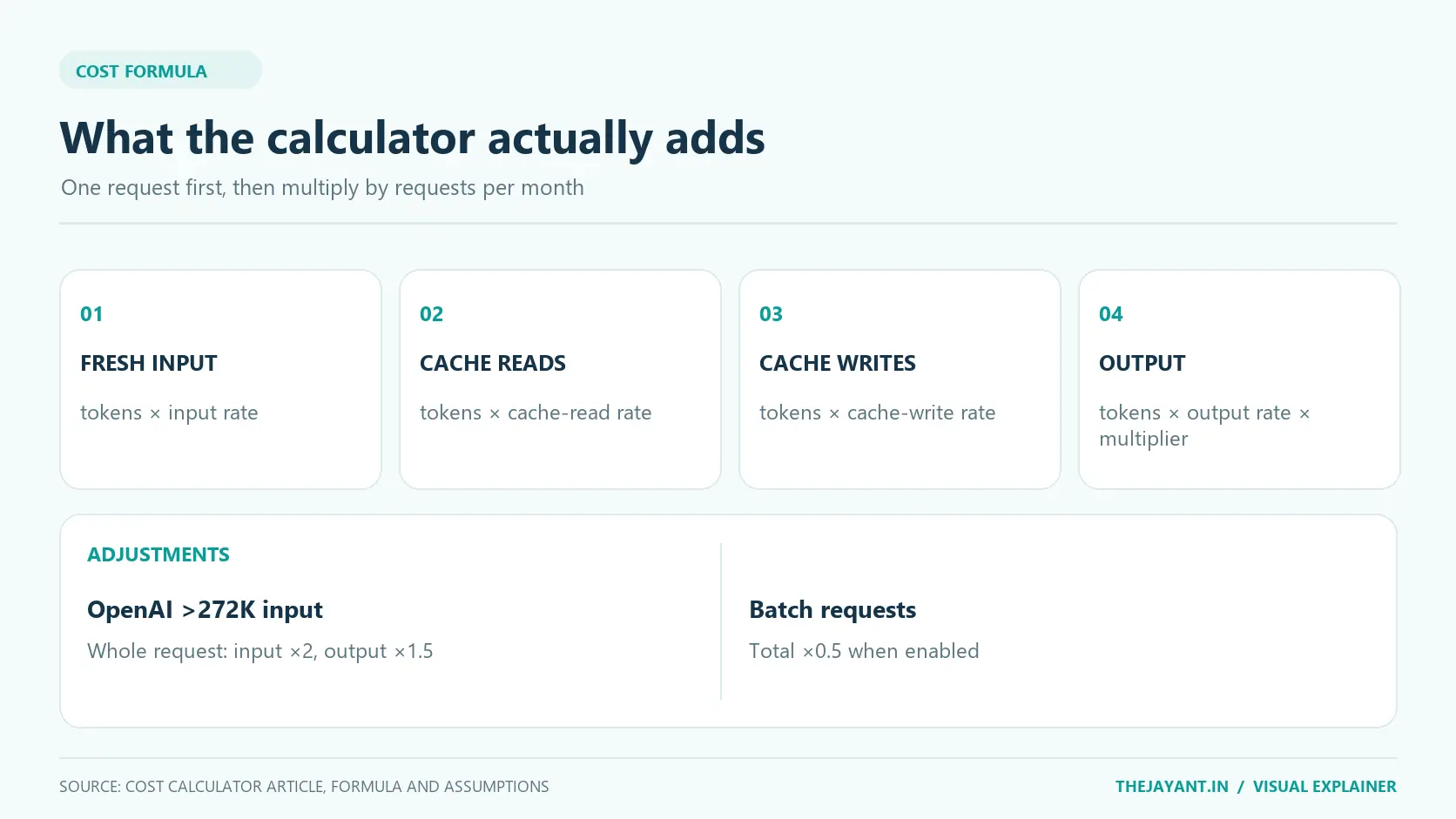
For each model, the cost of one request is:
cost = fresh_input × input_price
     + cached_input × cache_read_price
     + cache_writes × cache_write_price
     + output × output_price × output_multiplier

OpenAI models, when fresh + cached + writes > 272,000 tokens:
     input, cache read and cache write prices × 2, output price × 1.5

Batch ticked: total × 0.5
Assumptions to be aware of: Assumptions
- Output includes reasoning. Both companies bill thinking or reasoning tokens as output. If you estimate output from the visible answer alone, you'll undercount, often by a lot at
higheffort and above. - The same token counts are used for every model by default. In reality, the two companies' tokenizers split text differently, and the models think for different lengths. The output multipliers in the Advanced section let you correct for this.
- Batch is applied on top of caching for every model. Anthropic documents that the two discounts stack. For OpenAI, check how your specific setup is billed.
- Cache writes use the 5-minute rate on Claude models. One-hour caching costs more ($8 per million on Opus 5.5).
- Not included: web search ($10 per 1,000 calls on both), other tool fees, data-residency premiums (+10%) and fast mode.
4. Five workloads, worked out
These are the calculator's five presets, at list prices with no batch discount. Calculation
Coding agent
1,000 requests, each with 10,000 fresh input tokens, 50,000 cached input tokens and 3,000 output tokens.
| Model | Per request | Total | vs Opus 5.5 |
|---|---|---|---|
| Claude Opus 5.5 | $0.110 | $110 | 1.00× |
| GPT-6 Sol | $0.060 | $60.00 | 0.55× |
| GPT-6 Luna | $0.0030 | $3.00 | 0.03× |
| Claude Fable 5.1 | $0.263 | $263 | 2.39× |
| GPT-6 Astra | $0.300 | $300 | 2.73× |
| Claude Opus 5 | $0.150 | $150 | 1.36× |
Output-heavy drafting
1,000 requests, each with 20,000 input tokens and 20,000 output tokens (reports, long code files, content drafts).
| Model | Per request | Total | vs Opus 5.5 |
|---|---|---|---|
| Claude Opus 5.5 | $0.480 | $480 | 1.00× |
| GPT-6 Sol | $0.240 | $240 | 0.50× |
| GPT-6 Luna | $0.012 | $12.00 | 0.03× |
| Claude Fable 5.1 | $1.20 | $1,200 | 2.50× |
| GPT-6 Astra | $1.20 | $1,200 | 2.50× |
| Claude Opus 5 | $0.600 | $600 | 1.25× |
One 400K-token document
A single request with a 400,000-token document and a 5,000-token answer.
| Model | Per request | Total | vs Opus 5.5 |
|---|---|---|---|
| Claude Opus 5.5 | $1.70 | $1.70 | 1.00× |
| GPT-6 Sol (272K+ rate) | $1.68 | $1.68 | 0.99× |
| GPT-6 Luna (272K+ rate) | $0.084 | $0.084 | 0.05× |
| Claude Fable 5.1 | $4.25 | $4.25 | 2.50× |
| GPT-6 Astra (272K+ rate) | $8.38 | $8.38 | 4.93× |
| Claude Opus 5 | $2.13 | $2.13 | 1.25× |
Bulk classification
10,000 requests, each with 300 input tokens and 50 output tokens (intent tagging, sentiment, routing).
| Model | Per request | Total | vs Opus 5.5 |
|---|---|---|---|
| Claude Opus 5.5 | $0.0022 | $22.00 | 1.00× |
| GPT-6 Sol | $0.0011 | $11.00 | 0.50× |
| GPT-6 Luna | $0.0001 | $0.550 | 0.03× |
| Claude Fable 5.1 | $0.0055 | $55.00 | 2.50× |
| GPT-6 Astra | $0.0055 | $55.00 | 2.50× |
| Claude Opus 5 | $0.0028 | $27.50 | 1.25× |
Support chat
10,000 conversations, each with 2,000 fresh input tokens, 8,000 cached tokens (policies and product info) and 500 output tokens.
| Model | Per request | Total | vs Opus 5.5 |
|---|---|---|---|
| Claude Opus 5.5 | $0.020 | $196 | 1.00× |
| GPT-6 Sol | $0.011 | $106 | 0.54× |
| GPT-6 Luna | $0.0005 | $5.30 | 0.03× |
| Claude Fable 5.1 | $0.047 | $470 | 2.40× |
| GPT-6 Astra | $0.053 | $530 | 2.70× |
| Claude Opus 5 | $0.027 | $265 | 1.35× |
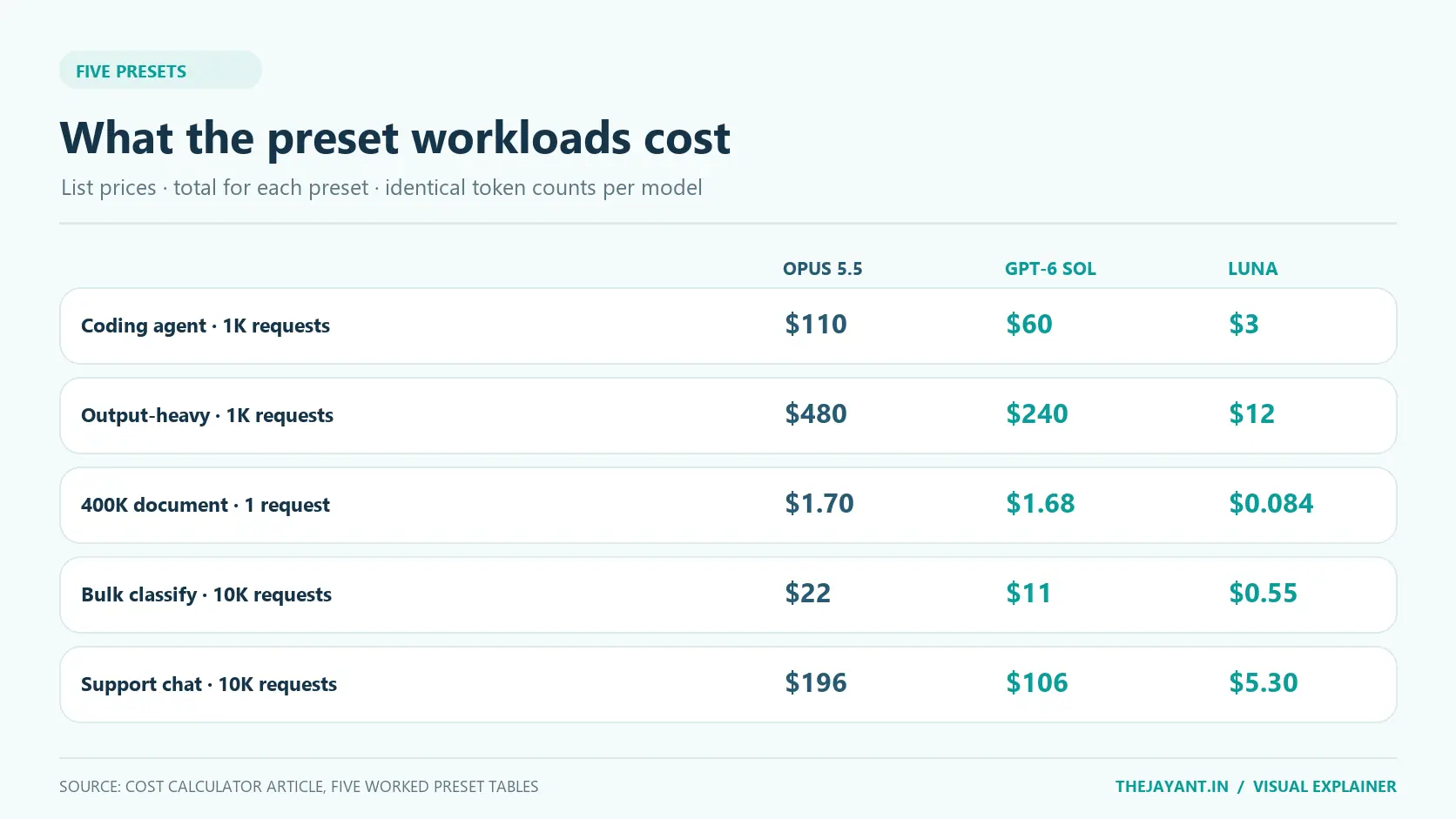
Across four of the five workloads, Sol is 45–50% cheaper than Opus 5.5 on identical tokens, and Luna is about 97% cheaper. The exception is the 400K-token document, where OpenAI's surcharge brings Sol level with Opus 5.5 and pushes Astra to nearly twice Fable 5.1's price ($8.38 against $4.25), even though the two cost the same on shorter prompts. The flagships (Fable 5.1 and Astra) cost 2.4–5× as much as Opus 5.5 on every workload.
5. Cost per token vs cost per finished task
The calculator compares models on identical token counts. Real models don't use identical token counts. The one independent measurement that ran both through the same ten evaluations is Artificial Analysis's Intelligence Index, at max effort: Observed
| At max effort | Claude Opus 5.5 | GPT-6 Sol |
|---|---|---|
| Intelligence Index score | 58 | 48 |
| Output tokens per task | ~119,000 | ~31,000 |
| Cost per task | ~$4 (derived from AA's $8,708 total) | $1.06 |
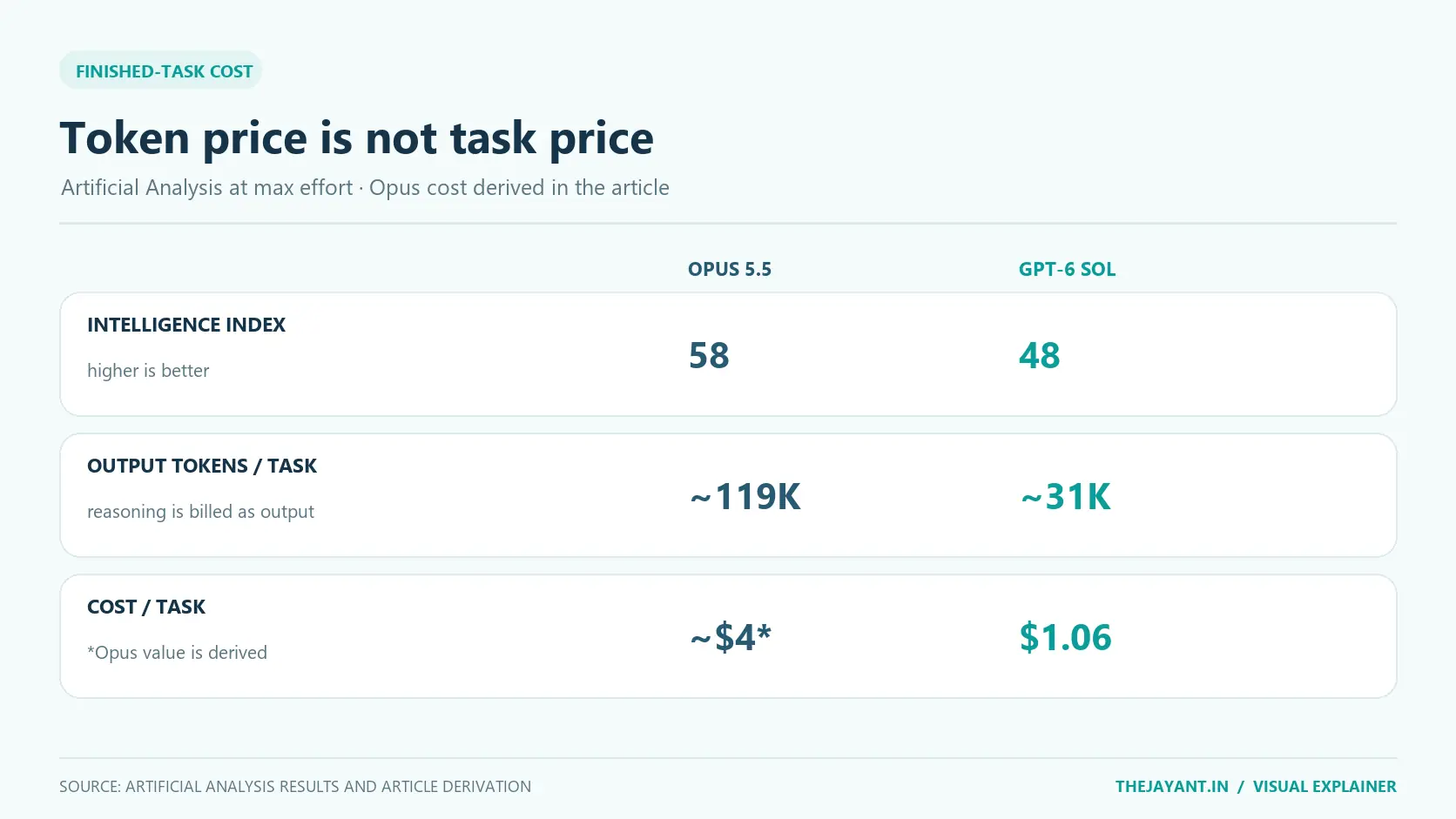
So at max effort, Opus 5.5 costs about 3.8× as much per task, not 2×, because it also thinks for about 3.8× as many tokens. To model that, set the Claude output multiplier to about 3.8 in the Advanced section. At default medium effort the ratio is likely lower, since Anthropic's early-access partners reported Opus 5.5 using 20–60% fewer tokens than Opus 5, but no independent medium-effort figure has been published yet. Analysis
What decides it in the end is cost per successful task: a cheaper model that fails more often and needs a human to fix the result can cost more overall. That method is worked through in what AI models actually cost per task.
6. Five ways to cut the bill, on either model
- Cache everything you resend. On Opus 5.5 and Sol alike, cached input costs $0.20 per million, 5% of Opus 5.5's input price and 10% of Sol's. For agents that resend a big system prompt every turn, this is the biggest single lever.
- Batch anything that can wait. Overnight classification, bulk rewrites and evaluation runs get 50% off on both platforms.
- Set effort deliberately. Opus 5.5 and Sol both default to
medium. Raise it only for tasks where you've measured a quality gain;maxcan multiply output tokens several times over. - Keep OpenAI prompts under 272K tokens, or send long ones to Claude. Above the threshold, Sol's price advantage disappears and Astra's cost doubles.
- Route by task. Luna for repetitive jobs with clear answers, Sol for routine agent turns and drafts, Opus 5.5 for long, high-stakes or judgement-heavy work. The comparison article sets out a four-tier routing plan.
7. Frequently asked questions
How much does Claude Opus 5.5 cost per request?
It depends on the tokens. At $4 per million input and $20 per million output, a request with 10,000 fresh input tokens, 50,000 cached tokens and 3,000 output tokens costs about $0.11. The same request on GPT-6 Sol costs about $0.06.
Is GPT-6 Sol always cheaper than Claude Opus 5.5?
Per token, yes: exactly half. But cached input costs the same on both ($0.20 per million), and above 272K input tokens OpenAI charges 2× input and 1.5× output, which makes Sol cost about the same as Opus 5.5 on very long prompts. Per finished task, it also depends on how many tokens each model uses.
What is OpenAI's 272K surcharge?
For GPT-6 Sol, Luna and Astra, a request with more than 272,000 input tokens is billed at twice the input and cache rates and 1.5 times the output rate, for the whole request, not just the tokens above the threshold. Claude Opus 5.5 bills its full 1M-token context at the standard rate.
Do reasoning tokens count as output?
Yes. Both Anthropic and OpenAI bill thinking or reasoning tokens at the output rate, so include them when estimating output. They can be several times larger than the visible answer at high effort.
How much does batch processing save?
50% on input and output for both companies, in exchange for asynchronous processing. On Claude, batch stacks with prompt caching discounts.
What is the cheapest current model for simple tasks?
Of the models in this calculator, GPT-6 Luna at $0.10 per million input tokens and $0.50 per million output tokens, with cached input at $0.01. Classifying 10,000 short items costs about $0.55 before reasoning tokens.
Are these prices current?
They're the list prices published by Anthropic and OpenAI as of 23 September 2026. Enterprise agreements, regional processing premiums and fast mode are not included.
AI workflows that are cheap to run and easy to trust

I'm Jayant Solanki, an SEO, GEO and automation strategist working with eCommerce, local-service and global brands. I build AI-assisted SEO and content workflows that use the cheapest model that does each job well, and I measure them so the savings are real.
An automation engagement typically covers:
- Mapping current AI usage by task, volume and cost
- Benchmarking each task on the models that could do it
- Routing, caching and batch processing set up where they pay off
- Quality checks so cheaper never quietly means worse
- A monthly cost and quality report
Ranked #1 for "metal buildings" · +30% YoY organic traffic · Evidence-labelled research
Sources
- Claude Platform Docs, Pricing (model, cache, batch, fast mode and long-context pricing)
- Claude Platform Docs, Claude Opus 5.5 model page
- OpenAI API docs, GPT-6 Sol and GPT-6 Luna model pages (prices, cache rates, 272K rule)
- OpenAI API docs, GPT-6 Astra model page
- Artificial Analysis, Claude Opus 5.5 analysis; OfficeChai, GPT-6 Sol on the Artificial Analysis Intelligence Index
- The Decoder, Claude Opus 5.5 matches Fable 5.1 at 40 percent lower cost (output tokens per task)
Jayant Solanki
AI-Ready SEO, GEO & AIO strategist based in Indore, India, working with eCommerce, local-service and global brands across India, the UAE and the US. The calculator's prices will be updated when Anthropic or OpenAI change them, and when Sonnet 5.5 and Haiku 5.5 launch.
More about Jayant →