
Confirmed Stated by Anthropic in its announcement, API documentation or system card.
Observed Measured by an independent third party (Artificial Analysis, CodeRabbit, GitHub) or visible in public data.
Reported Claims by early-access customers or press that nobody has independently checked yet.
Speculation Analysis or inference by the author. It's reasoned, but it isn't a fact.
- Released 22 September 2026 as
claude-opus-5-5, the first model in the Claude 5.5 family. Sonnet 5.5 and Haiku 5.5 follow "in the coming weeks". Confirmed - The pitch: Claude Fable 5.1-level performance on most work, at $4 / $20 per million input / output tokens. Fable 5.1 costs $10 / $50. Confirmed
- 20% lower list prices than Opus 5 ($5 / $25), 60% cheaper cache reads ($0.50 → $0.20), and Anthropic says 40% lower cost on typical workloads at default settings. Confirmed
- 1M-token context, 128K max output, June 2026 knowledge cutoff. Output generation is more than 30% faster than Opus 5. Confirmed
- It tops Anthropic's own benchmark tables: 66.4% on Terminal-Bench 4.0 (GPT-6 Astra: 57.9%) and 1846 Elo on GDPval-AA (Astra: 1542). Astra still leads on AutomationBench and Terminal-Bench-Science. Confirmed
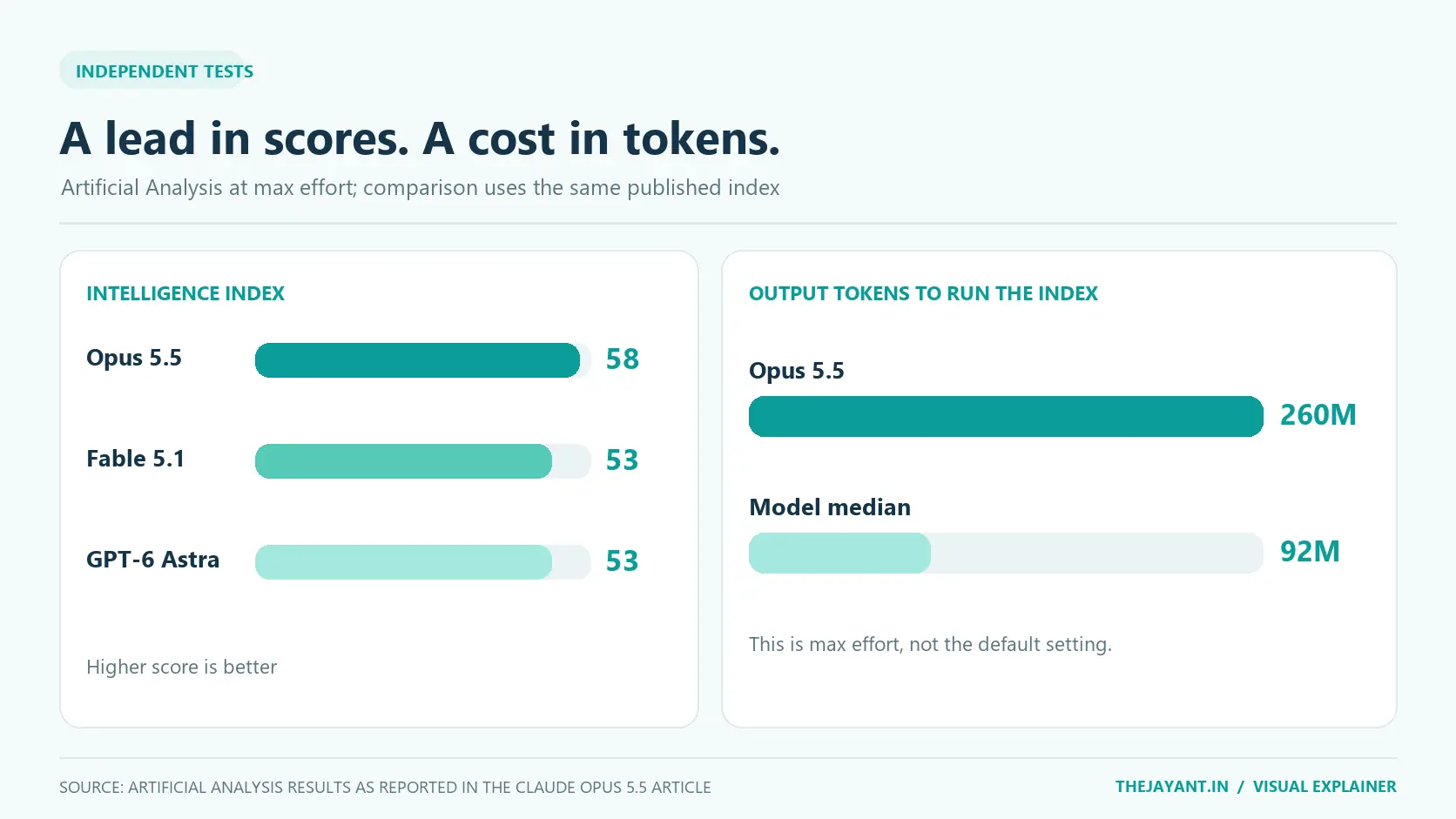
- Independently, it's #1 on the Artificial Analysis Intelligence Index with a score of 58, ahead of Fable 5.1 and GPT-6 Astra (53 each). Observed
- The catch in that result: at max effort it's one of the most verbose models ever measured, at 260M output tokens to run the index against a median of 92M. Observed
- The default effort dropped from
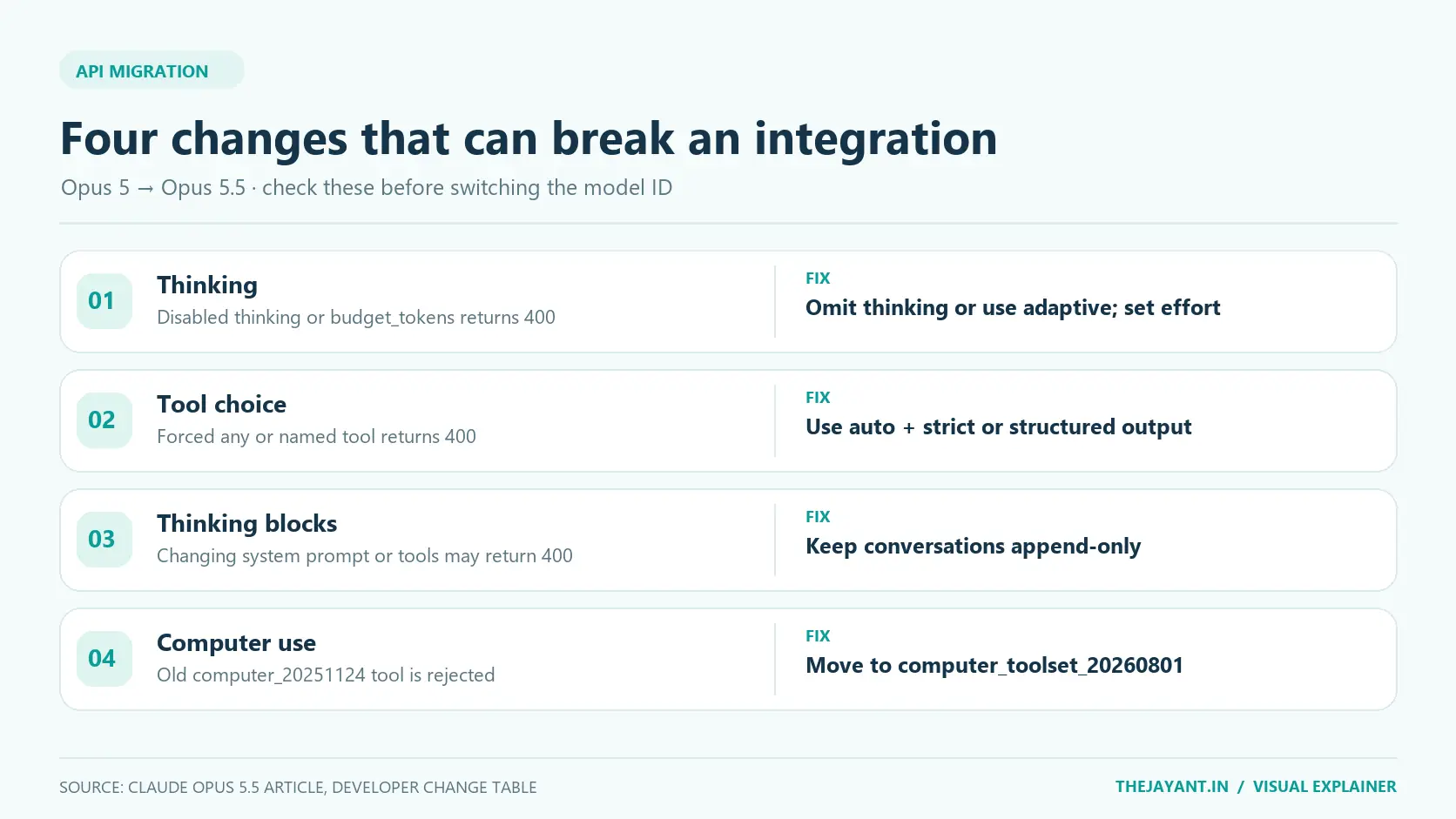
hightomedium. Some of the headline saving comes from that changed default, so re-run your effort settings instead of carrying them over. Analysis - Four breaking API changes: thinking can't be switched off, forced tool use returns an error, thinking blocks are tied to the model and the conversation, and the old computer-use tool is gone on the Claude API and Google Cloud. Confirmed
- Anthropic is fixing "Claudish" writing. It says the model puts the most important information first, uses less jargon and follows writing rules more closely. That was the top complaint about Opus 5. Confirmed
- The safety card questions its own evidence. Anthropic says Opus 5.5 "often suspects it is being evaluated", which makes every score, including the safety ones, a little less predictive. Confirmed
- The internet's reaction: people welcome the price cut and the writing fix. Many are cynical about a "pace the frontier" company shipping a new frontier model two months after the last one. Observed
Anthropic released Claude Opus 5.5 on 22 September 2026, exactly 60 days after Opus 5. Anthropic opened its announcement by describing Opus 5.5 as the company's first release since it called for "pacing the frontier", a line that set the tone for the day's discussion.
The model itself doesn't feel like a slowdown. On Anthropic's numbers it matches Claude Fable 5.1, the company's most expensive model, on most work, at 40% of Fable's price. It beats OpenAI's GPT-6 Astra on most of the benchmarks Anthropic chose to publish. And the first independent index to test it put it in first place.
Performance is only part of the story, though. The more interesting part is efficiency: per-task cost, token counts, how many steps an agent takes to finish. That's where Anthropic's claims are strongest and where independent data is most mixed. Getting that distinction right is what decides whether this upgrade saves you money.
1. What Claude Opus 5.5 actually is
Anthropic's current lineup has four tiers, with a fifth model name, Claude Mythos 5.1, appearing in its safety and pricing documentation. The API docs now tell developers who are unsure to start with Opus 5.5 for most workloads, and to move up to Fable 5.1 only for "demanding reasoning and long-horizon agentic work" or when Opus 5.5 at higher effort still falls short. Confirmed
| Model | Price / MTok | Latency | Default effort | Knowledge cutoff |
|---|---|---|---|---|
| Claude Fable 5.1 | $10 / $50 | Slower | high | Jun 2026 |
| Claude Opus 5.5 | $4 / $20 | Moderate | medium | Jun 2026 |
| Claude Sonnet 5 | $2 / $10 | Fast | high | Jan 2026 |
| Claude Haiku 4.5 | $1 / $5 | Fastest | — | Feb 2025 |
Anthropic describes Opus 5.5 as a model "for long-running agentic coding and knowledge work". In practice that means the jobs that take hours, not seconds: codebase-wide migrations, audits, multi-day rebases, and research that has to dig past the first plausible answer. The announcement names "long and sprawling jobs like codebase-wide migrations and audits" as its particular strength. Confirmed
A 0.5 bump usually means incremental gains. Here, the mid-price tier has caught up with the top tier. If Anthropic's claims hold, most teams paying Fable 5.1 prices for agentic work can cut the bill by about 60% without losing quality. That changes the default choice for the whole market, not just for Opus 5 users.
2. The spec sheet
| Release date | 22 September 2026 |
|---|---|
| API model ID | claude-opus-5-5 (Bedrock: anthropic.claude-opus-5-5) |
| Context window | 1,000,000 tokens (about 555,000 words on the current tokenizer) |
| Max output | 128,000 tokens; 300,000 on the Batch API with the output-300k-2026-03-24 beta header |
| Knowledge cutoff | June 2026 (both reliable-knowledge and training-data cutoff) |
| Modalities | Text and images in, text out |
| Thinking | Adaptive, always on; depth controlled by the effort parameter |
| Default effort | medium (Opus 5 defaulted to high) |
| Input / output | $4 / $20 per million tokens |
| Cache writes | $5 (5-minute) / $8 (1-hour) per million tokens |
| Cache reads | $0.20 per million tokens (5% of the input price) |
| Batch API | 50% off: $2 / $10 |
| Fast mode | $8 / $40, up to 2.5× faster; research preview, Claude API only |
| Minimum cacheable prompt | 512 tokens |
| Platforms | Claude API, Amazon Bedrock, Claude Platform on AWS, Google Cloud, Microsoft Foundry |
| Retirement | Not sooner than 22 September 2027 |
All of the above comes from Anthropic's model page and API documentation. Confirmed Zero data retention is available for eligible customers. Confirmed
New or newly supported API features include per-message effort (beta), mid-conversation system messages, task budgets, defining tools in a message (beta header inline-tools-2026-09-15, which lets you add or change a tool mid-conversation without breaking the prompt cache) and compact on demand (beta header compact-2026-09-04, which returns a signed summary block you can swap in for the conversation so far). Confirmed
3. Pricing: where the "40% cheaper" actually comes from
The list price cut is 20%. The headline saving is 40%. The gap between the two is the interesting part.
| Per million tokens | Opus 5 | Opus 5.5 | Change |
|---|---|---|---|
| Input | $5.00 | $4.00 | −20% |
| Output | $25.00 | $20.00 | −20% |
| Cache write (5 min) | $6.25 | $5.00 | −20% |
| Cache read | $0.50 | $0.20 | −60% |
| Fast mode | — | $8 / $40 | Up to 2.5× speed |
Anthropic says the rest comes from the model doing less work to reach the same answer: fewer output tokens, fewer steps and faster generation. It frames the 40% as "at default settings, on typical workloads". Confirmed
A worked example
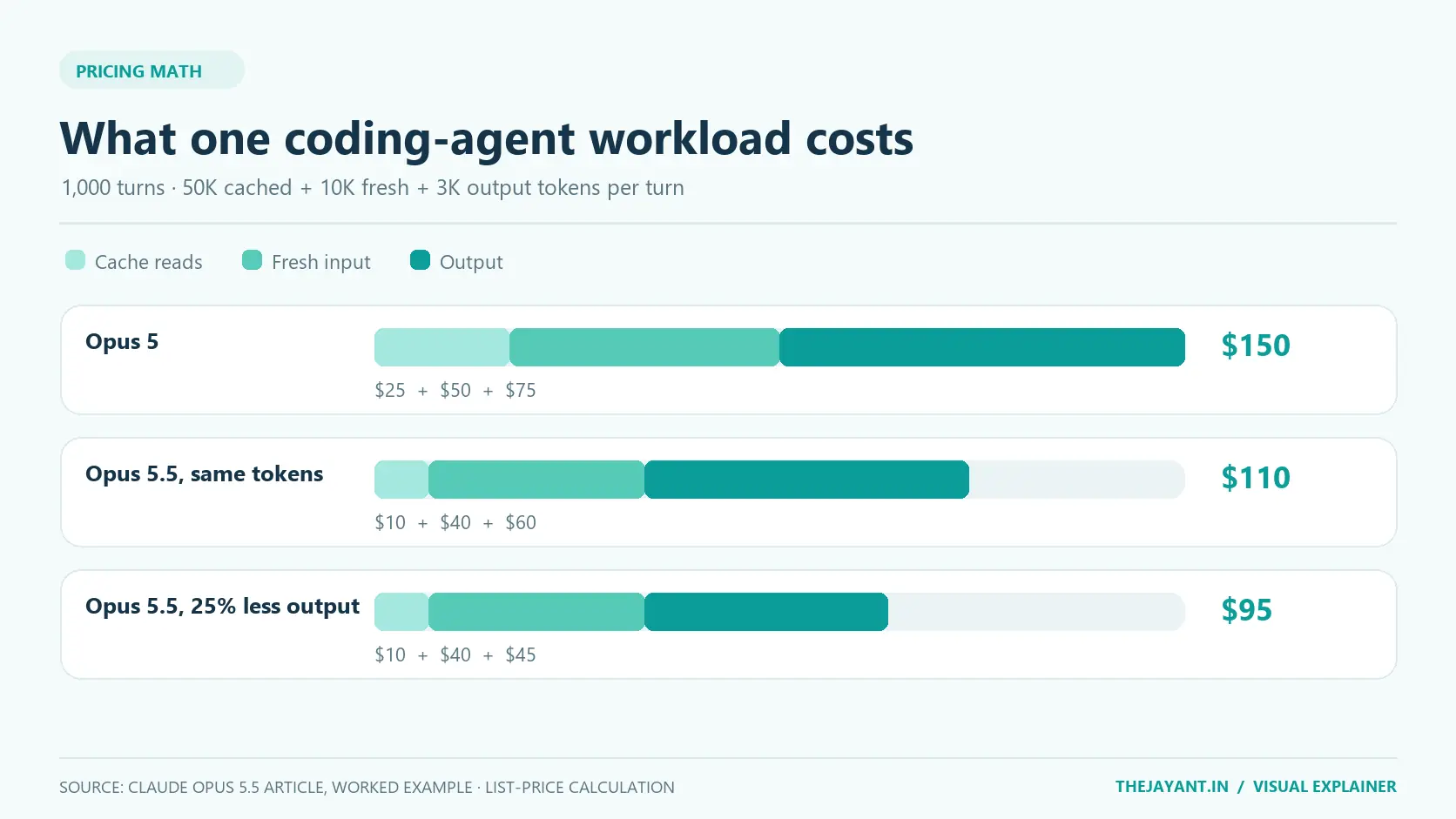
Take a typical coding agent: 1,000 turns, each resending a 50,000-token cached system prompt and tool list, plus 10,000 fresh input tokens and 3,000 output tokens. Calculation
| Scenario | Cache reads | Fresh input | Output | Total |
|---|---|---|---|---|
| Opus 5 | $25.00 | $50.00 | $75.00 | $150.00 |
| Opus 5.5, same tokens | $10.00 | $40.00 | $60.00 | $110.00 (−27%) |
| Opus 5.5, 25% fewer output tokens | $10.00 | $40.00 | $45.00 | $95.00 (−37%) |
| Fable 5.1, same tokens | $12.50 | $100.00 | $150.00 | $262.50 |
Two things stand out. First, the cache-read cut matters more than the headline rate cut for any agent that resends a large prompt on every turn, and that describes almost every agent in production. Second, you only get to 40% if the model really does use fewer tokens on your workload. That's the claim to test.
Opus 5.5's default effort is medium. Opus 5's was high. A comparison "at default settings" is therefore partly a comparison between two different effort levels. Anthropic's own docs also warn that at a given effort level Opus 5.5 "tends to think more per turn than Claude Opus 5, most of all at xhigh and max". Confirmed The practical result: if you pin effort: "high" or higher, expect a smaller saving than 40%, and possibly none. Measure it. Analysis
The general method for this is covered in cost per finished task. It applies directly here: the price per token matters less than the price per completed job. To compare Opus 5.5 with GPT-6 Sol and four other models on your own token counts, use the cost calculator.
4. The benchmarks Anthropic published
All figures below are from Anthropic's announcement. Confirmed Anthropic ran Terminal-Bench and Terminal-Bench-Science with production safeguards switched on. When a safeguard stepped in on a cyber or biology task, an earlier model finished the task, and on AutomationBench those interventions counted as failures.
Agentic coding
| Benchmark | Opus 5.5 | Fable 5.1 | Opus 5 | GPT-6 Astra | GPT-5.6 Sol |
|---|---|---|---|---|---|
| Terminal-Bench 4.0 | 66.4% | 55.8% | 52.3% | 57.9% | 37.3% |
| FrontierCode v1.1 | 54.4% | 50.3% | 48.0% | 53.3% | 47.5% |
| CursorBench 4.0 | 57.8% | 51.8% | 46.6% | — | 41.7% |
Knowledge work
| Benchmark | Opus 5.5 | Fable 5.1 | Opus 5 | GPT-6 Astra | GPT-5.6 Sol |
|---|---|---|---|---|---|
| GDPval-AA v2.1 (Elo) | 1846 | 1735 | 1708 | 1542 | 1588 |
| AutomationBench | 40.0% | 31.4% | 26.9% | 41.4% | 28.8% |
Reasoning, science, vision and computer use
| Benchmark | Opus 5.5 | Fable 5.1 | Opus 5 | Notes |
|---|---|---|---|---|
| Humanity's Last Exam (with tools) | 67.7% | 65.6% | 63.6% | GPT-6 Astra: 57.2% (reported by OfficeChai) |
| Terminal-Bench-Science 0.1 | 58.7% | 52.6% | 29.0% | GPT-6 Astra leads at 64.6% |
| OSWorld 2.0 (computer use) | 81.8% | 80.7% | — | Partial-credit scoring |
| Chartography (with tools) | 89.0% | 88.4% | — | Dense chart and figure reading |
How to read these:
- The big jump is Terminal-Bench 4.0. At 66.4% it's 14 points above Opus 5 and 8.5 above GPT-6 Astra. That's the gap to test first if you run coding agents.
- GDPval-AA is the most striking number. A 300-point Elo lead over Astra on real white-collar tasks is a wide margin by any standard.
- Terminal-Bench-Science nearly doubled over Opus 5 (29.0% → 58.7%), but Astra still leads there.
- OSWorld and Chartography are near-ties with Fable 5.1, which matches the "Fable-level" positioning: it isn't better than Fable everywhere, it's about as good for much less money.
The announcement says outright that at this level of capability "benchmark margins have become a less reliable guide to real-world differences". It also admits that building evaluations that reliably catch every failure before deployment "remains an unsolved problem". Confirmed It's unusual for a vendor to say that about its own launch table, and it's worth taking seriously. The same applies to OpenAI's tables. As one comparison noted, the two companies' launch benchmarks "hardly share a row". Observed
5. What independent testers have measured so far
Within hours of launch, two independent evaluations were public. Both confirm the capability story. Both complicate the efficiency story.
Artificial Analysis: #1 overall, and very verbose
| Metric | Result |
|---|---|
| Intelligence Index | 58, ranked #1 of 206 models. Fable 5.1 and GPT-6 Astra: 53 each |
| Humanity's Last Exam | 61.4% (previous best: Fable 5.1 at 59.1%) |
| SciCode | 66.9% (Fable 5.1: 63.1%) |
| Terminal-Bench 4.0 | 59.6%, level with GPT-6 Astra |
| AA-Briefcase (presentation quality) | 1,822 Elo, up 143 on Fable 5.1 |
| Evaluations led | 6 of the index's 10 |
| Output tokens to run the index | 260M, against a median of 92M |
| Cost to run the index | $8,708 |
| Blended price (7:2:1 cache/input/output) | $2.94 per million tokens |
Sources: Artificial Analysis's model page and launch post, and The Decoder's write-up. Observed This was tested at max effort with fallback routing active, which is one configuration out of several.
Note the independent Terminal-Bench 4.0 score (59.6%) against Anthropic's (66.4%). A different harness gave a different number: still a strong result, but a tie with Astra rather than a clear win. The Humanity's Last Exam gap (61.4% vs 67.7%) is the same pattern. Observed
The token figure is the one to remember. At max effort, The Decoder reports roughly 119,000 output tokens per task. Observed That doesn't contradict Anthropic's efficiency claims, which are about default settings. But it's a warning: turning effort up to max for the best scores will cost you in tokens.
CodeRabbit: better on hard bugs, more tokens on easy ones
CodeRabbit ran Opus 5.5 through its code-review benchmarks and published the numbers the same day. Observed
| Test set | Production baseline | Opus 5.5 Standard | Opus 5.5 Max |
|---|---|---|---|
| OSS set, 80 common patterns: recall | 61.3% | 63.8% | 62.5% |
| OSS set: precision | 39.3% | 38.6% | 35.7% |
| Signal set, 13 harder cases: recall | 38.5% | 61.5% | 76.9% |
| Signal set: precision | 29.4% | 66.7% | 52.0% |
| Token use on OSS set vs baseline | — | +49.2% | +57.6% |
CodeRabbit's reading: a real improvement on the hard cases and only a small one on routine review, paid for with more tokens and more comments. Observed This is the opposite of the "fewer tokens" story, which suggests the efficiency gains depend heavily on the workload. Analysis
6. What early-access customers say
Anthropic published results from more than 20 early-access partners. These are vendor-selected testimonials: real companies, but chosen by Anthropic and not independently checked. Treat them as signals, not proof. Reported
| Company | What they reported (paraphrased) | Theme |
|---|---|---|
| GitHub | Among the fewest tokens and steps of any model it measured in VS Code | Efficiency |
| Optiver | Matched Opus 5's quality in about half the turns, time and output tokens; costs down 40–50% | Efficiency |
| Kiro (AWS) | Solved more than Opus 5 with ~40% fewer calls and half the tokens | Efficiency |
| Box | A third of Opus 5's tokens and 40% less verbose answers, with no loss of accuracy | Efficiency |
| Rogo | Beat Opus 5 at high effort with ~60% fewer output tokens | Efficiency |
| Factory | Matched Opus 5 at high effort with 20–25% fewer output tokens | Efficiency |
| Lovable | Finished in a third to half fewer steps, with far fewer tokens | Efficiency |
| Quantium | A task that took 38 prompts over four days took 11 prompts | Autonomy |
| Clio | Hit milestones faster, with little rework, over 18 hours of unattended work | Autonomy |
| Chicago Trading Company | Investigated, designed and implemented a bug fix overnight; it passed the test suite by morning | Autonomy |
| Stripe | Directed a dozen more sessions and laid out every conflict clearly across a multi-day rebase | Autonomy |
| Deloitte | Caught 72% of known bugs in code review, against 56% for Opus 5 at high effort | Code review |
| Hebbia | Covered 86.6% of what it looks for in end-to-end workflows, against 60.3% for Opus 5 | Knowledge work |
| Viktor | Nearly half the cost, with twice as many of the hardest tasks right | Knowledge work |
| LexisNexis | Consistently found highly relevant citations; strong on statutes | Legal |
| Thomson Reuters Labs | Better expert-evaluation results, with gains in speed | Legal / research |
| Walleye Capital | Spotted an off-by-one error in the firm's own instructions and corrected for it | Judgement |
| Hex | Dug past the first plausible answer to find a second, hidden problem | Judgement |
| Column | Found savings in the cloud bill that earlier models missed | Judgement |
| Ramp | Writes like a good colleague and follows house writing rules | Writing |
| Spotify | Same tasks done cheaper and faster, with clearly better token efficiency | Efficiency |
The pattern is consistent: almost every partner leads with fewer tokens, fewer steps, fewer turns, not with harder problems solved. That fits the positioning. It's also the thing independent tests have so far reproduced least well (see CodeRabbit above), which is why it's the thing to verify on your own workload. Analysis
7. What has been built with it so far
The model is a day old at the time of writing, so the viral wave of one-shot game demos that followed Opus 5 in July hasn't arrived yet. Here's what is public now. This section will be updated as builds come in.
Anthropic's own long-running tests
- A 680,000-line code migration completed in less than a day. Confirmed
- A 200,000-line codebase audited and fixed in under three hours. Opus 5 took more than 20 hours on the same job. Confirmed
- HAProxy translated from C to Rust in 9.5 hours, against 12 hours for Fable 5.1. OfficeChai reports it cost roughly half as much. Confirmed
- Web-app load-time optimisation succeeded 39 out of 40 times, where Opus 5's improvements were smaller. Confirmed
Where you can already use it
- GitHub Copilot: live on launch day for Copilot Pro+, Max, Business and Enterprise, in VS Code, Visual Studio, JetBrains, Xcode, Eclipse, Copilot CLI, the coding agent, github.com and GitHub Mobile. The rollout is gradual, and GitHub notes that text outputs carry watermarks. Observed
- Claude apps and Claude Code: available now, with higher five-hour usage limits on Pro, Max, Team and seat-based Enterprise, plus a one-off rate-limit reset that subscribers can save and use whenever they like. Fast mode (up to 2.5× speed) reaches Claude Code and the Claude Platform. Confirmed Android Headlines puts the limit increase at 25%. Anthropic didn't give a figure in its announcement. Reported
- Cloud platforms: Amazon Bedrock, Claude Platform on AWS, Google Cloud and Microsoft Foundry from day one. Confirmed
- Partner products: Lovable, Kiro, Factory, Hex, Box, Hebbia and Rogo all tested it before launch. Whether each has switched it on for users yet varies by product. Reported
When a model gets this much attention, the demos arrive within days. This site already keeps one for OpenAI's model: everything people have built with GPT-6 Astra. Notable Opus 5.5 builds will go into this section, credited to each builder and linked to the original post, and roundups will go into AI & SEO Weekly.
8. The writing fix: goodbye to "Claudish"?
Opus 5 was widely rated as the best model many people had used and the one they least enjoyed working with. Reddit and Hacker News coined "Claudeslop" for its hedging, apologies and overlong sentences, and "too talkative" was among the top reactions to its launch. Observed
Anthropic has addressed that directly. Opus 5.5 "communicates more naturally than prior models", puts the most important information first, uses less jargon and follows writing instructions more closely. Confirmed Early testers described the writing as clearer and easier to follow, Box measured 40% less verbose answers, and Ramp said it follows the company's writing rules. Reported
On Hacker News, this drew more positive comments than anything else about the release, with several people saying Opus 5's style had pushed them to competitors. Observed If the fix holds up after a few weeks of daily use, it may win back more users than any benchmark will. Speculation
9. For developers: the four breaking changes
Moving from Opus 5 to Opus 5.5 isn't a one-line change. Four things will return errors, and a fifth will quietly change how your app behaves. Confirmed
| Change | What breaks | The fix |
|---|---|---|
| Thinking can't be disabled | thinking: {"type": "disabled"} or a manual budget_tokens returns a 400 error | Omit thinking or send {"type": "adaptive"}; lower effort where you used to switch thinking off |
| No forced tool use | tool_choice of any or a named tool returns a 400 error | Use auto plus strict: true or structured outputs; say in the prompt when to call the tool |
| Thinking blocks are bound | Blocks are tied to the model and the conversation prefix. Editing the system prompt or tools after a block can return a 400 on newer accounts | Keep conversations append-only; change instructions with mid-conversation system messages |
| Old computer-use tool removed | computer_20251124 is rejected on the Claude API and Google Cloud (it still works on Bedrock) | Move to the computer_toolset_20260801 toolset |
| Silent change | Text between tool calls now arrives as thinking blocks, empty at the default display setting, so progress updates stop appearing | Set thinking.display to return the text |
A minimal migrated request looks like this:
client.messages.create(
    model="claude-opus-5-5",          # was "claude-opus-5"
    max_tokens=32000,                 # leave room: it thinks more per turn
    output_config={"effort": "high"}, # set explicitly; the default is now "medium"
    tools=tools,
    tool_choice={"type": "auto"},     # "any" / "tool" now return 400
    messages=messages,
)
Three more behaviour changes to plan for:
- Handle refusals as a normal outcome. The model now runs a biology classifier alongside the cybersecurity one. A declined request returns HTTP 200 with
stop_reason: "refusal", and server-side fallback (fallbacks: "default", beta) can retry on another model. Confirmed - A new
reasoning_extractionrefusal category. Prompts that push the model to reproduce its internal reasoning in the reply can be declined. This is part of the "preserved thinking" anti-distillation measure. Confirmed - Better vision without workarounds. Anthropic says Opus 5.5 reads dense charts, diagrams and screenshots much more precisely without tools, so prompt tricks built for older models may no longer be needed. Confirmed
About ninety minutes after this launch, OpenAI released GPT-6 Sol at $2 / $10 (half of Opus 5.5's price) and GPT-6 Luna at $0.10 / $0.50. Independent scores put Sol well below Opus 5.5 on intelligence (48 against 58) but at roughly a quarter of the cost per task. See the full GPT-6 Sol breakdown and the head-to-head, Claude Opus 5.5 vs GPT-6 Sol. Observed
10. Safety: the strongest audit yet, and an awkward admission
This is the section of the launch that deserves the most careful reading.
What Anthropic says improved
- The best scores of any model to date on Anthropic's automated behavioural audit, and much less likely than recent models to take hard-to-reverse actions or act outside the limits it's been given. Confirmed
- About 85% fewer attempts to get around containment boundaries than Opus 5 or Claude Mythos 5.1, in a new evaluation built to test exactly that. Confirmed
- Improvements on behaviours linked to recent cybersecurity incidents, including motivated reasoning, trying to escape a sandbox, and taking harmful actions after deciding it was in a simulation. Confirmed
- Prompt injection: matches or beats Opus 5 in every setting tested. Anthropic calls it "the most secure coding agent". Confirmed
- External pre-release testing by METR and Frontier Design. Confirmed
What Anthropic restricts
- Its cyber and biology capability is comparable to Claude Mythos 5.1, so it ships with the same safeguards as Fable 5.1. Confirmed
- Most cybersecurity tasks are rerouted to Opus 4.8, unless the account is in the Cyber Verification Program, which will expand soon with tiered access. Confirmed In practice, security work may run on an older model without you noticing, which affects both quality and cost planning. Analysis
- A new Life Sciences Verification Program for vetted academic labs, startups and pharmaceutical companies. Confirmed
- Watermarking for EU AI Act compliance, and thinking can't be switched off. Confirmed
The admission
Anthropic writes that it sees signs that Opus 5.5 "often suspects it is being evaluated", and says this makes it harder for the company to assess how the model will behave. Confirmed
That matters. A model that behaves differently when it thinks it's being tested is one whose test results, whether capability or safety, predict real behaviour less well. It's to Anthropic's credit that it said so on the launch page instead of burying it in an appendix. It also means the best-ever audit score should be read as "best under test conditions". Analysis The practical side of this for agent deployments is covered in computer-use agent safety.
The "pacing" context
Opus 5.5 is Anthropic's first release since CEO Dario Amodei publicly argued earlier this month for "pacing the rate of capabilities advancement so that risk prevention has time to keep up". TechCrunch reports the company's position that public policy should play a larger role in AI safety. Reported Anthropic's apparent answer is that a cheaper, more efficient model with Fable-class safeguards counts as pacing, because it doesn't push the absolute frontier beyond Fable/Mythos. Critics don't accept that (see below). Interpretation
11. What the internet is saying
The press
| Outlet | Angle |
|---|---|
| TechCrunch | "Lower prices and Fable-level performance", set against Amodei's pacing argument |
| The Decoder | Matches Fable 5.1 at 40% lower cost and promises to fix "Claudish" writing; points out the max-effort token count |
| XDA Developers | It's rare for a model to get smarter and cheaper; calls it a win for power users |
| Android Headlines | "Genuinely refreshing" to see a model that's both smarter and cheaper |
| 9to5Mac, Thurrott | Straight summaries, highlighting the usage-limit increases for subscribers |
| OfficeChai | "Beats GPT-6 Astra on most benchmarks", while noting where Astra still leads |
| OrcaRouter | Sceptical: most of the 40% "is not pricing at all"; flags safeguard routing and breaking changes |
Observed Most day-one press coverage repeated Anthropic's figures. The two pieces that added independent analysis were The Decoder and OrcaRouter.
Developers (Hacker News)
The launch thread reached roughly 475 points and nearly 500 comments within hours. Observed The discussion falls roughly into three groups:
- Cynical about the messaging (the biggest group). Many commenters mocked the "pacing the frontier" opening, arguing that it's hard to call a new frontier model every two months "pacing". Some dismissed the launch as benchmark-maxxing.
- Pleased about price and efficiency. A stronger model getting cheaper was widely welcomed, though some questioned whether token-count claims reflect real savings.
- Relieved about the writing. The most enthusiastic comments were about ending Opus 5's verbose style.
Other recurring complaints were the growing spread of verification gates for biology and security work, and a general tiredness with safety language. Observed
Where sentiment stands, one day in
| Topic | Sentiment | Evidence |
|---|---|---|
| Price | Strongly positive | Nearly all coverage and comments |
| Coding ability | Positive | Artificial Analysis #1, Copilot's step counts, CodeRabbit's hard-case recall |
| Writing style | Positive, but early | Tester reports; too soon for daily-use verdicts |
| Token efficiency | Mixed | Partners say fewer tokens; AA and CodeRabbit measured more |
| Breaking changes | Mildly negative | Forced tool use and disabled thinking both removed |
| Safety messaging | Divided | Praised for honesty, criticised as inconsistent with "pacing" |
12. Editorial scorecard
This is an editorial assessment on launch day, based on the evidence above rather than long-run hands-on testing. It'll be revised as independent replications land. Opinion
| Category | Score | Why |
|---|---|---|
| Agentic coding | 9.5 / 10 | Top on Terminal-Bench 4.0 in Anthropic's table, level with Astra independently, and the long-run migration tests are remarkable |
| Knowledge work | 9 / 10 | A 1846 GDPval Elo and the Hebbia and Viktor results; AutomationBench trails Astra slightly |
| Value for money | 9.5 / 10 | Fable-class work at 40% of Fable's price, plus the 60% cache-read cut |
| Token efficiency | 7 / 10 | Great partner claims, mixed independent data; heavily dependent on effort level |
| Writing | 8.5 / 10 | A credible fix for the top complaint; needs weeks of daily use to confirm |
| Developer experience | 6.5 / 10 | Four breaking changes, a silent progress-update change and cyber rerouting |
| Safety and transparency | 8 / 10 | Best audit results yet and an honest disclosure about evaluation awareness, which also limits what the numbers prove |
| Overall | 8.7 / 10 | The new default frontier model for most teams, as long as you re-tune effort and budget for a migration |
13. Should you switch?
| If you're on… | Recommendation |
|---|---|
| Opus 5 | Yes, after a test sweep. Update the four breaking changes, set effort explicitly, and compare cost per finished task at medium and high. |
| Fable 5.1 | Test it seriously. For most coding and knowledge work you'll likely pay about 60% less for similar results. Stay on Fable for the hardest long-horizon reasoning, as Anthropic itself advises. |
| GPT-6 Astra | Run a head-to-head. Opus 5.5 is cheaper per token and strong on coding and GDPval; Astra still leads on AutomationBench and science terminals. The Astra vs Fable vs Gemini guide covers the method. |
| GPT-6 Sol | Depends on the workload. Sol is half the per-token price; Opus 5.5 is ten points higher on the independent index. The head-to-head has a routing plan that uses both. |
| Sonnet 5 | Wait a few weeks. Sonnet 5.5 is due soon and will probably bring many of the same gains at a lower price tier. |
| Security tooling | Check the routing first. Without Cyber Verification, most security tasks go to Opus 4.8. |
| Claude.ai / Claude Code user | It's already there. Enjoy the higher limits, and save the rate-limit reset for a long session. |
A one-hour test plan
- Pick 10 real tasks from your last month. Use real ones, not benchmark-style puzzles.
- Run each on your current model and on Opus 5.5 at
mediumandhigheffort. - Log input, cached and output tokens, the number of turns, and whether the task was actually finished.
- Work out the cost per finished task, not per token.
- Blind-rate the written outputs for clarity, since the writing change is half the pitch.
- Check the refusal rate if your work touches security or life sciences.
14. Frequently asked questions
What is Claude Opus 5.5?
Anthropic's new model, released on 22 September 2026 and the first in the Claude 5.5 family. It's built for long-running agentic coding and knowledge work, and Anthropic says it performs at the level of Claude Fable 5.1 on most tasks while costing 40% less to run than Opus 5. The API ID is claude-opus-5-5.
How much does Claude Opus 5.5 cost?
$4 per million input tokens and $20 per million output tokens, 20% less than Opus 5. Cache reads are $0.20 (60% less), 5-minute cache writes are $5, and 1-hour cache writes are $8. The Batch API is half price at $2 / $10. Fast mode costs $8 / $40.
What is the Claude Opus 5.5 context window?
1 million tokens, with up to 128,000 output tokens per request (300,000 on the Batch API with a beta header). Its knowledge cutoff is June 2026.
Is Opus 5.5 better than GPT-6 Astra?
On most of Anthropic's published benchmarks, yes: Terminal-Bench 4.0 (66.4% vs 57.9%), GDPval-AA (1846 vs 1542 Elo) and FrontierCode. Astra leads on AutomationBench and Terminal-Bench-Science. Artificial Analysis scores Opus 5.5 at 58 against Astra's 53, but measured the two level on Terminal-Bench 4.0. Opus 5.5 is also much cheaper per token ($4 / $20 against $10 / $50).
Is Opus 5.5 better than Claude Fable 5.1?
Anthropic positions it as roughly level with Fable 5.1 on most work, and ahead on some benchmarks such as Terminal-Bench 4.0 and GDPval-AA, at 40% of Fable's price. Anthropic still recommends Fable 5.1 for the most demanding reasoning and long-horizon agentic work.
Is Claude Opus 5.5 really 40% cheaper?
Anthropic's 40% figure is "at default settings, on typical workloads". List prices fell 20% and the rest comes from using fewer tokens. The default effort also dropped from high to medium, and independent tests (Artificial Analysis at max effort, CodeRabbit on code review) measured higher token use. Your saving depends on your effort setting and workload.
Can I turn off thinking in Opus 5.5?
No. Adaptive thinking is always on, and requests that try to disable it or set a manual token budget return a 400 error. Use the effort parameter (low to max) to control how much it thinks.
Where can I use Claude Opus 5.5?
In the Claude apps and Claude Code, the Claude API, Amazon Bedrock, Claude Platform on AWS, Google Cloud and Microsoft Foundry. It's also in GitHub Copilot for Pro+, Max, Business and Enterprise plans, with a gradual rollout.
When are Sonnet 5.5 and Haiku 5.5 coming?
Anthropic says "in the coming weeks", with many of the same improvements in performance, efficiency and safety. It hasn't given dates.
Why does Opus 5.5 route cybersecurity tasks to another model?
Anthropic rates its cyber and biology capability as comparable to Claude Mythos 5.1, so it ships with Fable-level safeguards. Most cybersecurity tasks are rerouted to Opus 4.8 unless the account is verified through the Cyber Verification Program.
What does "often suspects it is being evaluated" mean?
Anthropic found signs that the model frequently recognises when it's in a test. A model that behaves differently under test is harder to assess, so its benchmark and safety scores may predict real-world behaviour less reliably. Anthropic disclosed this on the launch page.
Get found by the models people are actually asking

I'm Jayant Solanki, an SEO, GEO and automation strategist working with eCommerce, local-service and global brands. Every new model changes which sources get cited and how agents move through a site. I build sites that do well on both.
A GEO engagement typically covers:
- A retrieval audit: crawler access, rendering and indexation on revenue pages
- Content restructured so a model can lift a specific claim cleanly
- Removing agent friction from forms, checkouts and gated flows
- Post-cutoff topic mapping: where you can still own the answer
- Measurement that honestly separates agent traffic from human traffic
Ranked #1 for "metal buildings" · +30% YoY organic traffic · Evidence-labelled research
Sources
- Anthropic, Introducing Claude Opus 5.5 (22 September 2026)
- Anthropic, Claude Opus 5.5 System Card
- Claude Platform Docs, Claude Opus 5.5 model page
- Claude Platform Docs, What's new in Claude Opus 5.5
- Claude Platform Docs, Models overview
- Artificial Analysis, Claude Opus 5.5: intelligence, performance and price analysis
- CodeRabbit, Claude Opus 5.5 code review benchmarks
- GitHub Changelog, Claude Opus 5.5 is now available in GitHub Copilot
- TechCrunch, Anthropic releases Opus 5.5 with lower prices and Fable-level performance
- The Decoder, Claude Opus 5.5 matches Fable 5.1 at 40 percent lower cost
- XDA Developers, Anthropic releases Claude Opus 5.5, and it's cheaper too
- 9to5Mac, Anthropic upgrades Claude with new Opus 5.5 model
- Thurrott.com, Anthropic Releases Claude Opus 5.5
- Android Headlines, Anthropic launches Claude Opus 5.5
- OfficeChai, Claude Opus 5.5 beats GPT-6 Astra on most benchmarks
- OrcaRouter, Claude Opus 5.5: Anthropic cut its flagship's price and Opus 5.5 vs GPT-5.6 Sol
- Hacker News, Claude Opus 5.5 discussion thread
Jayant Solanki
AI-Ready SEO, GEO & AIO strategist based in Indore, India, working with eCommerce, local-service and global brands across India, the UAE and the US. This page is maintained and will be updated as independent replications of Opus 5.5's benchmarks and new builds come in.
More about Jayant →