
Confirmed Stated by OpenAI in its announcement, API documentation or help centre.
Observed Measured by an independent third party (such as Artificial Analysis) or visible in public data.
Reported Claims by press, community posts or leaks that nobody has independently checked.
Speculation Analysis or inference by the author. It's reasoned, but it isn't a fact.
- Released 22 September 2026: GPT-6 Sol (
gpt-6-sol) and GPT-6 Luna (gpt-6-luna), joining GPT-6 Astra in the GPT-6 family. Confirmed - Half price: Sol is $2 / $10 per million input / output tokens (GPT-5.6 Sol was $4 / $20). Luna is $0.10 / $0.50 (was $0.20 / $1.20). Confirmed
- 1,050,000-token context, 128K max output. Knowledge cutoff is 20 April 2026 for Sol and 18 May 2026 for Luna. Confirmed
- About half as many factual mistakes as GPT-5.6 Sol on OpenAI's internal factuality test, which OpenAI says approaches Astra-level reliability. Confirmed
- OpenAI's headline chart: on AutomationBench, Sol at
xhigheffort scores 33.2% at $0.27 per task, beating Claude Opus 5 at max effort (26.9%) at 9% of its cost per task. Confirmed - The comparisons were out of date on arrival. OpenAI measured against Claude Opus 5, and Anthropic had shipped Opus 5.5 ninety minutes earlier. Anthropic reports Opus 5.5 at 40.0% on the same benchmark. Observed
- Independently, the intelligence gain is small: 48 on the Artificial Analysis Intelligence Index, against 47 for GPT-5.6 Sol and 58 for Opus 5.5. Observed
- The real gain is cost. $1.06 per task to run that index, against $1.99 for GPT-5.6 Sol, even though it uses slightly more output tokens. Observed
- Hallucinations fell sharply on AA-Omniscience (92% → 60%), partly because Sol now declines more questions: it answers 83%, down from 99%. Observed
- It's not in regular ChatGPT yet. It's live in ChatGPT Work and Codex for Plus, Pro, Business, Enterprise and Edu, and in the API. Free and Go users get Luna in the desktop app. Confirmed
- No dedicated system card. The announcement's "system card" link points to GPT-6 Astra's card, and OpenAI hasn't published a Preparedness rating for Sol. Observed
- The internet's reaction: the price cut is loved (Luna's especially), benchmarks get a shrug, and some users miss GPT-5.6 Sol's "vibe". Observed
OpenAI released GPT-6 Sol and GPT-6 Luna on 22 September 2026, nineteen days after GPT-6 Astra and about ninety minutes after Anthropic launched Claude Opus 5.5.
The pitch is simple: Astra's training methods, brought down to the two price tiers most people actually use, at half the old price. OpenAI's framing is that GPT-6 Sol and Luna "help distribute the benefits of that intelligence by advancing the frontier on cost efficiency".
"Cost efficiency" is the honest word. On independent measurement, Sol is only slightly smarter than the model it replaces. It is much cheaper to run, noticeably more factual and better written. Whether that makes it the right model for you depends on which of those you were paying for.
The other launch of the day is covered in the full Claude Opus 5.5 breakdown, and the two are compared directly in Claude Opus 5.5 vs GPT-6 Sol.
1. What GPT-6 Sol actually is
OpenAI now has two generations on sale, each with named tiers. After this launch, the lineup looks like this: Confirmed
| Model | Role | API price / MTok | Knowledge cutoff |
|---|---|---|---|
| GPT-6 Astra | OpenAI's best model across the board | $10 / $50 | 30 Apr 2026 |
| GPT-6 Sol | Complex coding and agentic workflows | $2 / $10 | 20 Apr 2026 |
| GPT-6 Luna | Focused, high-volume tasks | $0.10 / $0.50 | 18 May 2026 |
| GPT-5.6 Sol | Previous Sol; still powers regular ChatGPT | $4 / $20 (promotional) | — |
| GPT-5.6 Terra | Mid tier in the 5.6 family; no GPT-6 version announced | — | — |
OpenAI says Sol and Luna were trained "with similar methods as GPT-6 Astra", bringing Astra's advances in professional work, factuality, coding, computer use and alignment to faster, cheaper models. Confirmed It also leaves no doubt about the hierarchy: Astra remains the choice "when you want the best results and an uncompromising experience". Confirmed
There's no GPT-6 Terra. Whether the middle tier is being retired, merged or just delayed hasn't been said. Commenters on Hacker News speculated that it's being discontinued. Speculation
Astra was a capability launch. Sol and Luna are a distribution launch: the same generation, priced for volume. That's why the interesting numbers here are per-task costs rather than record scores. It's also why OpenAI's charts plot score against cost rather than listing scores alone.
2. The launch: ninety minutes behind Anthropic
The timing is part of the story.
- About a week earlier, a Hacker News post reported
gpt-6-solappearing in the OpenAI API before any announcement. Observed - On the morning of 22 September, developers reported spotting a "GPT-6 Sol medium" string in a public Nvidia repository, and OpenAI changed GPT-5.6 Sol's API description from its "latest frontier agentic coding model" to a "reliable agentic workhorse for everyday tasks". Reported
- At about 12:31 p.m. ET, Anthropic announced Claude Opus 5.5. Reported
- Roughly ninety minutes later, OpenAI published "Introducing GPT-6 Sol and Luna", with a gradual rollout through the day. Reported (TechCrunch)
The consequence: every Claude comparison in OpenAI's post is against Claude Opus 5, Fable 5 or Fable 5.1, and none is against the Opus 5.5 that was already on sale. The New Stack said it plainly: OpenAI's comparisons were "already out of date". Observed Whether OpenAI timed its launch to follow Anthropic's, or both simply picked the same Tuesday, isn't known. Speculation
3. The spec sheet
| Spec | GPT-6 Sol | GPT-6 Luna |
|---|---|---|
| API model ID | gpt-6-sol | gpt-6-luna |
| Context window | 1,050,000 tokens | 1,050,000 tokens |
| Max output | 128,000 tokens | 128,000 tokens |
| Knowledge cutoff | 20 April 2026 | 18 May 2026 |
| Modalities | Text in/out, image in | Text in/out, image in |
| Reasoning effort | none, low, medium (default), high, xhigh, max | Same six levels, default medium |
| Input / output | $2.00 / $10.00 | $0.10 / $0.50 |
| Cached input | $0.20 (10% of input) | $0.01 |
| Cache writes | $2.50 (1.25× input) | $0.125 |
| Long prompts (>272K input) | 2× input and cache rates, 1.5× output, for the whole request | |
| Batch / Flex | 50% of standard rates | |
| Fast mode | 2× the applicable rates | |
| Regional processing | +10% where available; EU data residency on Standard processing only | |
| Fine-tuning | Not supported | |
| Tools (Responses API) | Web search, file search, image generation, code interpreter, hosted shell, apply patch, skills, computer use, MCP, tool search | |
| Rate limits (Tier 1 → Tier 5) | 500 RPM / 500K TPM → 15K RPM / 40M TPM | 500 RPM / 500K TPM → 30K RPM / 180M TPM |
All from OpenAI's model pages. Confirmed Note the odd detail that Luna's knowledge cutoff is four weeks later than Sol's. For questions about spring 2026, the cheaper model may know more. Analysis
4. Pricing: what half price really means
| Per million tokens | GPT-5.6 Sol | GPT-6 Sol | GPT-5.6 Luna | GPT-6 Luna |
|---|---|---|---|---|
| Input | $4.00 | $2.00 | $0.20 | $0.10 |
| Output | $20.00 | $10.00 | $1.20 | $0.50 |
One caveat: OpenAI measures the 50% cut against GPT-5.6's promotional pricing, which was itself a temporary reduction. Confirmed OpenAI credits "improvements in caching and inference", and says it's passing those savings on. Confirmed
Caching got better too
- Higher cache hit rates by default, with cached reads at a 90% discount. Confirmed
- Changing effort or turning tools on and off no longer breaks the cache. That matters for agents that step effort up and down between turns. Confirmed
- Explicit cache breakpoints, a Prompt Caching dashboard and a diagnostics tool that explains missed cache hits. Confirmed
- GitHub reports that these improvements cut the share of prompt tokens needing fresh processing by more than 50% across billions of Copilot requests. Reported (via OpenAI)
A worked example
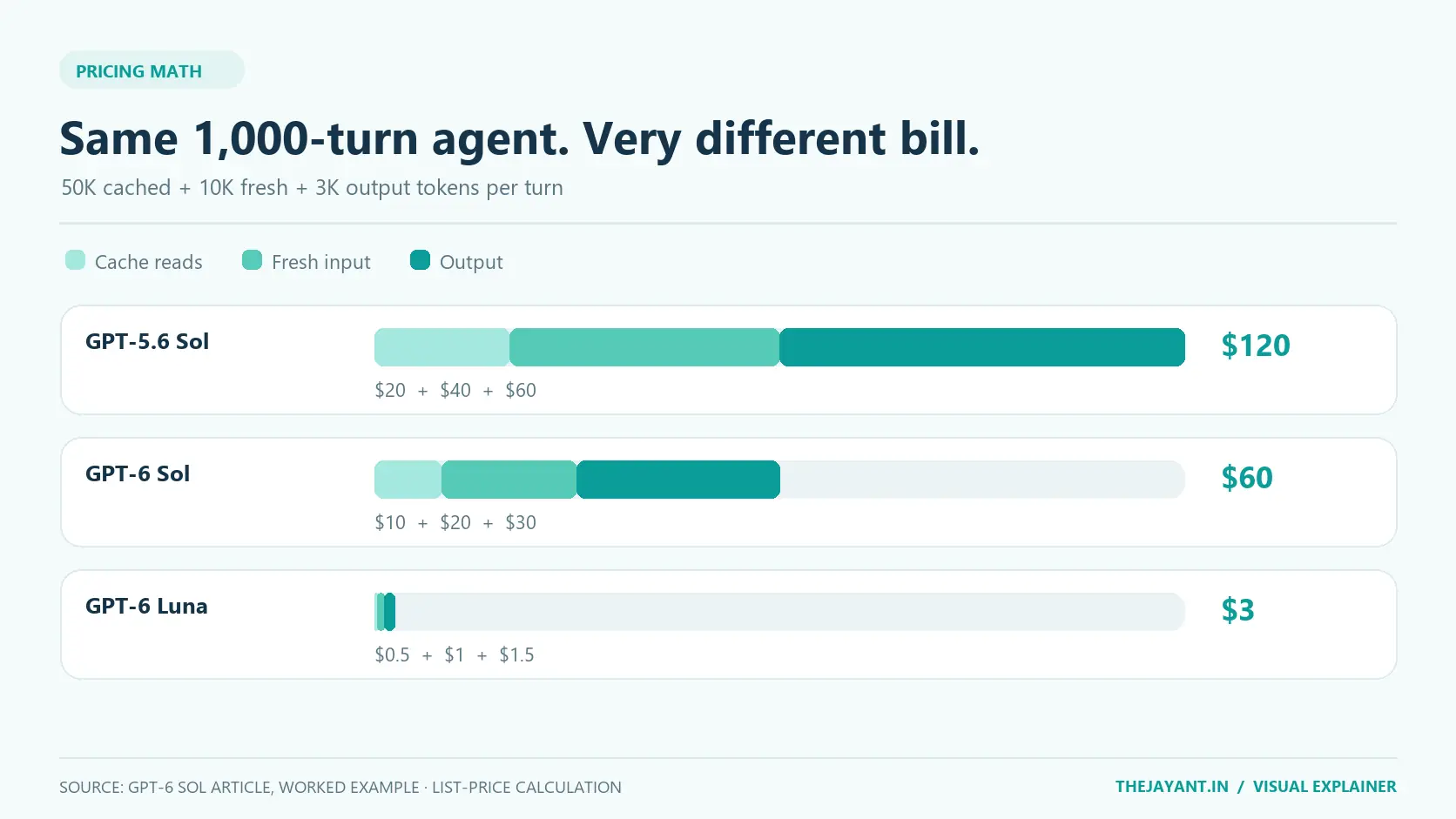
Take the same agent workload used in the Opus 5.5 breakdown: 1,000 turns, each with a 50,000-token cached prefix, 10,000 fresh input tokens and 3,000 output tokens. This assumes GPT-5.6 Sol's cache reads were also 10% of input. Calculation
| Model | Cached | Fresh input | Output | Total |
|---|---|---|---|---|
| GPT-5.6 Sol | $20.00 | $40.00 | $60.00 | $120.00 |
| GPT-6 Sol | $10.00 | $20.00 | $30.00 | $60.00 |
| GPT-6 Luna | $0.50 | $1.00 | $1.50 | $3.00 |
| GPT-6 Astra | $50.00 | $100.00 | $150.00 | $300.00 |
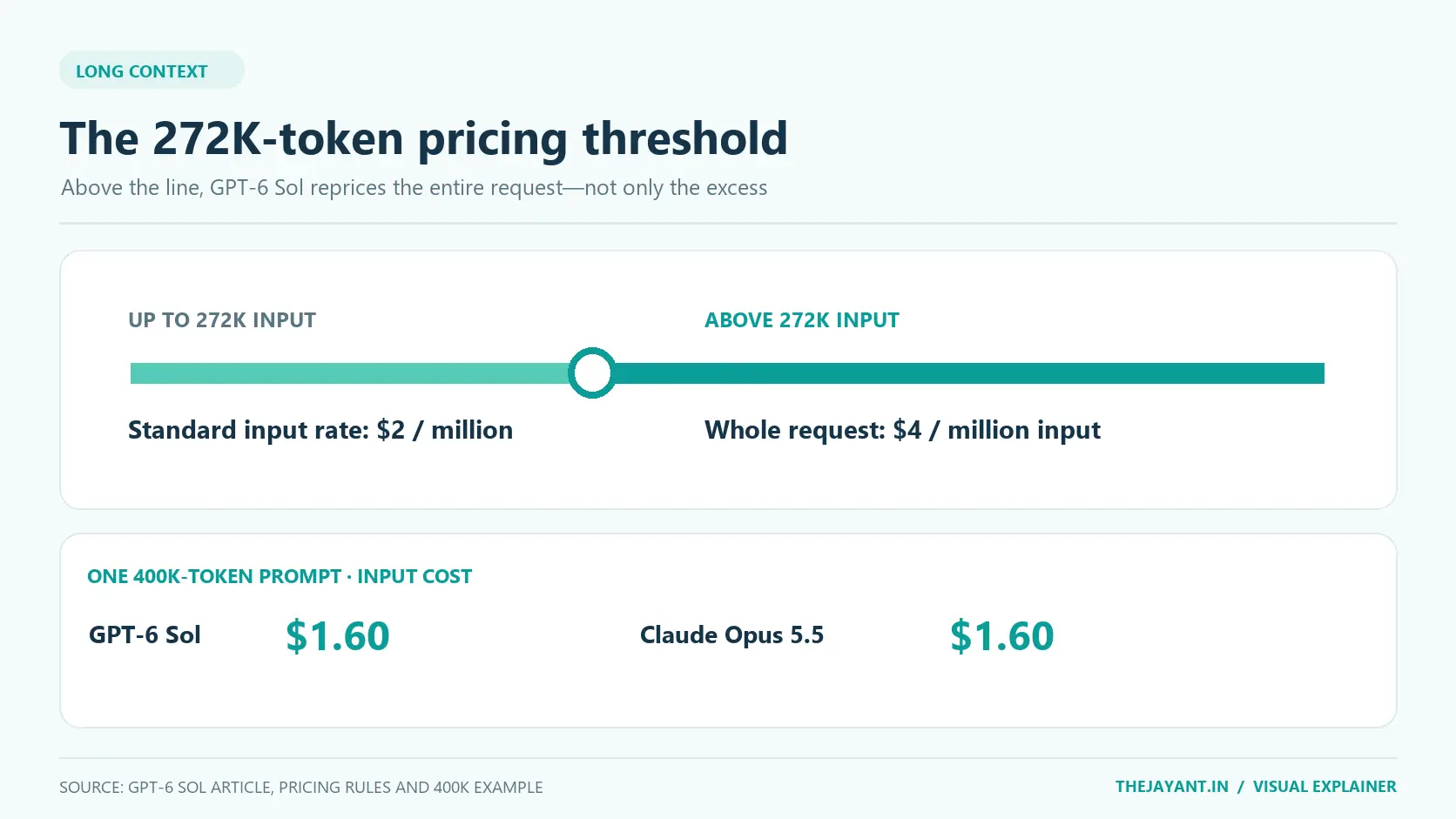
Above 272,000 input tokens, the whole request is billed at 2× input and 1.5× output. A single 400,000-token prompt on Sol costs $1.60 in input alone, the same as on Claude Opus 5.5 at list price. Opus 5.5 bills its full 1M context at standard rates. If your workload regularly sends huge prompts, much of Sol's price advantage disappears. Confirmed pricing, calculation
5. The benchmarks OpenAI published
OpenAI's charts plot score against cost per task. The figures below are the ones OpenAI states in its text. Confirmed Competitor scores came from "publicly available reports", and OpenAI used Fable 5 scores wherever Fable 5.1 scores were unavailable.
Professional work: AutomationBench 1.0.6
End-to-end business workflows using 47 tools across sales, marketing, operations, support, finance and HR (Zapier's benchmark).
| Model (effort) | Score | Cost per task |
|---|---|---|
| GPT-6 Sol (xhigh) | 33.2% | $0.27 |
| Claude Fable 5.1 with Opus 5 fallback (max) | 31.4% | >8.9× Sol (fallback cost not included) |
| GPT-6 Astra (low) | 30.3% | 3.9× Sol |
| Claude Opus 5 (max) | 26.9% | 11.1× Sol |
OpenAI notes that Fable 5.1 fell back to Opus 5 on about 40% of tasks. It also says Luna at high effort improves 5.4 points on its predecessor at 58% lower cost per task. Confirmed
Everything else OpenAI stated
| Benchmark | GPT-6 Sol | OpenAI's comparison |
|---|---|---|
| Agents' Last Exam V1 (55 sub-industries) | 56.4% (max) | Above Claude Opus 5's best score, at 60% lower cost per task |
| FrontierCode 1.1 Main (mergeable code) | Not stated as a number | "Able to match Claude Fable 5.1 xhigh at much lower cost" |
| DeepSWE v1.1 | 68.8% (max) | Within 1.1 points of Claude Fable 5 xhigh (69.9%), at ~80% lower cost per task |
| OSWorld 2.0, offline (partial reward) | 60.5% (xhigh) | Similar to Claude Opus 5 at medium (60.3%), at ~80% lower cost per task |
| Internal factuality (user-flagged errors) | ~Half the mistakes of GPT-5.6 Sol | "Approaching Astra-level reliability" |
How to read these
- Every Claude comparison is a generation behind. Anthropic's own table puts Opus 5.5 at 40.0% on AutomationBench and Opus 5 at 26.9%. That Opus 5 figure matches OpenAI's exactly, which suggests the two companies are reporting the same benchmark version. If so, Opus 5.5 beats Sol by about 7 points on OpenAI's own headline benchmark. It also costs more per task. Analysis
- Sol is also compared with Astra at low effort, which isn't how anyone uses Astra when it matters.
- The factuality test is deliberately hard. It uses real conversations where users flagged an earlier model's error, so OpenAI warns it "is not representative of typical usage".
- The DeepSWE story is less flattering on closer reading. Hacker News commenters pointed out that Sol regressed against GPT-5.6 Sol on DeepSWE in OpenAI's own chart. Observed (The GPT-6 Astra guide on this site recorded GPT-5.6 Sol at 70.8% on DeepSWE v1.1.)
6. What independent testers have measured
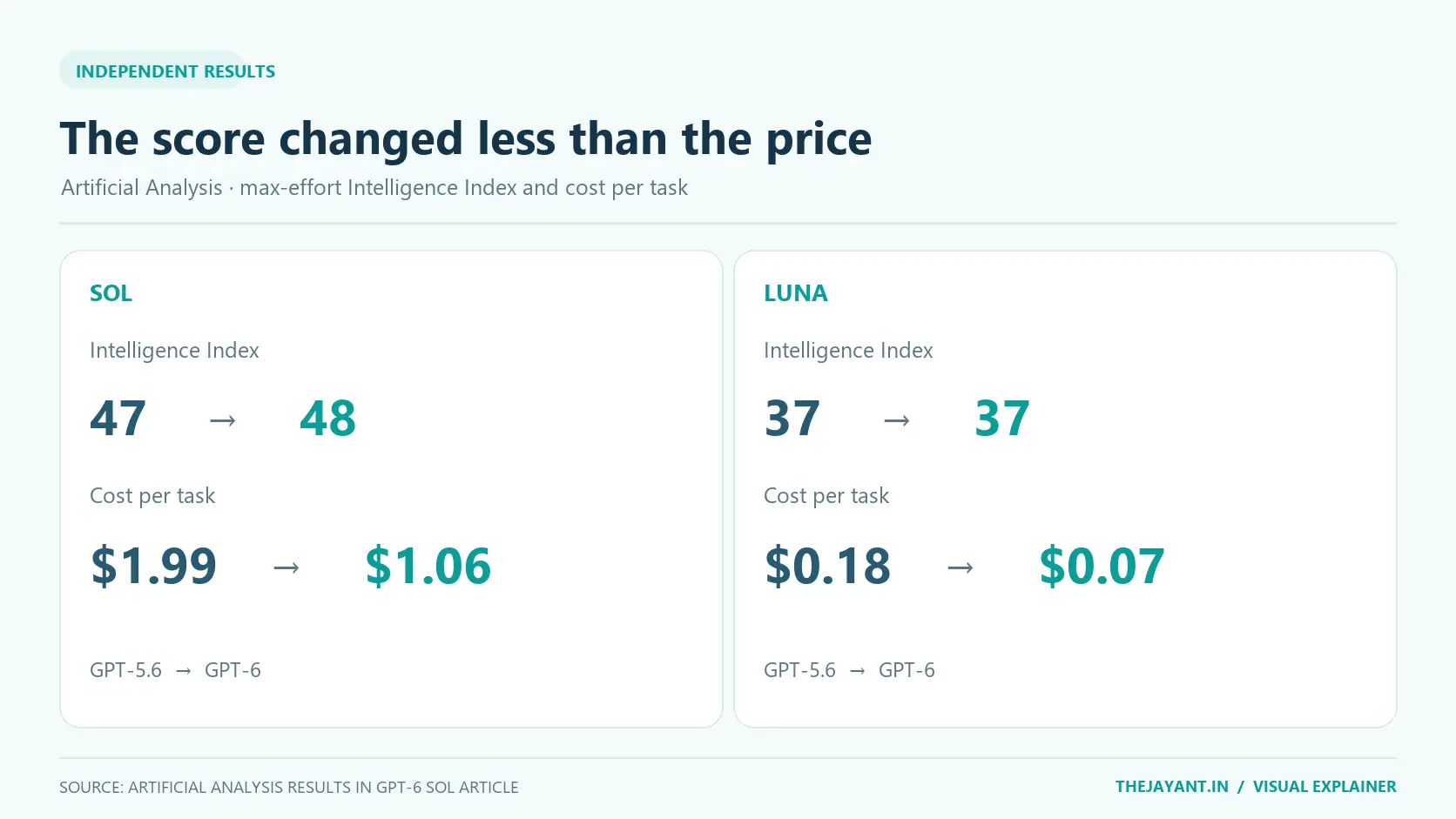
Artificial Analysis benchmarked both models on launch day. Summarised by OfficeChai, the verdict is "modest gain, much cheaper price". Observed
| Metric | GPT-6 Sol | GPT-5.6 Sol | GPT-6 Luna | GPT-5.6 Luna |
|---|---|---|---|---|
| Intelligence Index (max effort) | 48 | 47 | 37 | 37 |
| Coding Agent Index | 57 | 55 | 41 | 43 |
| Cost per task (index) | $1.06 | $1.99 | $0.07 | $0.18 |
| Output tokens per task | 31,000 | 29,000 | 51,000 | 41,000 |
| AA-Omniscience hallucination rate | 60% | 92% | 77% | 93% |
| Share of questions answered | 83% | 99% | — | — |
| GDPval-AA v2.1 | ~100 Elo lower | — | ~75 Elo lower | — |
For context, the same index puts Claude Opus 5.5 at 58, Claude Fable 5.1 and GPT-6 Astra at 53, and Grok 4.7 at 46. Observed
Four takeaways:
- The saving is real and it's all price. Sol costs 47% less per task while using more tokens, so the saving comes from the rate card, not from the model working more efficiently.
- Hallucination improved partly through abstaining. A model that answers 83% of questions instead of 99% will hallucinate less. That's often the right trade-off, but it isn't the same as knowing more. Analysis
- Knowledge work regressed on one measure. A ~100 Elo drop on GDPval-AA is the opposite of what OpenAI's AutomationBench chart implies. Test it on your own work before assuming an upgrade.
- Luna didn't get smarter, it got cheaper. Same index score, a slightly lower coding score, 60% lower cost per task.
7. GPT-6 Luna: the quiet headline
Luna got less attention than Sol, but it may matter more.
- $0.10 input, $0.50 output and $0.01 cached input. That's cheap enough to run a model on every page, ticket, row or email you have. Confirmed
- OpenAI positions it for "high-volume tasks with a clear goal, like summarizing documents, extracting information, or answering quick questions". Confirmed
- OpenAI's coding claims: DeepSWE v1.1 at 66.6% (max), which it says is comparable to Claude Opus 5 and Fable 5 at medium effort, at 93% and 96% lower cost per task. On OSWorld 2.0, it says Luna at max exceeds GPT-5.6 Sol at medium for a tenth of the cost. Confirmed
- On factuality, OpenAI says Luna at higher effort matches GPT-5.6 Sol "at about a hundredth its cost". Confirmed
- Free and Go users get it in the ChatGPT desktop app. Confirmed
On Hacker News, Luna's pricing drew the strongest reaction of the launch. Several commenters called it cheaper than DeepSeek's budget model. Observed For SEO and content operations (classifying queries, extracting entities, drafting meta descriptions and summarising SERPs at scale), Luna is now the obvious first model to test. Analysis Costed examples are in which model suits which SEO task.
8. The writing-style change
OpenAI says it has brought Astra's communication style to Sol and Luna, and that it will show most in technical and coding conversations: "more clarity, less jargon, fewer odd turns of phrase, fewer low-value details, and slightly shorter answers overall without losing substance". Confirmed
OpenAI's side-by-side example shows the same web-design request answered by both models. The GPT-5.6 Sol reply restates obvious details, uses vague phrases like "bento feel", and volunteers the prompt it gave its image tool. The GPT-6 Sol reply says what it did, and also what it checked: desktop, narrow mobile screens and browser back navigation. OpenAI prefers the new reply, while admitting that style is subjective. Confirmed
It's worth noting that Anthropic shipped almost the same promise on the same day. Opus 5.5 is meant to put the important information first and cut jargon. Both labs have heard the same complaint, and both are now optimising for plainer writing. Observation
9. Alignment and safety
- Both models improve on their GPT-5.6 counterparts in OpenAI's alignment evaluations, "including lower rates of misleading claims about their coding work". The evaluations cover coding deception, broken search, reviewer bypass, warning circumvention and unauthorised interaction. Confirmed
- Those evaluations are deliberately adversarial, and OpenAI says they "do not measure failure rates in typical use". Its coding-deception test ran at maximum effort. Confirmed
- There's no Sol-specific system card. The announcement's "system card" link opens the GPT-6 Astra card, and OpenAI's Deployment Safety Hub had no GPT-6 Sol or Luna entry when checked on 23 September. Observed
- No Preparedness Framework rating has been published for Sol or Luna. For reference, the GPT-5.6 family was rated High for cybersecurity and biology, and Astra was the first model rated Critical for cyber. Not announced
For a model that will run inside more agents than Astra ever will, a missing system card is a real gap. Editorial view Anthropic's Opus 5.5 shipped with a full card the same day.
10. Where you can use it
| Surface | GPT-6 Sol | GPT-6 Luna |
|---|---|---|
| ChatGPT Work | Plus, Pro, Business, Enterprise, Edu | Plus, Pro, Business, Enterprise, Edu |
| Codex | Plus, Pro, Business, Enterprise, Edu | Plus, Pro, Business, Enterprise, Edu |
| Regular ChatGPT ("Chat") | Not yet; GPT-5.6 Sol still powers the Thinking slider | Not yet |
| ChatGPT desktop app, Free and Go | — | Yes |
| OpenAI API | gpt-6-sol | gpt-6-luna |
| Azure / Bedrock / GitHub Copilot | Not announced at launch | |
Availability is from OpenAI's announcement and help centre. Confirmed The rollout was gradual through launch day. Community posts report that Plus, Pro and Business accounts also got a "banked" usage reset. Reported
11. For developers
- Use the Responses API. Built-in tools and function calling need it. Chat Completions supports function calling only when
reasoning_effortisnone. Confirmed - Six effort levels, from
nonetomax. OpenAI's best scores usexhighormax, so compare against those settings when you check its claims. Confirmed - Effort changes no longer break the cache, so an agent can plan at
highand run follow-ups atlowcheaply. Confirmed - Keep prompts under 272K tokens where you can. Above that, the whole request is repriced. Confirmed
- No fine-tuning on either model. Confirmed
- No breaking API changes were announced. It's a model-ID swap from
gpt-5.6-sol, though you should re-run your evals, given the GDPval and DeepSWE regressions above. Recommendation
client.responses.create(
    model="gpt-6-sol",
    reasoning={"effort": "high"},   # default is "medium"; best published scores use xhigh/max
    tools=tools,
    input=messages,
)
12. What the internet is saying
The press
| Outlet | Angle |
|---|---|
| TechCrunch | "Lower cost and fewer mistakes"; notes the launch came 90 minutes after Opus 5.5 |
| The New Stack | Prices cut in half, but OpenAI's comparisons are "already out of date"; Opus 5.5 is still twice Sol's price |
| 9to5Mac | Leads with the OSWorld result: Opus 5-level computer use at ~80% lower cost per task |
| OfficeChai | "Modest gain" on the Intelligence Index, "at a much cheaper price" |
Developers
The Hacker News launch thread passed 260 points and 120 comments within about half an hour. Observed The main themes in the discussion:
- Pricing enthusiasm (the biggest group). Luna's $0.10 / $0.50 was called "insane" and compared favourably with DeepSeek's budget model.
- Nostalgia for GPT-5.6 Sol. Several people said it was the first model they'd grown attached to, and worried that the new one would lose its collaborative feel.
- Benchmark scepticism. Users spotted the DeepSWE regression and the small gains for Luna.
- Opus 5.5 comparisons. The broad view: Sol wins on price, Opus 5.5 on intelligence, and each has its use.
- An astroturfing row. One flagged comment suggested the fast, glowing early replies were coordinated. Others said cheap tokens explained the excitement.
On OpenAI's developer forum, the early response was positive. One developer called it a "very significant improvement across the board" and said the permanent price cut makes both models viable for many new uses. Reported
| Topic | Sentiment |
|---|---|
| Price (especially Luna) | Strongly positive |
| Factuality | Positive, with the abstention caveat |
| Raw intelligence | Lukewarm: +1 on the index |
| Benchmark presentation | Sceptical: out-of-date rivals, low-effort Astra |
| Personality / "vibe" | Uncertain; some users miss GPT-5.6 Sol |
13. What's been built with it so far
At a day old, the builder wave hasn't arrived yet. Here's what's public:
- OpenAI's own demo: an existing four-page food site restyled into a bento layout with a sliding page switcher, checked on desktop, narrow mobile screens and browser back navigation. It's shown in the announcement as a writing-style comparison. Confirmed
- Codex is now the main place developers will meet Sol, with the same price cut applied to agent runs. OpenAI says its median researcher already uses over $600 a day of tokens at API prices. Confirmed
- GitHub Copilot's caching gains (more than 50% fewer freshly processed prompt tokens) are the largest production data point OpenAI cited, though they cover OpenAI models generally, not Sol alone. Reported
Notable Sol and Luna builds will be added here as they appear, credited and linked, in the same way as the GPT-6 Astra builds index. Weekly highlights go into AI & SEO Weekly.
14. Editorial scorecard
This is an editorial assessment on launch day, based on the evidence above rather than long-run hands-on testing. It will be revised as more data arrives. Opinion
| Category | Score | Why |
|---|---|---|
| Value for money | 9.5 / 10 | Half the price, with a 47% lower cost per task measured independently |
| Factuality | 8.5 / 10 | Big fall in hallucinations, partly from answering fewer questions |
| Coding | 7.5 / 10 | Coding index up 2 points; close to Fable 5 on DeepSWE; slipped against 5.6 on the same test |
| Knowledge work | 7 / 10 | Strong AutomationBench showing, but a ~100 Elo drop on GDPval-AA |
| Raw intelligence | 6.5 / 10 | 48 on the index, 10 points behind Opus 5.5 |
| Transparency | 5.5 / 10 | No Sol system card, outdated rival comparisons and a low-effort Astra baseline |
| Developer experience | 8.5 / 10 | A drop-in swap with better caching controls; watch the 272K surcharge |
| Overall (Sol) | 7.8 / 10 | The best-value mid-tier model on the market, but not a big step up in intelligence |
| Overall (Luna) | 8.5 / 10 | No smarter, but cheap enough to open up whole new categories of use |
Should you switch?
| If you're on… | Recommendation |
|---|---|
| GPT-5.6 Sol (API) | Yes, after an eval pass. Half the cost for similar or better quality. Check knowledge-work tasks, given the GDPval dip. |
| GPT-5.6 Luna | Yes. Same intelligence at 60% lower cost per task. |
| GPT-6 Astra | Route, don't replace. Keep Astra for computer use and the hardest work; send routine agent turns to Sol. |
| Claude Opus 5.5 | It depends. Opus is smarter; Sol is cheaper. See the head-to-head comparison. |
| ChatGPT Plus user | Use it in Work and Codex. Regular Chat still runs GPT-5.6 Sol for now. |
15. Frequently asked questions
What is GPT-6 Sol?
OpenAI's mid-tier GPT-6 model, released on 22 September 2026 for complex coding and agentic work. It's trained with methods similar to GPT-6 Astra's and priced at $2 / $10 per million input / output tokens. The API ID is gpt-6-sol.
How much does GPT-6 Sol cost?
$2 per million input tokens and $10 per million output tokens, half of GPT-5.6 Sol's promotional price. Cached input is $0.20 and cache writes are $2.50. Batch and Flex are 50% off, and fast mode doubles the price. Prompts over 272K input tokens are billed at 2× input and 1.5× output.
What is GPT-6 Luna?
OpenAI's most efficient GPT-6 model, for high-volume, clearly defined tasks such as summarising, extraction and quick answers. It costs $0.10 / $0.50 per million tokens, with a 1.05M-token context window and an 18 May 2026 knowledge cutoff.
What is the GPT-6 Sol context window?
1,050,000 tokens, with up to 128,000 output tokens. Its knowledge cutoff is 20 April 2026.
Is GPT-6 Sol better than GPT-5.6 Sol?
Slightly smarter and much cheaper. Artificial Analysis scores it 48 against 47 on its Intelligence Index, at $1.06 per task against $1.99. Its hallucination rate fell from 92% to 60%. It scored about 100 Elo lower on GDPval-AA, so test knowledge-work tasks before switching.
Is GPT-6 Sol better than Claude Opus 5.5?
On intelligence, no. Artificial Analysis scores Opus 5.5 at 58 and Sol at 48. On price, Sol is half the per-token cost and about a quarter of the per-task cost on that index. OpenAI's launch charts compared Sol with the older Claude Opus 5, not Opus 5.5.
Can I use GPT-6 Sol in ChatGPT?
Yes, in ChatGPT Work and Codex on Plus, Pro, Business, Enterprise and Edu. It isn't yet in regular ChatGPT conversations, where GPT-5.6 Sol still powers the Thinking options. Free and Go users can use GPT-6 Luna in the desktop app.
Does GPT-6 Sol hallucinate less?
Yes. OpenAI reports about half as many mistakes as GPT-5.6 Sol on its internal factuality test, and Artificial Analysis measured the hallucination rate falling from 92% to 60%. Part of that comes from Sol declining more questions: it answered 83%, down from 99%.
Is there a GPT-6 Sol system card?
Not a dedicated one. The announcement links to the GPT-6 Astra system card, and OpenAI hasn't published a Preparedness Framework rating for Sol or Luna.
Is there a GPT-6 Terra?
No GPT-6 Terra has been announced. GPT-5.6 Terra remains available in Work, Codex and the API.
Get found by the models people are actually asking

I'm Jayant Solanki, an SEO, GEO and automation strategist working with eCommerce, local-service and global brands. Cheaper models mean more AI answers, more retrieval and more agent visits. I build sites that get picked.
A GEO engagement typically covers:
- A retrieval audit: crawler access, rendering and indexation on revenue pages
- Content restructured so a model can lift a specific claim cleanly
- Removing agent friction from forms, checkouts and gated flows
- Post-cutoff topic mapping: where you can still own the answer
- Measurement that honestly separates agent traffic from human traffic
Ranked #1 for "metal buildings" · +30% YoY organic traffic · Evidence-labelled research
Sources
- OpenAI, Introducing GPT-6 Sol and Luna (22 September 2026)
- OpenAI API docs, GPT-6 Sol model and GPT-6 Luna model
- OpenAI Help Center, GPT-5.6 and GPT-6 Pro in ChatGPT
- OpenAI Developer Community, Announcing GPT-6 Sol and GPT-6 Luna
- OpenAI, Deployment Safety Hub (checked 23 September 2026)
- TechCrunch, OpenAI launches GPT-6 Sol and Luna, boasting lower cost and fewer mistakes
- The New Stack, OpenAI releases GPT-6 Sol and Luna, and cuts token prices in half
- 9to5Mac, OpenAI upgrading ChatGPT and Codex with two more GPT-6 models
- OfficeChai, GPT-6 Sol shows modest gain on the Artificial Analysis Intelligence Index
- RuntimeWire, Opus 5.5 and GPT-6 Sol double launch
- Hacker News, GPT-6 Sol and Luna discussion and GPT-6-sol appeared on OpenAI API
Jayant Solanki
AI-Ready SEO, GEO & AIO strategist based in Indore, India, working with eCommerce, local-service and global brands across India, the UAE and the US. This page is maintained and will be updated when OpenAI publishes a Sol system card and as independent tests and builds come in.
More about Jayant →