
Confirmed Stated by Anthropic or OpenAI in their announcements, API documentation or crawler documentation.
Observed Measured by an independent third party or visible in public data.
Reported Press or third-party claims that nobody has independently checked.
Speculation Analysis, calculation or inference by the author.
- The knowledge windows now differ by two months. Claude Opus 5.5 was trained on data to June 2026; GPT-6 Sol to 20 April 2026. For anything that changed in between, Claude may answer from memory while Sol has to search. Confirmed
- After June 2026, both models have to search. On anything newer, the clearest, best-dated live source gets quoted by both. Analysis
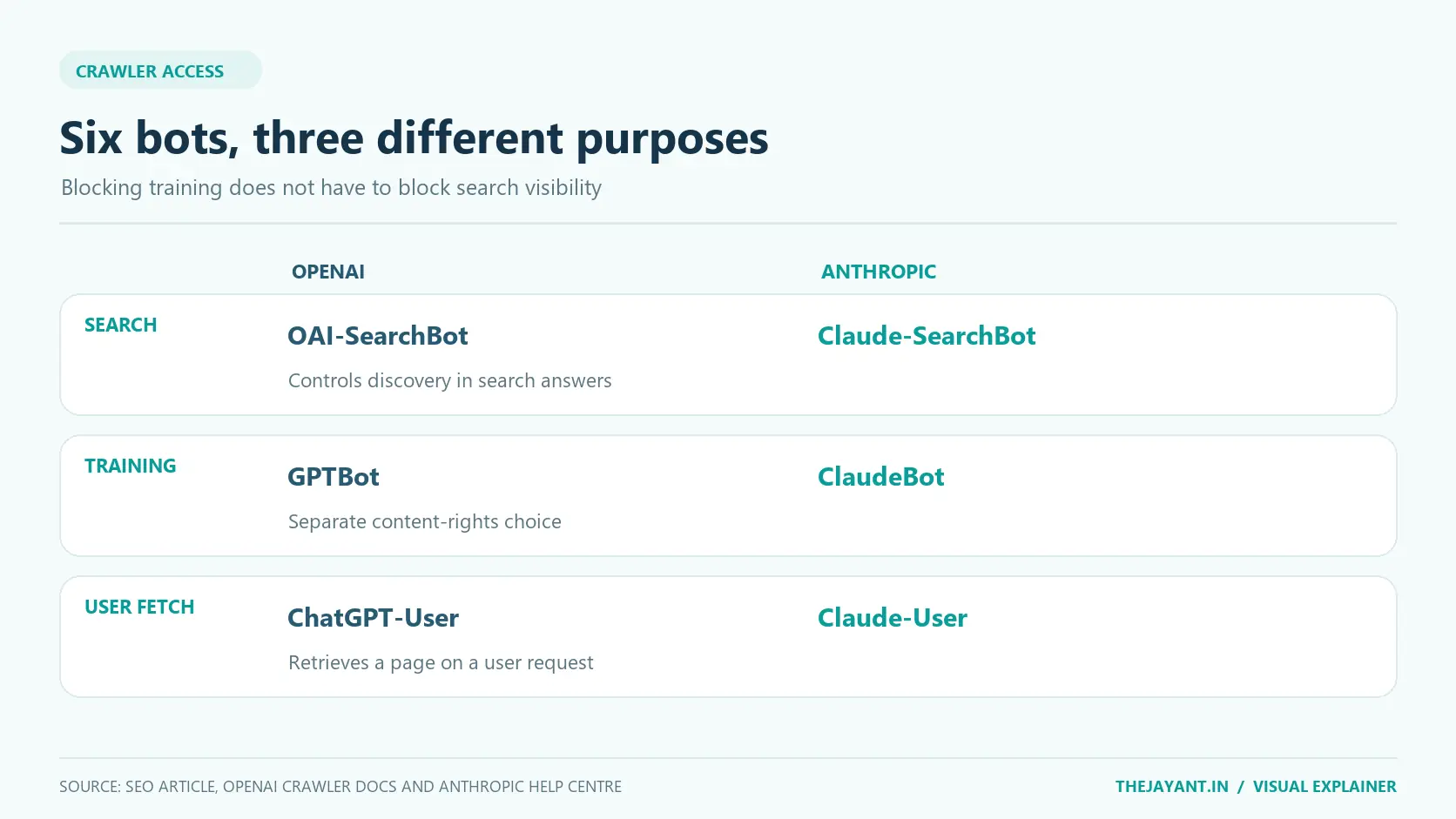
- Six crawlers decide whether you're even in the running: OAI-SearchBot, GPTBot and ChatGPT-User for OpenAI; Claude-SearchBot, ClaudeBot and Claude-User for Anthropic. They're controlled separately. Confirmed
- Cheap tokens make web search the expensive part. A $10-per-1,000 search call now costs about ten times more than the model reading a 10,000-token page on GPT-6 Luna. Budget apps may search less and lean on training data. Analysis
- Test both assistants, not one. With different cutoffs and different crawlers, a brand can be cited by Claude and missing from ChatGPT, or the other way round.
- For SEO work itself: GPT-6 Luna for bulk classification (about $0.55 per 10,000 keywords before reasoning tokens), GPT-6 Sol for briefs and drafts, Claude Opus 5.5 for audits and strategy. Calculation
On 22 September 2026, Anthropic released Claude Opus 5.5 and OpenAI released GPT-6 Sol and GPT-6 Luna, about ninety minutes apart. The model coverage, benchmarks and the head-to-head comparison are in separate articles.
This one answers a narrower question: what do these two launches change for being found, used and cited by AI? The general groundwork, such as agent traffic in analytics, the friction audit and content structure, is covered in what GPT-6 Astra changes for SEO and still applies. What follows is what's new this week.
1. Why these two launches matter more for search than the flagships
Flagship models set records. Mid-tier models set volume. Most AI answers people actually read, whether in a support widget, a coding agent, a browser extension or a research tool, come from whichever model is good enough and cheap enough to run at scale. This week that tier got much cheaper:
| Model | Price / MTok | Change | Where people meet it |
|---|---|---|---|
| Claude Opus 5.5 | $4 / $20 | −20% vs Opus 5 | Claude apps, Claude Code, GitHub Copilot, AWS, Google Cloud, Microsoft |
| GPT-6 Sol | $2 / $10 | −50% vs GPT-5.6 Sol | ChatGPT Work, Codex, OpenAI API |
| GPT-6 Luna | $0.10 / $0.50 | −50% vs GPT-5.6 Luna | ChatGPT Work, Codex, API, desktop app for Free and Go |
Prices and availability: Confirmed. When a capable model costs a tenth of a cent per thousand words, developers put AI answers into places that never had them: product pages, internal search, email triage, comparison tools. Each of those is a new place where your content either gets retrieved and credited, or doesn't. Analysis
There's also a quieter shift. Both launches promise plainer, more direct answers: Anthropic says Opus 5.5 "puts the most important information up front", and OpenAI promises "less jargon" and "slightly shorter answers". Confirmed Shorter answers mean fewer sources quoted per answer, so the competition for each citation gets tighter. Speculation
2. The knowledge windows: where each model has to look things up
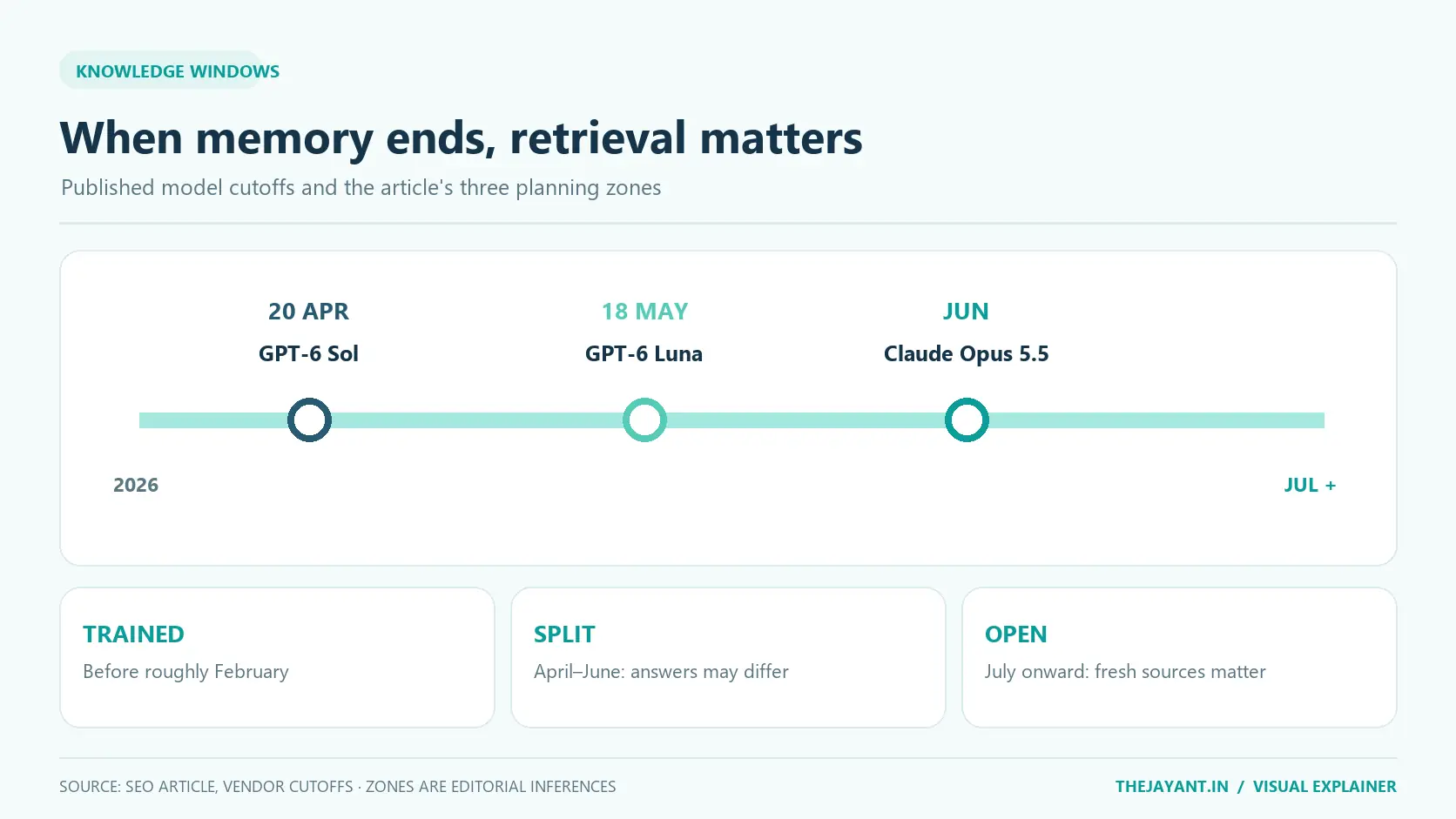
A model's knowledge cutoff marks where memory ends and retrieval begins. Here's the current map, from each vendor's documentation:
| Model | Knowledge cutoff | Source |
|---|---|---|
| Claude Opus 5.5 | June 2026 | Anthropic docs Confirmed |
| Claude Fable 5.1 | June 2026 | Anthropic docs Confirmed |
| GPT-6 Luna | 18 May 2026 | OpenAI docs Confirmed |
| GPT-6 Astra | 30 April 2026 | OpenAI docs Confirmed |
| GPT-6 Sol | 20 April 2026 | OpenAI docs Confirmed |
| Claude Sonnet 5 | January 2026 | Anthropic docs Confirmed |
| GPT-5.6 Sol (still powers regular ChatGPT) | 16 February 2026 | Third-party comparison Reported |
That gives three zones to plan content around:
- Before about February 2026: trained territory. Every current model has seen it. You're competing with what the model already "believes", and changing that takes repeated, consistent coverage across many sources over time.
- April to June 2026: the split zone. Opus 5.5 and Fable 5.1 may know it from training; GPT-6 Sol, Astra and regular ChatGPT have to retrieve it. The same question can get a memorised answer from Claude and a retrieved, cited answer from ChatGPT.
- July 2026 onwards: open territory. Every model has to search. There's no trained opinion to overcome, so a well-structured, clearly dated page can become the answer quickly.
These zones are an inference from the published cutoffs. A cutoff isn't a hard wall, and coverage thins out in the final months before it. Analysis
For topics that changed between April and June 2026 (a pricing change, a product launch, a regulation or a new statistic), check how ChatGPT answers. Its main models have to retrieve here, so a clearly dated page that states the change can win citations that a Claude answer won't give, because Claude may simply answer from memory. On the Claude side, check whether its remembered answer is accurate, and fix the sources it learned from if it isn't.
3. Six crawlers, two companies, separate switches
Neither model can cite a page its company's crawlers can't reach. Both companies now split crawling by purpose, and each switch works independently:
| User agent | Company | Purpose | If you block it |
|---|---|---|---|
OAI-SearchBot | OpenAI | Surfaces sites in ChatGPT search | Missing from ChatGPT search answers |
GPTBot | OpenAI | Training data | Future content not used for training |
ChatGPT-User | OpenAI | Fetches pages for actions a user starts | OpenAI says robots.txt "may not apply" |
Claude-SearchBot | Anthropic | Indexes content for Claude's search results | Less visible in Claude search answers |
ClaudeBot | Anthropic | Training data | Future content excluded from training |
Claude-User | Anthropic | Fetches pages when a Claude user asks | Claude can't fetch your pages for users |
From OpenAI's crawler documentation and Anthropic's help centre. Confirmed OpenAI also runs OAI-AdsBot to check ad landing pages, and says robots.txt changes take about 24 hours to affect search. Anthropic says all three of its bots honour robots.txt, including Claude-User, and that blocking ClaudeBot does not block the other two. Confirmed
If your aim is to be cited but not used for training, the robots.txt logic looks like this:
# Visible in AI search and user-initiated fetches
User-agent: OAI-SearchBot
Allow: /

User-agent: Claude-SearchBot
Allow: /

User-agent: ChatGPT-User
Allow: /

User-agent: Claude-User
Allow: /

# Training is a separate, content-rights decision
User-agent: GPTBot
Disallow: /

User-agent: ClaudeBot
Disallow: /
Whether to allow training is a business decision, not an SEO one. The llms.txt and AI crawler guide covers the trade-offs. The common mistake is different: a robots.txt written in 2024 that names GPTBot and ClaudeBot but never mentions the search and user agents, or a CDN bot-protection rule that silently blocks all six. Analysis
4. Search economics: why cheap models may search less
This is the least discussed effect of the price cuts, and possibly the most important one for visibility.
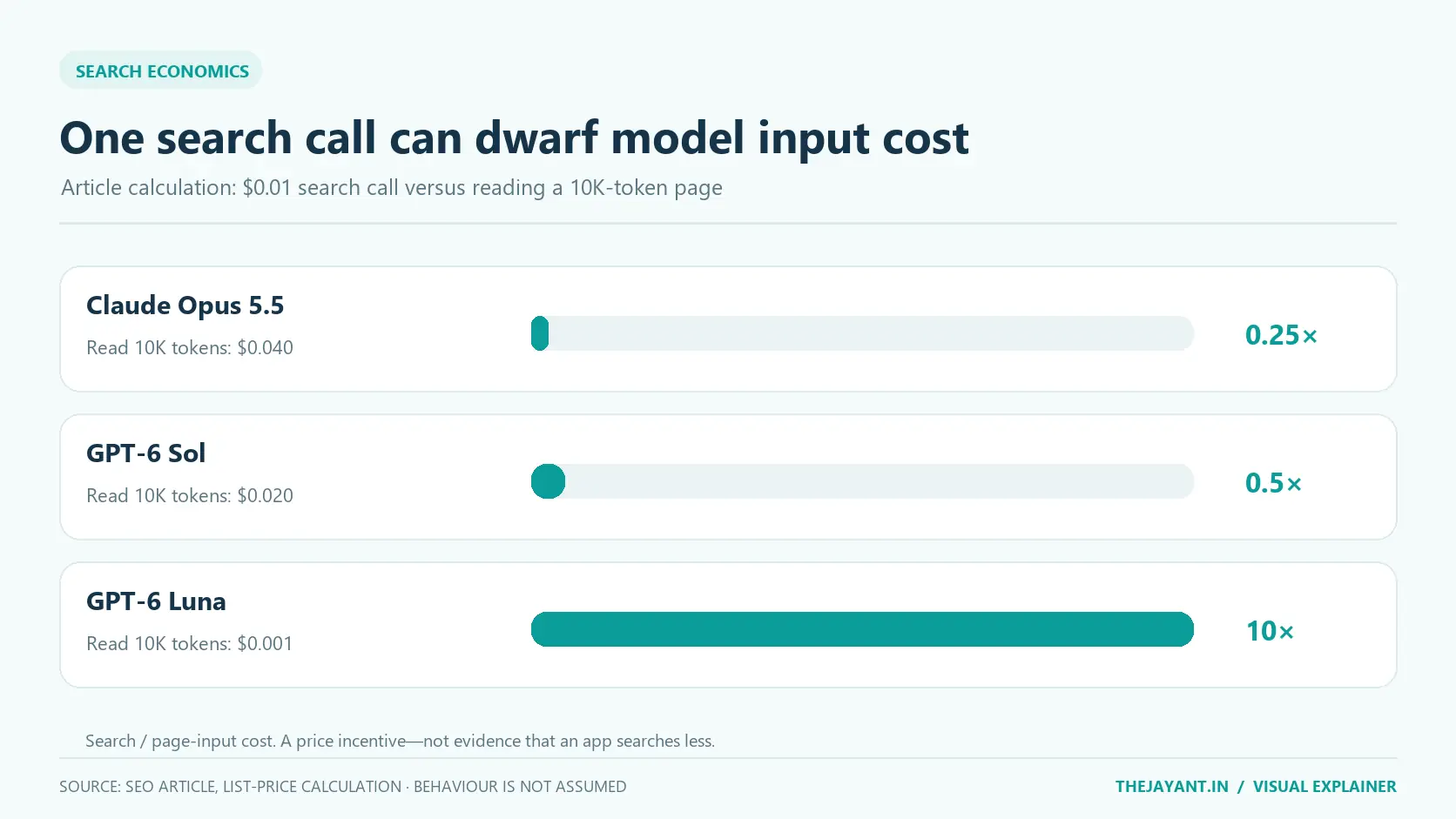
Both companies charge a flat fee for their built-in web search tool: $10 per 1,000 searches on the Claude API, and $10 per 1,000 calls listed for OpenAI's reasoning models, plus the tokens the results add. Confirmed That fee didn't fall this week. Token prices did.
| Model | Cost to read a 10,000-token page | One search call | Search as a multiple |
|---|---|---|---|
| Claude Opus 5.5 | $0.040 | $0.010 | 0.25× |
| GPT-6 Sol | $0.020 | $0.010 | 0.5× |
| GPT-6 Luna | $0.001 | $0.010 | 10× |
Calculation at list input prices. On Luna, one search costs ten times as much as reading a whole page. A developer building a high-volume product on a budget model has a real reason to limit web search: answer from the model's memory where possible, and search only when a question clearly needs fresh facts. Speculation
If that happens at scale, it cuts both ways for SEO:
- Training-data presence matters again. Cheap assistants that rarely search answer from what they learned, so being well represented in the sources models train on (consistent facts, widely cited pages, a clear entity footprint) is back to being a visibility lever, not just a legacy one.
- Freshness signals become the trigger. If apps search only when a question looks time-sensitive, pages that make their dates and "as of" facts explicit are more likely to be what those searches find.
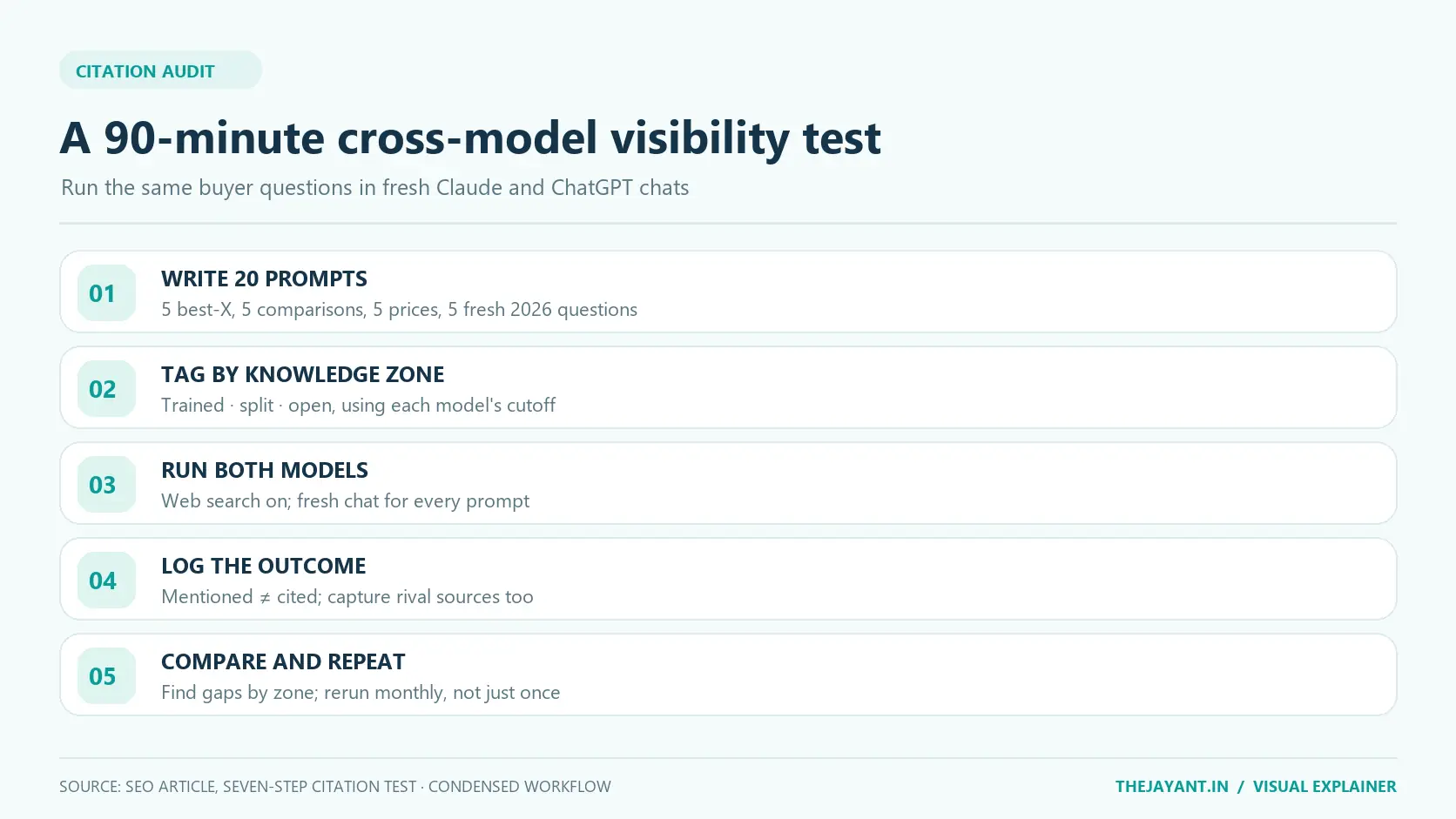
5. A cross-model citation test (about 90 minutes)
You don't need a tool to start. A spreadsheet and two browser tabs are enough.
- Write 20 prompts your buyers would really ask: five "best X for Y", five "X vs Y", five "how much does X cost", and five about something that changed in 2026.
- Tag each prompt by knowledge zone: trained (before February 2026), split (April to June 2026) or open (July 2026 onwards).
- Run every prompt in Claude and in ChatGPT with web search on, in a fresh chat each time.
- Log two separate columns: mentioned (your brand is named) and cited (your page is linked as a source). They're different outcomes with different fixes.
- Log the competitors that are mentioned and cited in your place.
- Read the pattern by zone. Missing in the open zone usually means crawling or structure. Missing in the trained zone means a weak footprint across sources. A split between Claude and ChatGPT in the split zone is often just timing.
- Re-run monthly. Answers vary from run to run, so trends across months mean more than any single result.
A worked template for logging this is in Notion for SEO (the AI Answer Log system), and the scoring method is in the AI search visibility benchmark.
6. Content moves that work on both models
The fundamentals are covered in how to get cited by AI search. Four points matter particularly this week:
- Put an explicit date on every fact that changes. "As of 22 September 2026, GPT-6 Sol costs $2 per million input tokens" gives a model something it can lift and a date to judge freshness by. A sentence like "prices recently dropped" gives it nothing.
- Answer first, then explain. Both launches promise shorter, more direct answers, and a model writing a short answer takes the clearest single sentence it can find.
- Use tables for anything comparable. Specs, prices and pros and cons in a real HTML table are easier to extract accurately than the same facts spread across paragraphs.
- Label claims by how certain they are. Pages that separate confirmed facts from speculation give a model a safer quote, which matters more now that both vendors are optimising against hallucination and OpenAI's Sol answers fewer questions when unsure. Analysis
7. Which model for which SEO task, and what it costs
These models are also tools for SEO work. Estimated list-price costs for common jobs are below. The token counts are illustrative and exclude reasoning tokens, which both companies bill as output, so real costs at higher effort settings will be higher. Calculation
| Task | Assumed tokens | GPT-6 Luna | GPT-6 Sol | Claude Opus 5.5 | Pick |
|---|---|---|---|---|---|
| Classify 10,000 keywords by intent | 300 in / 50 out each | $0.55 | $11 | $22 | Luna |
| Draft 1,000 meta descriptions | 1,500 in / 100 out each | $0.20 | $4 | $8 | Luna, then spot-check |
| One content brief from SERP data | 20K in / 4K out | $0.004 | $0.08 | $0.16 | Sol |
| 100 first drafts of 2,000 words | 5K in / 3K out each | $0.20 | $4 | $8 | Sol, with human editing |
| Technical audit of a 300K-token crawl export | 300K in / 10K out | $0.07* | $1.35* | $1.40 | Opus 5.5 |
| Competitor strategy synthesis | 150K in / 8K out | $0.02 | $0.38 | $0.76 | Opus 5.5 |
* Above 272K input tokens, OpenAI bills the whole request at 2× input and 1.5× output. That's why Sol costs almost exactly the same as Opus 5.5 on the 300K audit ($1.35 against $1.40), instead of about half. At that price, the stronger model is the better buy. Confirmed pricing rule.
The pattern: Luna for anything repetitive with a clear right answer, Sol for drafting, and Opus 5.5 for judgement and very long inputs. Opus 5.5 also has the newer knowledge cutoff, which matters for strategy work about 2026 search changes. At these prices the model bill is rarely the real cost. The review time for a wrong classification or a weak brief almost always is. Editorial view
You can run your own numbers in the Opus 5.5 vs GPT-6 Sol cost calculator.
8. A two-week plan
| Days | Action | Output |
|---|---|---|
| 1–2 | Check robots.txt, CDN bot rules and server logs for all six AI user agents | A table of allowed, blocked and actually seen, per agent |
| 3–4 | Build the 20-prompt set and tag each prompt by knowledge zone | A prompt list with zone tags |
| 5–6 | Run the cross-model citation test in Claude and ChatGPT | Mention and citation baseline, plus competitors |
| 7–9 | Fix the top five pages for prompts in the split and open zones: dated facts, answer-first intros, tables | Five updated pages |
| 10–11 | Move bulk SEO jobs (classification, meta drafts) to GPT-6 Luna, with a spot-check sample | Lower tooling cost; a quality log |
| 12–14 | Re-run the prompts on the fixed pages; schedule the monthly re-test | A before/after comparison and a monthly routine |
9. Frequently asked questions
Do Claude Opus 5.5 and GPT-6 Sol change how AI search works?
Not the mechanics, but the conditions. They have different knowledge cutoffs (June 2026 against 20 April 2026), their crawlers are controlled separately, and their lower prices will put AI answers into many more products. The result is more places to be cited, and more chance that Claude and ChatGPT treat the same brand differently.
What is the knowledge cutoff of Claude Opus 5.5 and GPT-6 Sol?
Claude Opus 5.5's reliable knowledge cutoff is June 2026. GPT-6 Sol's is 20 April 2026, and GPT-6 Luna's is 18 May 2026. For topics newer than a model's cutoff, it has to search the web to answer accurately.
Which crawlers should I allow to appear in ChatGPT and Claude answers?
For search visibility, allow OAI-SearchBot (ChatGPT search) and Claude-SearchBot (Claude search), plus ChatGPT-User and Claude-User for pages fetched on a user's request. GPTBot and ClaudeBot control training use only, and blocking them doesn't remove you from search answers.
Will cheaper AI models reduce traffic from AI search?
Possibly in one specific way. Web search costs a flat fee per call, which is now expensive compared with tokens on budget models like GPT-6 Luna. Products built on those models may search less and answer from training data more often, which makes a strong presence in training sources and clear freshness signals more important.
Which AI model is best for SEO work?
Use a mix. GPT-6 Luna is cheapest for bulk classification and meta descriptions, GPT-6 Sol suits briefs and first drafts, and Claude Opus 5.5 suits audits, strategy and very long inputs such as crawl exports over 272K tokens, where it costs about the same as Sol.
How do I check whether Claude and ChatGPT cite my site?
Run a fixed set of 20 buyer prompts in both with web search on, and log separately whether your brand is mentioned and whether your page is cited. Tag prompts by knowledge zone to understand the cause, and re-run monthly, because answers vary between runs.
Does GPT-6 Sol power regular ChatGPT?
Not yet. At launch, GPT-6 Sol was available in ChatGPT Work, Codex and the API. Regular ChatGPT conversations on paid plans still ran on GPT-5.6 Sol.
Be the source both assistants cite

I'm Jayant Solanki, an SEO, GEO and automation strategist working with eCommerce, local-service and global brands. Every new model moves the line between what AI remembers and what it looks up. I help brands be on the right side of it in Claude and ChatGPT alike.
A GEO engagement typically covers:
- Crawler access for all six AI user agents, checked against real logs
- Cross-model citation testing, with knowledge-zone analysis
- Content restructured so a model can lift a specific, dated claim
- AI-assisted SEO workflows priced to the cheapest model that does the job
- Measurement that honestly separates agent traffic from human traffic
Ranked #1 for "metal buildings" · +30% YoY organic traffic · Evidence-labelled research
Sources
- Claude Platform Docs, Models overview (knowledge cutoffs) and Pricing (web search at $10 per 1,000 searches)
- OpenAI API docs, GPT-6 Sol and GPT-6 Luna model pages; Pricing (web search tool)
- OpenAI, Overview of OpenAI crawlers
- Anthropic Help Center, Does Anthropic crawl data from the web, and how can site owners block the crawler?
- Anthropic, Introducing Claude Opus 5.5; OpenAI, Introducing GPT-6 Sol and Luna
- OrcaRouter, Claude Opus 5.5 vs GPT-5.6 Sol (GPT-5.6 Sol knowledge cutoff)
Jayant Solanki
AI-Ready SEO, GEO & AIO strategist based in Indore, India, working with eCommerce, local-service and global brands across India, the UAE and the US. This page will be updated as GPT-6 Sol reaches regular ChatGPT and as the crawler documentation changes.
More about Jayant →